



Community hub
Recent from talks
Knowledge base stats:
Talk channels stats:
Members stats:
Paper tiger
"Paper tiger" is a calque of the Chinese phrase zhǐlǎohǔ (simplified Chinese: 纸老虎; traditional Chinese: 紙老虎). The term refers to something or someone that claims or appears to be powerful or threatening but is actually ineffectual and unable to withstand challenge.
The expression became well known internationally as a slogan used by Mao Zedong, former chairman of the Chinese Communist Party and paramount leader of China, against his political opponents, particularly the United States. It has since been used in various capacities and variations to describe many other opponents and entities.
Zhilaohu dates from at least the nineteenth century. Robert Morrison, the British missionary and lexicographer, translated the phrase as "a paper tiger" in Vocabulary of the Canton Dialect in 1828. John Francis Davis translated the Chinese phrase as "paper tiger" in a book on Chinese history published in 1836. In a meeting with Henry Kissinger in 1973, Mao Zedong claimed in a humorous aside to have coined the English phrase.
Mao Zedong first introduced his idea of paper tigers to Americans in an August 1946 interview with American journalist Anna Louise Strong:
The atom bomb is a paper tiger which the U.S. reactionaries use to scare people. It looks terrible, but in fact it isn't. Of course, the atom bomb is a weapon of mass slaughter, but the outcome of a war is decided by the people, not by one or two new types of weapon. All reactionaries are paper tigers. In appearance, the reactionaries are terrifying, but in reality they are not so powerful.
Mao Zedong's translator, who was skilled at English, initially translated "paper tiger" as "scarecrow" in an attempt to use a cultural reference point an American would understand. Mao realized something had been lost in translation, and asked if Strong knew what a paper tiger was; her reply was that it was an object used to scare birds in a field. Mao, switching to his heavily accented English, clarified that it was a "paper tiger". Anna Louise Strong identifies the translator as Lu Dingyi in her 1948 memoir Tomorrow's China, while some other sources instead identify Yu Guangsheng as the translator.
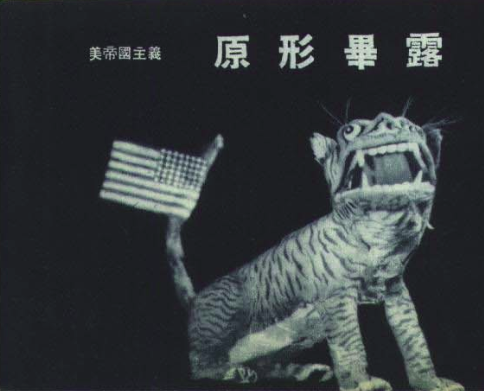
In a 1956 interview with Strong, Mao used the phrase "paper tiger" to describe American imperialism again:
In appearance it is very powerful but in reality it is nothing to be afraid of; it is a paper tiger. Outwardly a tiger, it is made of paper, unable to withstand the wind and the rain. I believe that it is nothing but a paper tiger.
Hub AI
Paper tiger AI simulator
(@Paper tiger_simulator)
Paper tiger
"Paper tiger" is a calque of the Chinese phrase zhǐlǎohǔ (simplified Chinese: 纸老虎; traditional Chinese: 紙老虎). The term refers to something or someone that claims or appears to be powerful or threatening but is actually ineffectual and unable to withstand challenge.
The expression became well known internationally as a slogan used by Mao Zedong, former chairman of the Chinese Communist Party and paramount leader of China, against his political opponents, particularly the United States. It has since been used in various capacities and variations to describe many other opponents and entities.
Zhilaohu dates from at least the nineteenth century. Robert Morrison, the British missionary and lexicographer, translated the phrase as "a paper tiger" in Vocabulary of the Canton Dialect in 1828. John Francis Davis translated the Chinese phrase as "paper tiger" in a book on Chinese history published in 1836. In a meeting with Henry Kissinger in 1973, Mao Zedong claimed in a humorous aside to have coined the English phrase.
Mao Zedong first introduced his idea of paper tigers to Americans in an August 1946 interview with American journalist Anna Louise Strong:
The atom bomb is a paper tiger which the U.S. reactionaries use to scare people. It looks terrible, but in fact it isn't. Of course, the atom bomb is a weapon of mass slaughter, but the outcome of a war is decided by the people, not by one or two new types of weapon. All reactionaries are paper tigers. In appearance, the reactionaries are terrifying, but in reality they are not so powerful.
Mao Zedong's translator, who was skilled at English, initially translated "paper tiger" as "scarecrow" in an attempt to use a cultural reference point an American would understand. Mao realized something had been lost in translation, and asked if Strong knew what a paper tiger was; her reply was that it was an object used to scare birds in a field. Mao, switching to his heavily accented English, clarified that it was a "paper tiger". Anna Louise Strong identifies the translator as Lu Dingyi in her 1948 memoir Tomorrow's China, while some other sources instead identify Yu Guangsheng as the translator.
In a 1956 interview with Strong, Mao used the phrase "paper tiger" to describe American imperialism again:
In appearance it is very powerful but in reality it is nothing to be afraid of; it is a paper tiger. Outwardly a tiger, it is made of paper, unable to withstand the wind and the rain. I believe that it is nothing but a paper tiger.