


Community hub
Recent from talks
Contribute something to knowledge base
Content stats: 0 posts, 0 articles, 1 media, 0 notes
Members stats: 0 subscribers, 0 contributors, 0 moderators, 0 supporters
Subscribers
Supporters
Contributors
Moderators
Hub AI
Para Para AI simulator
(@Para Para_simulator)
Hub AI
Para Para AI simulator
(@Para Para_simulator)
Para Para
Para Para (パラパラ, ParaPara) or Para-Para is a synchronized dance that originated in Japan. Unlike most types of club and rave dancing, Para Para features specific synchronized movements for each song, much like line dancing. Para Para has been around since the early 1980s, when European countries started selling Italo disco and Eurodisco and, in the mid-to late 1970s, new wave and synthpop music in Japan. However, the dance did not achieve much popularity outside Japan until the late 1990s.
Para Para is strongly associated with Eurobeat. Eurobeat artist Dave Rodgers has described Para Para as the only way to dance to Eurobeat, which is usually "so fast."
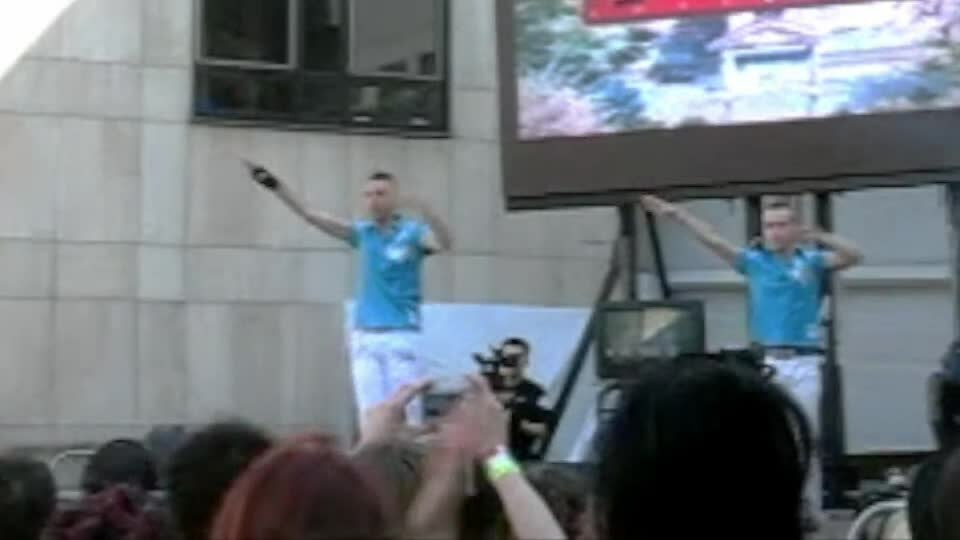
Para Para dancing consists of mostly upper body movements in synchronization with a four-on-the-floor rhythm. Dancing involves choreographed motions with the arms and hands while stepping to the right and left, similar to the movements of traditional festival dances such as Bon Odori and cheering squads called Ōendan. Para Para dancing is generally done to Eurobeat and Eurodance music, with each track having its own dance routine. Para Para involves very little lower body movement, with the exception of moving one's hips, stepping in place, and jumping or hopping. Some routines feature more complex leg movements. Routines are generally choreographed by groups affiliated with popular clubs in Japan (see below).
Fans of Para Para often refer to themselves as "paralists" and include official and unofficial teams of dancers in Japan, Chile, Brazil, Spain, the United States, Canada, Taiwan, Hong Kong, Finland, and several other countries.[citation needed] Some such dance teams are recognized by major Japanese music labels such as Avex and have been featured in Japanese media like the magazine Egg.
The history of Para Para is largely described by the community and historians in terms of "booms", during which Para Para saw an increase in popularity. Times of decreased popularity are referred to as "glacial" periods. To date, there have been four distinct booms, each with a distinct cultural and historical context.
The term "official" in the parapara world describes routines made by certain clubs/choreography groups in Japan. A non-exhaustive list of official club events are Starfire, SEF, 9LoveJ, and Twinstar. These routines are danced and learned by most people in the community.
In response to official routines, people in Japan have made their own routines, called "maniac" routines. This movement started in the late 1990s with clubs like Hibiya Radio City and Tottori Eleven choreographing their own routines. In addition to the club events mentioned, other famous maniac club events that existed were Medusa, Area, Joy, AXOS, Bless, and TMD. As of 2008[update], club events in Japan have not choreographed many maniac routines, and the movement has basically stopped. However, some official club events like Starfire and SEF still continue. Some paralists prefer maniac to official routines, though, and continue to host small events like Ravenous that feature maniac routines.
Some variants of Para Para include TechPara (set to hyper techno instead of Eurobeat), and TraPara or ToraPara (set to trance).
Para Para
Para Para (パラパラ, ParaPara) or Para-Para is a synchronized dance that originated in Japan. Unlike most types of club and rave dancing, Para Para features specific synchronized movements for each song, much like line dancing. Para Para has been around since the early 1980s, when European countries started selling Italo disco and Eurodisco and, in the mid-to late 1970s, new wave and synthpop music in Japan. However, the dance did not achieve much popularity outside Japan until the late 1990s.
Para Para is strongly associated with Eurobeat. Eurobeat artist Dave Rodgers has described Para Para as the only way to dance to Eurobeat, which is usually "so fast."
Para Para dancing consists of mostly upper body movements in synchronization with a four-on-the-floor rhythm. Dancing involves choreographed motions with the arms and hands while stepping to the right and left, similar to the movements of traditional festival dances such as Bon Odori and cheering squads called Ōendan. Para Para dancing is generally done to Eurobeat and Eurodance music, with each track having its own dance routine. Para Para involves very little lower body movement, with the exception of moving one's hips, stepping in place, and jumping or hopping. Some routines feature more complex leg movements. Routines are generally choreographed by groups affiliated with popular clubs in Japan (see below).
Fans of Para Para often refer to themselves as "paralists" and include official and unofficial teams of dancers in Japan, Chile, Brazil, Spain, the United States, Canada, Taiwan, Hong Kong, Finland, and several other countries.[citation needed] Some such dance teams are recognized by major Japanese music labels such as Avex and have been featured in Japanese media like the magazine Egg.
The history of Para Para is largely described by the community and historians in terms of "booms", during which Para Para saw an increase in popularity. Times of decreased popularity are referred to as "glacial" periods. To date, there have been four distinct booms, each with a distinct cultural and historical context.
The term "official" in the parapara world describes routines made by certain clubs/choreography groups in Japan. A non-exhaustive list of official club events are Starfire, SEF, 9LoveJ, and Twinstar. These routines are danced and learned by most people in the community.
In response to official routines, people in Japan have made their own routines, called "maniac" routines. This movement started in the late 1990s with clubs like Hibiya Radio City and Tottori Eleven choreographing their own routines. In addition to the club events mentioned, other famous maniac club events that existed were Medusa, Area, Joy, AXOS, Bless, and TMD. As of 2008[update], club events in Japan have not choreographed many maniac routines, and the movement has basically stopped. However, some official club events like Starfire and SEF still continue. Some paralists prefer maniac to official routines, though, and continue to host small events like Ravenous that feature maniac routines.
Some variants of Para Para include TechPara (set to hyper techno instead of Eurobeat), and TraPara or ToraPara (set to trance).
Recent media
Recent media