Respect all members: no insults, harassment, or hate speech.
Be tolerant of different viewpoints, cultures, and beliefs. If you do not agree with others, just create separate note, article or collection.
Clearly distinguish between personal opinion and fact.
Verify facts before posting, especially when writing about history, science, or statistics.
Promotional content must be published on the “Related Services and Products” page—no more than one paragraph per service. You can also create subpages under the “Related Services and Products” page and publish longer promotional text there.
Do not post materials that infringe on copyright without permission.
Always credit sources when sharing information, quotes, or media.
Be respectful of the work of others when making changes.
Discuss major edits instead of removing others' contributions without reason.
If you notice rule-breaking, notify community about it in talks.
Do not share personal data of others without their consent.
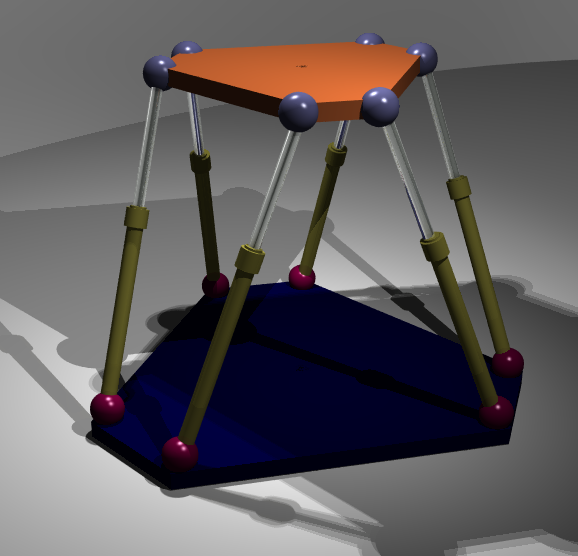
Abstract render of a Hexapod platform (Stewart Platform)
A parallel manipulator is a mechanical system that uses several computer-controlled serial chains to support a single platform, or end-effector. Perhaps, the best known parallel manipulator is formed from six linear actuators that support a movable base for devices such as flight simulators. This device is called a Stewart platform or the Gough-Stewart platform in recognition of the engineers who first designed and used them.[1]
Also known as parallel robots, or generalized Stewart platforms (in the Stewart platform, the actuators are paired together on both the basis and the platform), these systems are articulated robots that use similar mechanisms for the movement of either the robot on its base, or one or more manipulator arms. Their 'parallel' distinction, as opposed to a serial manipulator, is that the end effector (or 'hand') of this linkage (or 'arm') is directly connected to its base by a number of (usually three or six) separate and independent linkages working simultaneously. No geometrical parallelism is implied.
A parallel manipulator is designed so that each chain is usually short, simple and can thus be rigid against unwanted movement, compared to a serial manipulator. Errors in one chain's positioning are averaged in conjunction with the others, rather than being cumulative. Each actuator must still move within its own degree of freedom, as for a serial robot; however in the parallel robot the off-axis flexibility of a joint is also constrained by the effect of the other chains. It is this closed-loop stiffness that makes the overall parallel manipulator stiff relative to its components, unlike the serial chain that becomes progressively less rigid with more components.
This mutual stiffening also permits simple construction: Stewart platform hexapods chains use prismatic jointlinear actuators between any-axis universal ball joints. The ball joints are passive: simply free to move, without actuators or brakes; their position is constrained solely by the other chains. Delta robots have base-mounted rotary actuators that move a light, stiff, parallelogram arm. The effector is mounted between the tips of three of these arms and again, it may be mounted with simple ball-joints. Static representation of a parallel robot is often akin to that of a pin-jointed truss: the links and their actuators feel only tension or compression, without any bending or torque, which again reduces the effects of any flexibility to off-axis forces.
A further advantage of the parallel manipulator is that the heavy actuators may often be centrally mounted on a single base platform, the movement of the arm taking place through struts and joints alone. This reduction in mass along the arm permits a lighter arm construction, thus lighter actuators and faster movements. This centralisation of mass also reduces the robot's overall moment of inertia, which may be an advantage for a mobile or walking robot.
All these features result in manipulators with a wide range of motion capability. As their speed of action is often constrained by their rigidity rather than sheer power, they can be fast-acting, in comparison to serial manipulators.
A manipulator can move an object with up to 6 degrees of freedom (DoF), determined by 3 translation 3T and 3 rotation 3R coordinates for full 3T3R mobility. However, when a manipulation task requires less than 6 DoF, the use of lower mobility manipulators, with fewer than 6 DoF, may bring advantages in terms of simpler architecture, easier control, faster motion and lower cost.[2] For example, the 3 DoF Delta [3][4] robot has lower 3T mobility and has proven to be very successful for rapid pick-and-place translational positioning applications. The workspace of lower mobility manipulators may be decomposed into `motion' and `constraint' subspaces. For example, 3 position coordinates constitute the motion subspace of the 3 DoF Delta robot and the 3 orientation coordinates are in the constraint subspace. The motion subspace of lower mobility manipulators may be further decomposed into independent (desired) and dependent subspaces: consisting of `concomitant' or `parasitic' motion which is undesired motion of the manipulator.[5][6][7] The debilitating effects of parasitic motion should be mitigated or eliminated in the successful design of lower mobility manipulators. For example, the Delta robot does not have parasitic motion since its end effector does not rotate.
Hexapod positioning systems, also known as Stewart Platforms.
Most robot applications require rigidity. Serial robots may achieve this by using high-quality rotary joints that permit movement in one axis but are rigid against movement outside this. Any joint permitting movement must also have this movement under deliberate control by an actuator. A movement requiring several axes thus requires a number of such joints. Unwanted flexibility or sloppiness in one joint causes a similar sloppiness in the arm, which may be amplified by the distance between the joint and the end-effectuor: there is no opportunity to brace one joint's movement against another. Their inevitable hysteresis and off-axis flexibility accumulates along the arm's kinematic chain; a precision serial manipulator is a compromise between precision, complexity, mass (of the manipulator and of the manipulated objects) and cost. On the other hand, with parallel manipulators, a high rigidity may be obtained with a small mass of the manipulator (relatively to the charge being manipulated). This allows high precision and high speed of movements, and motivates the use of parallel manipulators in flight simulators (high speed with rather large masses) and electrostatic or magnetic lenses in particle accelerators (very high precision in positioning large masses).
A drawback of parallel manipulators, in comparison to serial manipulators, is their limited workspace. As for serial manipulators, the workspace is limited by the geometrical and mechanical limits of the design (collisions between legs maximal and minimal lengths of the legs). The workspace is also limited by the existence of singularities, which are positions where, for some trajectories of the movement, the variation of the lengths of the legs is infinitely smaller than the variation of the position. Conversely, at a singular position, a force (like gravity) applied on the end-effector induce infinitely large constraints on the legs, which may result in a kind of "explosion" of the manipulator. The determination of the singular positions is difficult (for a general parallel manipulator, this is an open problem). This implies that the workspaces of the parallel manipulators are, usually, artificially limited to a small region where one knows that there is no singularity.
Another drawback of parallel manipulators is their nonlinear behavior: the command which is needed for getting a linear or a circular movement of the end-effector depends dramatically on the location in the workspace and does not vary linearly during the movement.
Parallel robots are usually more limited in the workspace; for instance, they generally cannot reach around obstacles. The calculations involved in performing a desired manipulation (forward kinematics) are also usually more difficult and can lead to multiple solutions.
Prototype of "PAR4", a 4-degree-of-freedom, high-speed, parallel robot.
[1][2] Parallel manipulator with parasitic motion.Gogu, Grigore (2008). Structural Synthesis of Parallel Robots, Part 1: Methodology. Springer. ISBN978-1-4020-5102-9.
Gogu, Grigore (2009). Structural Synthesis of Parallel Robots, Part 2: Translational topologies with Two and Three Degrees of Freedom. Springer. ISBN978-1-4020-9793-5.
A parallel manipulator is a type of robotic mechanism consisting of a fixed base platform connected to a moving end-effector platform by two or more independent kinematic chains, each typically incorporating actuators and joints such as prismatic, revolute, or spherical types.[1][2] This closed-loop structure enables precise control of the end-effector's position and orientation, often providing multiple degrees of freedom while distributing loads across the chains for enhanced stability.[1]Practical development of parallel manipulators accelerated in the mid-20th century.[2] In 1949, V.E. Gough designed a six-degree-of-freedom (6-DOF) platform for tire testing, while D. Stewart's 1965 work on flight simulators popularized the "Stewart platform," a fully parallel manipulator with six universal-prismatic-spherical (UPS) limbs.[2][1] Notable variants include the Delta robot for high-speed tasks and hexapods for multi-axis machining, with fully parallel designs featuring one actuator per degree of freedom to minimize structural complexity.[2]Parallel manipulators excel in applications requiring high precision, stiffness, and dynamic performance, offering advantages such as superior load-to-weight ratios (e.g., supporting 600 kg with a 35 kg structure), reduced sensitivity to errors, and high repeatability due to error averaging across chains.[2][3] They provide greater structural rigidity and lower inertia compared to serial manipulators, enabling accelerations over 20g and angular velocities exceeding 1000 degrees per second.[3] However, limitations include a restricted workspace, the presence of singular configurations that can cause loss of control, and computationally intensive forward kinematics.[1]Key applications span diverse fields: in aerospace, for motion simulators achieving high-fidelity 6-DOF replication; in manufacturing, for precision machine tools like hexapod mills with sub-millimeter accuracy; in medicine, for surgical robots and physiotherapy devices offering micrometer-level precision; and in assembly, for high-speed pick-and-place operations in packaging via Delta robots.[3][1] Emerging uses include space exploration trackers and reconfigurable systems for adaptive tasks.[3]
Overview
Definition and principles
A parallel manipulator is defined as a closed-loop mechanism in which a mobile platform, functioning as the end-effector, is connected to a fixed base through multiple independent kinematic chains, typically referred to as legs.[4] These legs allow the platform to achieve motion by simultaneous actuation, distinguishing parallel manipulators from open-chain serial designs through their interconnected architecture.[5]The fundamental components of a parallel manipulator include the fixed base, which provides a stable reference frame; the mobile platform, which carries the end-effector and undergoes controlled motion; and the legs, each comprising rigid links interconnected by joints such as revolute, prismatic, universal, or spherical types, with actuators often integrated into the legs to impart motion.[4] This closed-loop configuration distributes loads across the legs, enhancing structural rigidity and precision in positioning the platform.[5]At its core, a parallel manipulator operates on principles of constrained rigid body motion in three-dimensional space, where a free rigid body possesses six degrees of freedom: three translational along the x, y, and z axes, and three rotational about those axes.[6] The closed-loop architecture imposes kinematic constraints via the multiple chains, limiting the platform's freedom to a desired subset of these six degrees. The mobility, or effective degrees of freedom M, can be estimated using the Grübler-Kutzbach criterion for spatial mechanisms: M=6(n−1)−5j, where n is the number of links (including the base and platform) and j is the number of single-degree-of-freedom joints, assuming no redundant constraints.[7] This formula accounts for the overconstrained nature of parallel systems, where the loops reduce overall mobility compared to unconstrained assemblies.
Historical development
The origins of parallel manipulators trace back to early conceptual work on spatial mechanisms in the 1940s and 1950s, driven by needs in mechanical testing and engineering applications. During this period, researchers explored closed-loop kinematic chains to achieve precise multi-degree-of-freedom motion in three-dimensional space, laying foundational principles for devices that could simulate complex loads and movements. A pivotal contribution came from V.E. Gough, who in 1947 conceived a six-degree-of-freedom platform mechanism as part of a universal tire-testing machine to evaluate tire performance under varied conditions, including vertical, lateral, and torsional loads; this device, patented in 1949 and operational by 1954, represented one of the earliest practical implementations of a parallel structure for spatial manipulation.[8][9]The Gough platform gained wider recognition in the 1960s through D. Stewart's independent work, which popularized its potential beyond testing. In 1965, Stewart proposed a similar six-actuator configuration for flight simulation, emphasizing its ability to provide controlled six-degree-of-freedom motion via linear actuators mounted to a fixed base, thus introducing the mechanism to the broader engineering community for dynamic simulation applications.[10] This rediscovery spurred interest in parallel architectures, though initial adoption remained limited to specialized uses. By the 1980s, a surge in robotics research revitalized the field, with influential theoretical advancements such as K.H. Hunt's 1983 application of screw theory to analyze the structural kinematics of in-parallel-actuated robot arms, providing a mathematical framework for synthesizing and understanding their mobility and constraints.[11]The late 1980s and 1990s marked key evolutionary milestones, including Reymond Clavel's invention of the Delta robot in 1985, a three-degree-of-freedom parallel manipulator designed for high-speed pick-and-place operations in assembly tasks, featuring a unique parallelogram linkage to achieve translational motion with reduced inertia.[12] Industrial adoption accelerated in the 1990s, particularly for flight simulators based on the Stewart platform, which became standard in aviation training systems due to their high stiffness and load-bearing capacity.[13] Entering the 2000s, parallel manipulators saw refinements for micro- and nano-scale applications, such as compliant mechanisms for precision positioning in microscopy and semiconductor fabrication, enabling sub-micrometer accuracies through miniaturized parallel kinematics.[14]
Kinematics and modeling
Forward kinematics
Forward kinematics in parallel manipulators involves determining the position and orientation of the mobile platform given the known lengths of the actuated legs or joint angles. This process is essential for understanding the end-effector's pose in configurations where the input parameters are the actuator displacements. Unlike serial manipulators, where forward kinematics is straightforward, parallel structures introduce closed-loop constraints that complicate the computation.[15]The primary challenge arises from the nonlinear nature of the equations, leading to multiple possible solutions for the platform's pose. For a general 6-degree-of-freedom (6-DOF) Stewart platform, the forward kinematics problem can yield up to 40 real or complex solutions, though typically only a subset are physically feasible within the manipulator's operational range. This multiplicity requires careful selection of the correct assembly mode to avoid erroneous poses during trajectory planning. Numerical methods, such as the Newton-Raphson iteration, are commonly employed to approximate solutions by minimizing an error function derived from the leg length constraints, often converging to high precision (e.g., errors below 10−12) when provided with suitable initial guesses.[16][15]The mathematical framework typically employs homogeneous transformation matrices to model each leg's geometry. For the Stewart platform, with base attachment points pi (for i=1 to 6), platform points bi, position vector d of the platform center, rotation matrix R, and known leg lengths li, the constraint equations form a system of nonlinear equations:∥pi−(Rbi+d)∥=li,i=1,…,6These equations, when squared to eliminate square roots, result in 6 polynomial constraints that must be solved alongside the orthogonality conditions of R, totaling 9 equations in 9 unknowns (3 translations and 3 Euler angles or equivalent).[15]Analysis of forward solutions must account for workspace boundaries, defined primarily by the maximum and minimum leg lengths, beyond which no real solutions exist. Near these boundaries, the solutions become sensitive, with small changes in leg lengths producing large variations in pose. Singularity avoidance in forward kinematics focuses on selecting iterative paths or initial conditions that steer away from configurations where the manipulator's Jacobian matrix is ill-conditioned, preventing divergence in numerical solvers and ensuring stable computation within the constant-orientation workspace.[17]
Inverse kinematics and dynamics
Inverse kinematics in parallel manipulators involves determining the joint variables, typically the lengths of the actuated legs, given a desired pose of the end-effector platform. Unlike forward kinematics, which often requires solving complex nonlinear equations, inverse kinematics for parallel manipulators is generally straightforward and admits closed-form analytical solutions, particularly for symmetric designs. This simplicity arises from the geometric constraints imposed by the fixed base and the parallel legs, allowing direct computation of leg lengths as Euclidean distances between attachment points on the base and the platform.A representative example is the Delta robot, a three-degree-of-freedom translational parallel manipulator developed by Reymond Clavel, where each leg consists of a parallelogram linkage actuated by a revolute joint. For a desired end-effector position (x,y,z), the actuated joint angles θi of the i-th leg are computed using closed-form solutions derived from geometric constraints, such as solving quadratic equations via tangent half-angle substitution: θi=2tan−1(ti), where ti satisfies the fixed arm length conditions of the upper arm and parallelogram forearm. This enables rapid computation suitable for real-time control.[18][19]For the six-degree-of-freedom Gough-Stewart platform, inverse kinematics similarly reduces to computing the extension of each prismatic leg as the distance between corresponding points on the base and moving platform, transformed by the platform's orientation. Given the platform pose defined by position (x,y,z) and rotation matrixR, the leg length lj for the j-th leg is lj=∥bj−(p+Raj)∥, where p=(x,y,z), aj is the j-th platform attachment vector, and bj is the corresponding base vector. This analytical approach, rooted in the platform's spherical-prismatic-spherical leg architecture, facilitates precise actuation without iterative methods.Dynamic modeling of parallel manipulators couples inverse kinematics with equations of motion to predict forces and torques required for trajectory tracking. The Lagrange formulation is widely adopted due to its systematic handling of the system's constrained topology, where the Lagrangian L=T−V is defined with kinetic energyT including translational and rotational components of the platform and legs, such as T=21mvTv+21ωTIω for the platform (with mass m, velocity v, angular velocity ω, and inertia tensor I) plus leg contributions, and potential energyV accounting for gravity. The equations dtd(∂q˙∂L)−∂q∂L=τ+λTA incorporate generalized forces τ, Lagrange multipliers λ for holonomic constraintsAq˙=0, and joint accelerations derived via the manipulator's Jacobian. This constrained approach ensures accurate force distribution across the parallel structure.The Jacobian matrix plays a central role in linking end-effector velocities to actuated joint rates, x˙=Jq˙, where x is the platform twist and q the joint variables; its inverse form maps actuator efforts to platform wrenches. Singularities occur when det(J)=0, leading to loss of mobility or infinite stiffness, which must be avoided in workspace planning—parallel manipulators exhibit both constraint and actuation singularities distinct from serial types. Analysis of the Jacobian's regularity is essential for safe operation, as detailed in interval-based methods for certifying non-singular poses.[20]In overconstrained parallel manipulators with actuation redundancy—where the number of actuators exceeds the degrees of freedom—force distribution becomes critical to minimize energy consumption or maximize stiffness. Redundancy allows optimization of internal forces via null-space projection of the Jacobian, solving τ=JTf+(I−JT(JJT)−1J)u for platform wrench f and secondary task u, enabling uniform load sharing and singularity avoidance. This capability enhances robustness in designs like redundantly actuated Stewart platforms.[21][22]
Design and configurations
Core design features
Parallel manipulators are characterized by their use of multiple kinematic chains, or "legs," connecting a fixed base to a mobile platform, with each leg typically incorporating a combination of prismatic, revolute, or spherical joints to enable controlled motion. Prismatic joints provide linear translation along a single axis, revolute joints allow rotation about one axis, and spherical joints permit three rotational degrees of freedom, often arranged in serial chains such as spherical-prismatic-spherical (SPS) or universal-prismatic-spherical (UPS) configurations to balance mobility and constraint. These joint types facilitate the transmission of forces and motions while maintaining structural integrity, with universal joints sometimes integrated to accommodate additional rotational freedom without introducing unwanted degrees of freedom.Degree-of-freedom (DOF) control in parallel manipulators relies on a distinction between active and passive constraints, where active joints are directly actuated to drive the system, and passive joints impose geometric constraints to limit extraneous motions. For instance, in a typical six-DOF manipulator, six active prismatic joints might be paired with passive spherical or revolute joints in each leg to constrain the platform to the desired translational and rotational motions, ensuring precise end-effector positioning while distributing loads across multiple paths for enhanced rigidity. This approach leverages the closed-loop architecture to achieve higher payload capacities compared to open-chain designs, with passive elements often designed to operate under tension or compression without actuation.Actuation strategies in parallel manipulators prioritize efficiency, speed, and load-bearing capability, commonly employing linear motors for direct-drive precision in prismatic joints, hydraulic or pneumatic cylinders for high-force applications in heavy-duty tasks, and cable-driven systems for lightweight, high-speed operations that reduce inertial loads. Linear motors offer backlash-free motion and rapid acceleration, while hydraulic actuators provide robust force output suitable for industrial environments, and cable-driven mechanisms enable compact designs with minimal moving mass by routing flexible cables through guides. These choices are selected based on the manipulator's operational demands, such as workspace size and dynamic performance.Structural considerations emphasize achieving high stiffness-to-weight ratios through material selection and precise fabrication, with carbon fiber composites frequently used for mobile platforms and leg links to minimize deflection under load while keeping overall mass low. Aluminum alloys or steel may complement these in base structures for durability, but advanced composites like carbon fiber are preferred for their superior specific modulus, enabling manipulators to handle accelerations up to 10g without excessive vibration. Calibration techniques, such as laser tracker measurements or double ball-bar testing, are essential to compensate for manufacturing tolerances and assembly errors, often reducing positioning inaccuracies to sub-millimeter levels through kinematic parameter optimization.[23]Singularity management is a critical design aspect, addressed through asymmetric leg arrangements that alter joint placements to expand the usable workspace and avoid configurations where the manipulator loses or gains instantaneous DOF, potentially leading to control instability. Redundant actuators, such as adding extra prismatic joints beyond the minimum required DOF, provide fault tolerance and allow real-time adjustment of leg tensions to steer clear of singular poses, enhancing operational reliability in dynamic environments. These strategies are informed by geometric analysis of the manipulator's Jacobian matrix, ensuring that singularities are either excluded from the workspace or mitigated via control algorithms.[24]
Lower-mobility types
Lower-mobility parallel manipulators are defined as multi-loop mechanisms possessing fewer than six degrees of freedom (DOF), typically ranging from 2 to 5 DOF, achieved through underactuated or constrained kinematic chains that restrict rotational motions.[25] These designs prioritize specific task-oriented motions, such as pure translation or planar movement, by limiting the mobility of individual legs to eliminate unnecessary orientations while maintaining structural rigidity.[26]Prominent examples include 3-DOF translational platforms, such as the orthogonal parallel manipulator, which employs three orthogonal prismatic joints in its legs to enable decoupled linear motions along the x, y, and z axes, facilitating high-precision positioning in manufacturing tasks.[27] Another key instance is the 3-RRR planar mechanism, consisting of three identical revolute-revolute-revolute (RRR) kinematic chains connected to a fixed base and moving platform, commonly used for pick-and-place operations due to its ability to achieve rapid two-dimensional translation and rotation within a plane.[28]In terms of design specifics, these manipulators often feature a reduced number of legs—typically three—to simplify the architecture and focus on high-speed linear or planar trajectories, with decoupled kinematics that allow independent control of each degree of freedom, thereby easing computational demands for trajectory planning and real-time operation.[26] This configuration contrasts with higher-mobility systems by incorporating passive joints or geometric constraints in the legs, such as spherical or universal joints briefly referenced in core designs, to enforce the desired motion constraints without additional actuators.[29]The advantages of lower-mobility types lie in their structural simplicity, which yields a larger usable workspace relative to serial manipulators for targeted tasks, alongside reduced inertia and lower actuation requirements that enhance speed and energy efficiency in applications like assembly lines.[29] For instance, the decoupled nature minimizes error propagation between axes, improving accuracy in repetitive motions compared to coupled full-mobility designs.[25]
Full-mobility types
Full-mobility parallel manipulators provide six degrees of freedom (6-DOF), enabling complete spatial motion including three translations and three rotations, typically achieved through six actuated legs or equivalent kinematic chains that couple these motions in parallel.[30] These structures connect a fixed base to a mobile platform via extensible legs, allowing for high stiffness and precise control over coupled pose adjustments.[31]The Stewart-Gough platform stands as a seminal full-mobility type, featuring six universal-prismatic-spherical (UPS) legs that attach to the base and platform, providing full 6-DOF dexterity for tasks requiring arbitrary orientation and position.[31] Variants like the 6-RSS configuration, where revolute-spherical-spherical (RSS) joints replace some UPS elements, maintain the 6-DOF capability while adapting to specific load or speed requirements.[32]Hexa robot variants represent another prominent class of full-mobility manipulators, often employing hybrid joint arrangements to achieve 6-DOF, such as in Pierrot's HEXA design featuring six RUS (revolute-universal-spherical) limbs for high-speed operations.[33] These configurations prioritize high-speed operations and are scalable for industrial integration, with the mobile platform supported by parallel chains that distribute forces evenly across translations and rotations.[34]Design variations in full-mobility manipulators include asymmetric platform geometries, which alter leg attachment points to enlarge the singularity-free workspace and mitigate pose-dependent dexterity losses inherent in symmetric setups.[35] For instance, irregular base or platform shapes can shift singularity loci, improving operational versatility without altering the core 6-DOF structure.[36]Hybrid serial-parallel designs extend the reach of full-mobility manipulators by integrating a serial arm with a distal 6-DOF parallel wrist or platform, combining the large workspace of serial kinematics with parallel precision for applications needing both extended range and fine manipulation.[37] This architecture, often using a 3-DOF serial base followed by a Stewart-Gough-like parallel module, achieves up to 6-DOF overall while preserving structural rigidity.[38]Calibration for full-mobility parallel manipulators focuses on error modeling to account for manufacturing tolerances and joint misalignments, with geometric parameter identification techniques estimating leg lengths, joint centers, and platform orientations through least-squares optimization of measured poses.[39] These methods, such as those using differential kinematics, enable sub-millimeter accuracy by iteratively refining the 6-DOF pose model against end-effector measurements, crucial for handling the coupled errors in translations and rotations.[40]
Comparison with serial manipulators
Structural and kinematic differences
Parallel manipulators are characterized by a closed-loop kinematic architecture, in which the end-effector, often a mobile platform, is connected to a fixed base through multiple independent serial kinematic chains, or legs, creating parallel pathways for force and motion transmission. This contrasts with serial manipulators, which utilize an open kinematic chain composed of a sequential series of links and joints, where each segment supports the subsequent ones in a cantilevered manner. In parallel structures, external loads on the end-effector are distributed across all legs simultaneously, allowing the base to provide direct support through multiple routes, whereas in serial designs, loads propagate cumulatively along the chain, with each link bearing the full downstream burden.[41][42][43]Kinematically, the degrees of freedom in parallel manipulators are inherently coupled due to the closed-loop constraints imposed by the legs, meaning that changes in one actuated joint influence the overall end-effector pose through interdependent leg lengths or angles. Serial manipulators, by comparison, feature decoupledjoint motions, where each joint's rotation or translation primarily affects its immediate link without direct constraint from downstream elements. Singularities in parallel manipulators typically arise from geometric configurations where the legs align in a way that alters the instantaneous mobility, often resulting in a gain of degrees of freedom and potential unconstrained motions in certain directions. In serial manipulators, singularities occur when joint axes align, such as becoming collinear or parallel, leading to a loss of degrees of freedom and reduced controllability in orientation. The workspace of parallel manipulators is generally smaller and more complex in shape, bounded by the intersection of reachable volumes from each leg, while serial manipulators achieve larger, more expansive reaches limited primarily by joint limits and link lengths.[41][42][43]For instance, a standard 6-DOF serial manipulator like a 6R (revolute-revolute) arm employs six links connected in series, resulting in a straightforward chain with cumulative positioning errors. In contrast, a 6-DOF parallel platform connects the base and end-effector via six legs, each comprising multiple links and joints, which increases the total link count but provides redundant structural paths for enhanced kinematic constraint distribution.[42][43]
Performance advantages and limitations
Parallel manipulators exhibit several performance advantages over serial manipulators, primarily stemming from their closed-loop architecture that distributes loads across multiple kinematic chains. One key benefit is the higher stiffness-to-weight ratio, achieved through base-mounted actuators and rigid end-effectors that minimize moving masses and enhance structural rigidity.[44] This allows parallel systems to maintain precision under load, with examples like the Orthoglide manipulator demonstrating stiffness values up to 3.23 kN/mm in unloaded configurations. Additionally, they offer superior dynamic performance, including faster acceleration and higher bandwidth, due to reduced inertia; for instance, the Agile Eye parallel manipulator achieves angular velocities exceeding 1000 deg/s and accelerations over 20,000 deg/s².Accuracy is another strength, as errors in individual links are averaged across the parallel structure rather than accumulating as in serial chains, potentially reducing geometrical errors by up to 90%. Calibrated parallel systems can attain positioning errors below 0.03 mm and orientation errors under 0.000003 rad, supporting high-precision tasks. Payload capacity is also enhanced, with loads shared among chains enabling higher weight-to-payload ratios compared to serial designs, which suffer from cantilevered structures and compliance accumulation.Despite these benefits, parallel manipulators have notable limitations. Their workspace is typically smaller and more complex in shape, often constrained to volumes on the order of 0.45 times the leg length due to link interferences and joint limits, limiting dexterity relative to serial manipulators' expansive reach.[44] Control complexity increases near singularities, where stiffness drops dramatically and manipulability indices like the condition number of the Jacobian diverge, complicating trajectory planning.[44] Reconfigurability is challenging, as architectural changes require redesigning the entire linkage system, unlike the modular adaptability of serial arms.Quantitative comparisons highlight these trade-offs. Parallel manipulators often support payloads 2-5 times higher than equivalent serial ones in high-acceleration scenarios, with energy efficiency improved due to lower inertial loads, though this comes at the cost of workspace volumes that are 20-50% smaller in optimized designs. To mitigate limitations, hybrid parallel-serial designs integrate the stiffness and speed of parallel mechanisms with the larger workspace of serial ones, as seen in systems combining base-mounted parallel stages with wrist-like serial extensions.
Applications and advancements
Industrial and manufacturing uses
Parallel manipulators, particularly Delta robots, are widely deployed in high-speed pick-and-place operations within electronics assembly lines, where their parallel kinematic structure enables rapid, precise movements for handling small components such as circuit boards and semiconductors.[45] These robots can achieve cycle rates of up to 120 picks per minute, making them ideal for repetitive tasks that demand high throughput and minimal downtime.[46] In addition, parallel manipulators serve as 5-axis platforms in CNC machining, providing enhanced rigidity and dynamic performance for complex milling and contouring of parts, as exemplified by the METROM Pentapod system, which supports simultaneous 5-sided machining.[47]A notable case study is ABB's IRB 340 FlexPicker, introduced in 1998 as one of the first commercial Delta robots, which revolutionized packaging and assembly by achieving accelerations up to 10g for lightweight payload handling in food, pharmaceutical, and electronics sectors.[48] In automotive manufacturing, parallel manipulators are utilized for part handling and machining tasks, leveraging their inherent structural rigidity to maintain precision under heavy loads and vibrations, thereby supporting efficient production of components like engine blocks and chassis elements.[49]Integration of parallel manipulators into automated systems often involves sensor feedback, such as vision and force sensors, to enable real-time path planning and adaptive control, ensuring collision-free operations in dynamic environments.[50] Their scalability facilitates deployment in multi-robot cells, where coordinated units perform parallel tasks like sorting and assembly, optimizing workflow in large-scale production lines. Economically, these systems reduce cycle times in sorting and pick-and-place applications compared to serial manipulators, with parallel designs offering advantages in speed through lower inertia and higher acceleration capabilities.[51]
Specialized and emerging applications
Parallel manipulators, particularly 6-DOF Stewart platforms, have been integral to simulation environments since the 1960s, providing high-fidelity motion cues for training in complex scenarios. Originally proposed by D. Stewart in 1965 for aircraft simulators, these systems replicate six degrees of freedom to simulate realistic dynamics, such as turbulence or gravitational shifts. NASA utilized Stewart platforms in the 1970s for flight simulationtraining, including aircraft operations at Langley Research Center and early applications in space-related scenarios, enhancing spatial awareness and response times without real-world risks.[52] Similar platforms are employed in driving simulators for automotive research, where they deliver precise tilt, surge, and sway to study human factors in vehicle control under varied conditions.[53]In medical applications, parallel manipulators enable haptic devices and surgical robots that enhance precision during procedures. Haptic interfaces based on parallel kinematics provide force feedback to surgeons, allowing intuitive control while filtering hand tremors through the system's inherent stiffness and low inertia. For minimally invasive surgery, hybrid parallel robots like PARASURG-9M facilitate access to confined spaces in abdominal, urological, and thoracic operations, eliminating natural tremors and achieving sub-millimeter accuracy to reduce tissue damage.[54] These mechanisms support tremor reduction by decoupling end-effector motion from operator inputs.[55]Emerging applications leverage parallel manipulators at micro- and nano-scales for delicate tasks in biotechnology. MEMS-based parallel mechanisms, such as compliant XYZ platforms, enable precise cell handling by providing multi-axis positioning with minimal parasitic motion, allowing manipulation of biological samples like pollen or stem cells without contamination.[14] These systems integrate electrostatic or piezoelectric actuators to achieve resolutions below 1 micrometer, supporting applications in single-cell injection and assembly for regenerative medicine.[56] In space robotics, hexapod parallel manipulators facilitate satellite alignment and servicing in microgravity. For instance, NASA's use of hexapods in the Robotic Refueling Mission tests precise positioning for orbital repairs, with load capacities up to 500 kg and accuracies of 10 micrometers to align antennas or capture satellites autonomously.[57] These full-mobility configurations offer versatility for in-orbit adjustments, compensating for thermal distortions in satellite structures.[58]Post-2020 advancements have integrated AI into parallel manipulator control for dynamic environments. Machine learning algorithms, such as fuzzy-neural networks, enable adaptive workspaces by real-time reconfiguration of kinematic parameters, expanding operational envelopes by 20-30% in unstructured settings like disaster response.[59]Deep reinforcement learning has been applied to cable-driven parallels for trajectory optimization, improving energy efficiency and adaptability in tasks requiring variable payloads.[60] From 2023 to 2025, partnerships have advanced AI-powered parallel robot systems for enhanced human-robot collaboration in manufacturing.[61] Sustainable designs incorporate soft actuators, such as pneumatic or electrohydraulic elements, into parallel frameworks to reduce material use and enhance biocompatibility. These bio-inspired systems, using biodegradable polymers, achieve compliant motion for eco-friendly applications in environmental monitoring, with actuation strains up to 200% while minimizing electronic waste.[62]