
Recent from talks
Estimation theory
Knowledge base stats:
Talk channels stats:
Members stats:
Estimation theory
Estimation theory is a branch of statistics that deals with estimating the values of parameters based on measured empirical data that has a random component. The parameters describe an underlying physical setting in such a way that their value affects the distribution of the measured data. An estimator attempts to approximate the unknown parameters using the measurements. In estimation theory, two approaches are generally considered:
For example, it is desired to estimate the proportion of a population of voters who will vote for a particular candidate. That proportion is the parameter sought; the estimate is based on a small random sample of voters. Alternatively, it is desired to estimate the probability of a voter voting for a particular candidate, based on some demographic features, such as age.
Or, for example, in radar the aim is to find the range of objects (airplanes, boats, etc.) by analyzing the two-way transit timing of received echoes of transmitted pulses. Since the reflected pulses are unavoidably embedded in electrical noise, their measured values are randomly distributed, so that the transit time must be estimated.
As another example, in electrical communication theory, the measurements which contain information regarding the parameters of interest are often associated with a noisy signal.
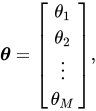
For a given model, several statistical "ingredients" are needed so the estimator can be implemented. The first is a statistical sample – a set of data points taken from a random vector (RV) of size N. Put into a vector, Secondly, there are M parameters whose values are to be estimated. Third, the continuous probability density function (pdf) or its discrete counterpart, the probability mass function (pmf), of the underlying distribution that generated the data must be stated conditional on the values of the parameters: It is also possible for the parameters themselves to have a probability distribution (e.g., Bayesian statistics). It is then necessary to define the Bayesian probability After the model is formed, the goal is to estimate the parameters, with the estimates commonly denoted , where the "hat" indicates the estimate.
![{\displaystyle \mathbf {x} ={\begin{bmatrix}x[0]\\x[1]\\\vdots \\x[N-1]\end{bmatrix}}.}](https://wikimedia.org/api/rest_v1/media/math/render/svg/3e73cc498b4c467a2b8efe9650edf8930df68d7f)


One common estimator is the minimum mean squared error (MMSE) estimator, which utilizes the error between the estimated parameters and the actual value of the parameters as the basis for optimality. This error term is then squared and the expected value of this squared value is minimized for the MMSE estimator.

Commonly used estimators (estimation methods) and topics related to them include:
Consider a received discrete signal, , of independent samples that consists of an unknown constant with additive white Gaussian noise (AWGN) with zero mean and known variance (i.e., ). Since the variance is known then the only unknown parameter is .
![{\displaystyle x[n]}](https://wikimedia.org/api/rest_v1/media/math/render/svg/864cbbefbdcb55af4d9390911de1bf70167c4a3d)


![{\displaystyle w[n]}](https://wikimedia.org/api/rest_v1/media/math/render/svg/2a4e3e5afc2a8c6da9020b8c6b21450959101a18)


Hub AI
Estimation theory AI simulator
(@Estimation theory_simulator)
Estimation theory
Estimation theory is a branch of statistics that deals with estimating the values of parameters based on measured empirical data that has a random component. The parameters describe an underlying physical setting in such a way that their value affects the distribution of the measured data. An estimator attempts to approximate the unknown parameters using the measurements. In estimation theory, two approaches are generally considered:
For example, it is desired to estimate the proportion of a population of voters who will vote for a particular candidate. That proportion is the parameter sought; the estimate is based on a small random sample of voters. Alternatively, it is desired to estimate the probability of a voter voting for a particular candidate, based on some demographic features, such as age.
Or, for example, in radar the aim is to find the range of objects (airplanes, boats, etc.) by analyzing the two-way transit timing of received echoes of transmitted pulses. Since the reflected pulses are unavoidably embedded in electrical noise, their measured values are randomly distributed, so that the transit time must be estimated.
As another example, in electrical communication theory, the measurements which contain information regarding the parameters of interest are often associated with a noisy signal.
For a given model, several statistical "ingredients" are needed so the estimator can be implemented. The first is a statistical sample – a set of data points taken from a random vector (RV) of size N. Put into a vector, Secondly, there are M parameters whose values are to be estimated. Third, the continuous probability density function (pdf) or its discrete counterpart, the probability mass function (pmf), of the underlying distribution that generated the data must be stated conditional on the values of the parameters: It is also possible for the parameters themselves to have a probability distribution (e.g., Bayesian statistics). It is then necessary to define the Bayesian probability After the model is formed, the goal is to estimate the parameters, with the estimates commonly denoted , where the "hat" indicates the estimate.
One common estimator is the minimum mean squared error (MMSE) estimator, which utilizes the error between the estimated parameters and the actual value of the parameters as the basis for optimality. This error term is then squared and the expected value of this squared value is minimized for the MMSE estimator.
Commonly used estimators (estimation methods) and topics related to them include:
Consider a received discrete signal, , of independent samples that consists of an unknown constant with additive white Gaussian noise (AWGN) with zero mean and known variance (i.e., ). Since the variance is known then the only unknown parameter is .