
Recent from talks
Bayesian statistics
Knowledge base stats:
Talk channels stats:
Members stats:
Bayesian statistics
Bayesian statistics (/ˈbeɪziən/ BAY-zee-ən or /ˈbeɪʒən/ BAY-zhən) is a theory in the field of statistics based on the Bayesian interpretation of probability, where probability expresses a degree of belief in an event. The degree of belief may be based on prior knowledge about the event, such as the results of previous experiments, or on personal beliefs about the event. This differs from a number of other interpretations of probability, such as the frequentist interpretation, which views probability as the limit of the relative frequency of an event after many trials. More concretely, analysis in Bayesian methods codifies prior knowledge in the form of a prior distribution.
Bayesian statistical methods use Bayes' theorem to compute and update probabilities after obtaining new data. Bayes' theorem describes the conditional probability of an event based on data as well as prior information or beliefs about the event or conditions related to the event. For example, in Bayesian inference, Bayes' theorem can be used to estimate the parameters of a probability distribution or statistical model. Since Bayesian statistics treats probability as a degree of belief, Bayes' theorem can directly assign a probability distribution that quantifies the belief to the parameter or set of parameters.
Bayesian statistics is named after Thomas Bayes, who formulated a specific case of Bayes' theorem in a paper published in 1763. In several papers spanning from the late 18th to the early 19th centuries, Pierre-Simon Laplace developed the Bayesian interpretation of probability. Laplace used methods now considered Bayesian to solve a number of statistical problems. While many Bayesian methods were developed by later authors, the term "Bayesian" was not commonly used to describe these methods until the 1950s. Throughout much of the 20th century, Bayesian methods were viewed unfavorably by many statisticians due to philosophical and practical considerations. Many of these methods required much computation, and most widely used approaches during that time were based on the frequentist interpretation. However, with the advent of powerful computers and new algorithms like Markov chain Monte Carlo, Bayesian methods have gained increasing prominence in statistics in the 21st century.
Bayes' theorem is used in Bayesian methods to update probabilities, which are degrees of belief, after obtaining new data. Given two events and , the conditional probability of given that is true is expressed as follows:


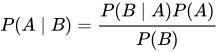
where . Although Bayes' theorem is a fundamental result of probability theory, it has a specific interpretation in Bayesian statistics. In the above equation, usually represents a proposition (such as the statement that a coin lands on heads fifty percent of the time) and represents the evidence, or new data that is to be taken into account (such as the result of a series of coin flips). is the prior probability of which expresses one's beliefs about before evidence is taken into account. The prior probability may also quantify prior knowledge or information about . is the likelihood function, which can be interpreted as the probability of the evidence given that is true. The likelihood quantifies the extent to which the evidence supports the proposition . is the posterior probability, the probability of the proposition after taking the evidence into account. Essentially, Bayes' theorem updates one's prior beliefs after considering the new evidence .


The probability of the evidence can be calculated using the law of total probability. If is a partition of the sample space, which is the set of all outcomes of an experiment, then,



Hub AI
Bayesian statistics AI simulator
(@Bayesian statistics_simulator)
Bayesian statistics
Bayesian statistics (/ˈbeɪziən/ BAY-zee-ən or /ˈbeɪʒən/ BAY-zhən) is a theory in the field of statistics based on the Bayesian interpretation of probability, where probability expresses a degree of belief in an event. The degree of belief may be based on prior knowledge about the event, such as the results of previous experiments, or on personal beliefs about the event. This differs from a number of other interpretations of probability, such as the frequentist interpretation, which views probability as the limit of the relative frequency of an event after many trials. More concretely, analysis in Bayesian methods codifies prior knowledge in the form of a prior distribution.
Bayesian statistical methods use Bayes' theorem to compute and update probabilities after obtaining new data. Bayes' theorem describes the conditional probability of an event based on data as well as prior information or beliefs about the event or conditions related to the event. For example, in Bayesian inference, Bayes' theorem can be used to estimate the parameters of a probability distribution or statistical model. Since Bayesian statistics treats probability as a degree of belief, Bayes' theorem can directly assign a probability distribution that quantifies the belief to the parameter or set of parameters.
Bayesian statistics is named after Thomas Bayes, who formulated a specific case of Bayes' theorem in a paper published in 1763. In several papers spanning from the late 18th to the early 19th centuries, Pierre-Simon Laplace developed the Bayesian interpretation of probability. Laplace used methods now considered Bayesian to solve a number of statistical problems. While many Bayesian methods were developed by later authors, the term "Bayesian" was not commonly used to describe these methods until the 1950s. Throughout much of the 20th century, Bayesian methods were viewed unfavorably by many statisticians due to philosophical and practical considerations. Many of these methods required much computation, and most widely used approaches during that time were based on the frequentist interpretation. However, with the advent of powerful computers and new algorithms like Markov chain Monte Carlo, Bayesian methods have gained increasing prominence in statistics in the 21st century.
Bayes' theorem is used in Bayesian methods to update probabilities, which are degrees of belief, after obtaining new data. Given two events and , the conditional probability of given that is true is expressed as follows:
where . Although Bayes' theorem is a fundamental result of probability theory, it has a specific interpretation in Bayesian statistics. In the above equation, usually represents a proposition (such as the statement that a coin lands on heads fifty percent of the time) and represents the evidence, or new data that is to be taken into account (such as the result of a series of coin flips). is the prior probability of which expresses one's beliefs about before evidence is taken into account. The prior probability may also quantify prior knowledge or information about . is the likelihood function, which can be interpreted as the probability of the evidence given that is true. The likelihood quantifies the extent to which the evidence supports the proposition . is the posterior probability, the probability of the proposition after taking the evidence into account. Essentially, Bayes' theorem updates one's prior beliefs after considering the new evidence .
The probability of the evidence can be calculated using the law of total probability. If is a partition of the sample space, which is the set of all outcomes of an experiment, then,