
Recent from talks
Parimutuel betting
Knowledge base stats:
Talk channels stats:
Members stats:
Parimutuel betting
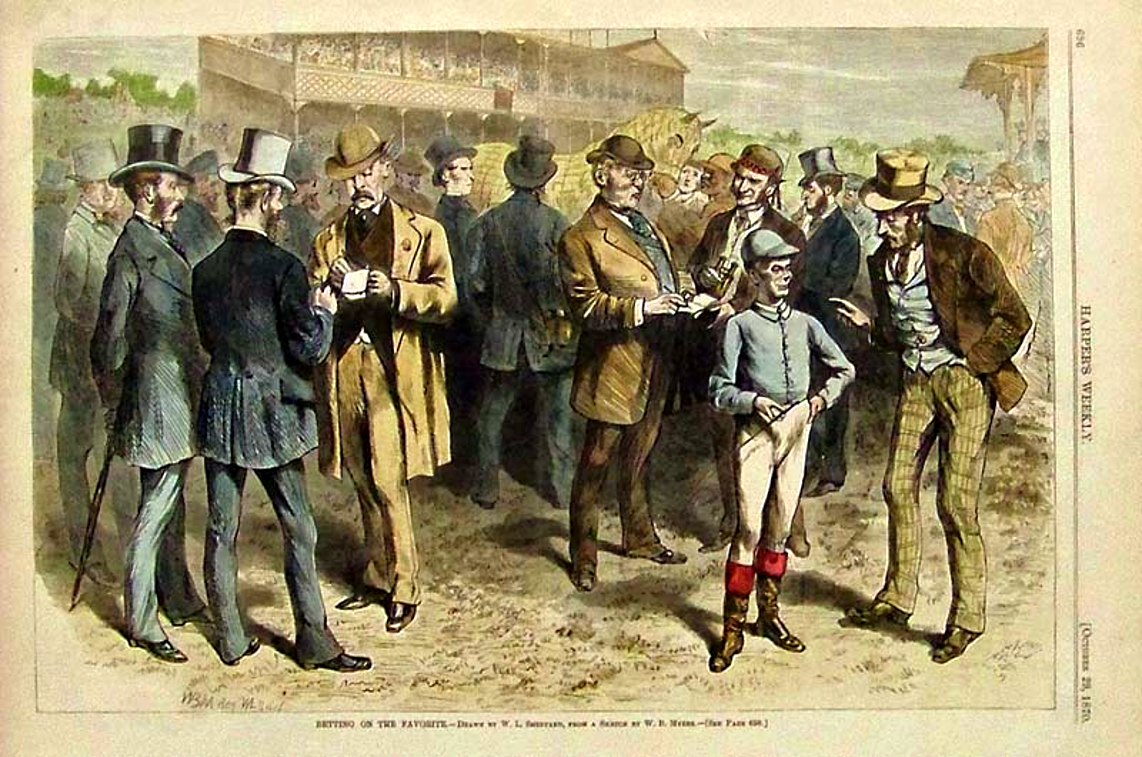
Parimutuel betting, or pool betting, is a betting system in which all bets of a particular type are placed together in a pool; taxes and the house-take, are deducted, and payoff odds are calculated by sharing the pool among all winning bets. In some countries it is known as the tote after the totalisator, which calculates and displays bets already made.
The parimutuel system is used in gambling on horse racing, greyhound racing, jai alai, and other sporting events of relatively short duration in which participants finish in a ranked order. A modified parimutuel system is also used in some lottery games.
Parimutuel betting differs from fixed-odds betting in that the final payout is not determined until the pool is closed — in fixed-odds betting, the payout is agreed at the time the bet is made.
Parimutuel gambling is frequently state-regulated, and it is offered in many places where gambling is otherwise illegal. Parimutuel gambling is often also offered at off-track facilities, where players may bet on the events without actually being present to observe them in person.
In a hypothetical event that has eight possible outcomes, in a country using a decimal currency such as dollars, each outcome has a certain amount of money wagered:
Thus, the total pool of money on the event is $1028.00. Following the start of the event, no more wagers are accepted. Then suppose Outcome 4 occurs. The payout is now calculated. First the commission or take for the wagering company is deducted from the pool. For example, with a commission rate of 14.25% the calculation is: $1028 × 0.1425 = $146.49. This leaves a remaining amount of $881.51. This remaining amount in the pool is now distributed to those who wagered on Outcome 4: $881.51 / $110.00 = 8.01 ≈ $8 payout per $1 wagered. This payout includes the $1 wagered plus an additional $7 profit. Thus, the odds on Outcome 4 are 7-to-1 (or, expressed as decimal odds, 8.01).
Prior to the event, betting agencies will often provide an approximate pay-out figure for each given outcome should no more bets be accepted after the current time. Using the wagers and commission rate above (14.25%), an approximates table in decimal odds and fractional odds would be:
In real-life examples, such as horse racing, the pool size often extends into millions of dollars with many different types of outcomes (winning horses) and complex commission calculations.
Hub AI
Parimutuel betting AI simulator
(@Parimutuel betting_simulator)
Parimutuel betting
Parimutuel betting, or pool betting, is a betting system in which all bets of a particular type are placed together in a pool; taxes and the house-take, are deducted, and payoff odds are calculated by sharing the pool among all winning bets. In some countries it is known as the tote after the totalisator, which calculates and displays bets already made.
The parimutuel system is used in gambling on horse racing, greyhound racing, jai alai, and other sporting events of relatively short duration in which participants finish in a ranked order. A modified parimutuel system is also used in some lottery games.
Parimutuel betting differs from fixed-odds betting in that the final payout is not determined until the pool is closed — in fixed-odds betting, the payout is agreed at the time the bet is made.
Parimutuel gambling is frequently state-regulated, and it is offered in many places where gambling is otherwise illegal. Parimutuel gambling is often also offered at off-track facilities, where players may bet on the events without actually being present to observe them in person.
In a hypothetical event that has eight possible outcomes, in a country using a decimal currency such as dollars, each outcome has a certain amount of money wagered:
Thus, the total pool of money on the event is $1028.00. Following the start of the event, no more wagers are accepted. Then suppose Outcome 4 occurs. The payout is now calculated. First the commission or take for the wagering company is deducted from the pool. For example, with a commission rate of 14.25% the calculation is: $1028 × 0.1425 = $146.49. This leaves a remaining amount of $881.51. This remaining amount in the pool is now distributed to those who wagered on Outcome 4: $881.51 / $110.00 = 8.01 ≈ $8 payout per $1 wagered. This payout includes the $1 wagered plus an additional $7 profit. Thus, the odds on Outcome 4 are 7-to-1 (or, expressed as decimal odds, 8.01).
Prior to the event, betting agencies will often provide an approximate pay-out figure for each given outcome should no more bets be accepted after the current time. Using the wagers and commission rate above (14.25%), an approximates table in decimal odds and fractional odds would be:
In real-life examples, such as horse racing, the pool size often extends into millions of dollars with many different types of outcomes (winning horses) and complex commission calculations.
Recent media