



Community hub
Recent from talks
Contribute something
Nothing was collected or created yet.
Vigorish
View on Wikipedia | This article possibly contains original research. (April 2024) |
 | This article needs additional citations for verification. (December 2011) |
Vigorish (also called the cut, the house edge, juice, the margin, the take, under-juice, or the vig) is the fee charged by a bookmaker for accepting a gambler's wager. In American English, it can also refer to the interest owed a loanshark in consideration for credit. The term came to English usage via Yiddish slang (Yiddish: וויגריש, romanized: vigrish) which was itself a loanword from Russian (Russian: вы́игрыш, romanized: výigryš, lit. 'gain, winnings').[1][2]
As a business practice it is an example of risk management; by doing so bookmakers can guarantee turning a profit regardless of the underlying event's outcome. As a rule, bookmakers do not want to have a financial interest creating a preference for one result over another in any given sporting event. This is accomplished by incentivizing their clientele to wager offsetting amounts on all potential outcomes of the event. The normal method by which this is achieved is by adjusting the payouts for each outcome (collectively called the line) as imbalances of total amounts wagered between them occur.
Within the mathematical disciplines of probability and statistics this is analogous to an overround,[3] though the two are not synonymous but are related by the connecting formulae below.[4] Over round occurs when the sum of the implied probabilities for all possible event results is above 100%, whereas the vigorish is the bookmaker's percentage profit on the total stakes made on the event. For example, an overround of 20% results in 16.66%[a] vigorish. The connecting formulae are

where v represents vigorish and o represents over round.
Proportionality
[edit]It is simplest to assume that vigorish is factored in proportionally to the true odds, although this need not be the case. Under proportional vigorish, a "fair odds" betting line of 2.00/2.00[b] without vigorish would decrease the payouts of all outcomes equally, perhaps to 1.95/1.95, once it was added. More commonly though, disproportional vigorish will be applied as part of the efforts to keep the amounts wagered balanced, such as 1.90/2.00, making the outcome with fewer dollars wagered appear more attractive due to the larger payout.
Example
[edit]In the context of betting, two individuals may choose to place a wager on opposite outcomes of an event, agreeing on "fair odds" or evens. This arrangement involves each party risking an equal amount, such as $100, with the potential to win the same amount. The arrangement is made directly between the individuals, bypassing a bookmaker. Consequently, the winner is entitled to the total amount staked by both parties, while the loser forfeits their stake. This direct betting approach implies that both parties accept the counterparty risk, acknowledging the possibility that the losing party may not honor the payment upon the event's conclusion, a risk typically mitigated by a bookmaker through the payment of vigorish.
When using a sportsbook with the odds set at 1.90/2.00 (10 to 11) with vigorish factored in, each person would have to risk or lay $110 to win $100 (the sportsbook collects $220 "in the pot"). The extra $10 per person is, in effect, a bookmaker's commission for taking the action. This $10 is not in play and cannot be doubled by the winning bettor; it can only be lost. A losing bettor simply loses his $110. A winning bettor wins back his original $110, plus his $100 winnings, for a total of $210. From the $220 collected, the sportsbook keeps the remaining $10 after paying out the winner.
Theory versus practice
[edit]Vigorish can be defined independent of the outcome of the event and of bettors' behaviors, by defining it as the percentage of total dollars wagered retained by the bookmaker in a risk-free wager. This definition is largely theoretical in practice as it makes the assumption that the bookmaker has balanced the wagers perfectly, such that they make equal profit regardless of the contest result.
For a two-outcome event, the vigorish percentage, v is
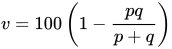
where the p and q are the decimal payouts for each outcome. This should not be confused with the percentage a bettor pays due to vigorish. No consistent definition of the percentage a bettor pays due to vigorish can be made without first defining the bettor's behavior under juiced odds and assuming a win-percentage for the bettor. These factors are discussed under the debate section.
For example, 1.90/2.00 pricing of an even match is 4.55% vigorish, and 1.95/1.95 pricing is 2.38% vigorish.
Vigorish percentage for three-way events may be calculated using the following formula:[5]
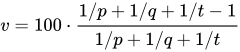
where p, q and t are the decimal payouts for each outcome. For comparison, for over round calculation only the upper part of the equation is used, leading to slightly higher percentage results than the vigorish calculation.
Other kinds of vigorish
[edit]Casino games
[edit]More generically, vigorish can refer to the bookmaker/casino's theoretical advantage from all possible wagers on any game they offer. The term may also refer, and be applied in specific ways, to particular casino games.
- Baccarat, in the house-banked version of baccarat (also mini-baccarat) commonly played in North American casinos, vigorish refers to the 5% commission (called the cagnotte) charged to players who win a bet on the banker hand. The rules of the game are structured so that the banker hand wins slightly more often than the player hand; the 5% vigorish restores the house advantage to the casino for both bets. In most casinos, a winning banker bet is paid at even money, with a running count of the commission owed kept by special markers in a commission box in front of the dealer. This commission must be paid when all the cards are dealt from the shoe or when the player leaves the game. Some casinos do not keep a running commission amount, and instead withdraw the commission directly from the winnings; a few require the commission to be posted along with the bet, in a separate space on the table.
- Backgammon, the recube vig is the value of having possession of the doubling cube to the player being offered a double.
- Craps, vigorish refers to the 5% commission charged on a buy bet, where a player wishes to bet that one of the numbers — 4, 5, 6, 8, 9 or 10 — will be rolled before a 7 is rolled. The commission is charged at the rate of $1 for every $20 bet. The bet is paid off at the true mathematical odds, but the 5% commission is paid as well, restoring the house advantage. For many years, this commission was paid whether the bet won or not. In recent years, many casinos have changed to charging the commission only when the bet wins, which greatly reduces the house advantage; for instance, the house advantage on a buy bet on the 4 or 10 is reduced from 5% to 1.67%, since the bet wins one-third of the time (2:1 odds against). In this case, the vig may be deducted from the winnings (for instance, a $20 bet on the 4 would be paid $39 – $40 at 2:1 odds, less the $1 commission), or the player may simply hand the commission in and receive the full payout. This rule is commonplace in Mississippi casinos, and becoming more widely available in Nevada.
- Roulette: odds are calculated out of 36 numbers, but the wheel has one or two extra pockets (zero and double zero).
- Slot machines - the payouts and winning combinations available on most slot machines and other electronic gambling systems are often designed such that an average of between 0.1% to 10% (varying by machine and facility) of funds taken in are not used to pay out winnings, and thus becomes the house's share. Machines or facilities with a particularly low percentage are often said to be loose.
- Poker
- In pai gow poker, a 5% commission charged on all winning bets is referred to as vigorish. Unlike baccarat, the commission is paid after each winning bet, either by the player handing in the amount from his stack of chips, or by having the vig deducted from the winnings.
- In table poker, the vigorish, more commonly called the rake, is a fraction of each bet placed into the pot. The dealer removes the rake from the pot after each bet (or betting round), making change if necessary. The winner of the hand gets the money that remains in the pot after the rake has been removed. Most casinos take 5-10% of the pot, typically capping the total rake at $3 or $4.
Other uses
[edit]- In investment banking, "vig" is sometimes used to describe profits from advisory and other activities.
- In sports, Pittsburgh Pirates announcer Bob Prince coined the term "hidden vigorish" to describe an underdog's ability to beat the odds in a given situation.
- The term is also used in reference to an auction house's buyers and sellers fees.
See also
[edit]- Loan shark
- Rake (poker)
- Market maker
- Bid–ask spread
- Spread betting including point spread
Notes
[edit]- ^ Much of the computation inherent to bookmaking is fractional, but frequently in print the decimal representations are used instead. This makes them easier to input into calculators and more agreeably format within any surrounding text. It is to be understood though that these fractions frequently result in a decimal repetend or infinitely repeating set of numbers somewhere to the right of the decimal point. For the sake of balancing clarity and accuracy, wherever possible this article will use a vinculum when there is a repetend, displaying the digits which infinitely repeat with an overline above them.
- ^ Betting lines offered as examples below represent the ratio of total payout (stake + winnings) to the original amount risked. In the case of a $1 wager, a fixed-odds betting line of 1.83/2.20 would result in actual winnings of $0.83 and $1.20 for the backers of the respective outcomes, once the original $1 spent to place the wager is subtracted. The amounts and currency used are irrelevant; the calculation is always: a wager of size n offers a total payout of n × the betting line.
References
[edit]- ^ "Definition of VIGORISH". www.merriam-webster.com. Retrieved 2019-06-03.
- ^ "Vigorish dictionary definition | The American Heritage® Dictionary of the English Language, Fifth Edition".
- ^ Moya, Fabián Enrique (2012-07-24). "Statistical Methodology for Profitable Sports Gambling" (PDF). www.stat.sfu.ca. p. 15. Archived (PDF) from the original on 2013-06-12. Retrieved 2019-06-02.
- ^ "A Refresher on Overround and Vig". Matter of Stats. 30 March 2017. Retrieved 2019-06-03.
- ^ "Profit margin calculator | Pinnacle". www.pinnacle.com. Retrieved 2019-06-03.
Vigorish
View on GrokipediaTerminology and Origins
Etymology
The term "vigorish" originates from Yiddish וויגריש (vigrish), a loanword borrowed from Russian вы́игрыш (výigryš), which translates to "winnings" or "gain."[9] This linguistic path reflects the influence of Eastern European immigrant languages on American slang, particularly in contexts involving profit or advantage.[10] The word entered English usage as slang in the early 20th century, with its first known attestation in 1912, in the writing of Alfred Henry Lewis, initially referring to a percentage returned to card players from their losses to encourage continued play.[11] It spread through American Jewish communities in urban centers and became associated with organized crime and gambling operations, where it denoted the fee or cut taken by bookmakers or houses.[12] Related terms include the shortened "vig," a direct abbreviation that gained popularity in mid-20th-century gambling vernacular. Synonyms such as "juice," derived from 1920s American underworld slang for illicit profit, and "take," an English term for the portion skimmed by operators, emerged alongside it but have distinct roots outside the Yiddish-Russian lineage.[11]Historical Development
The practice of bookmakers extracting a fee from wagers predates the formal term "vigorish," originating in 19th-century U.S. horse racing through parimutuel systems introduced at Jerome Park Racetrack in New York in 1872, where operators deducted approximately 10% from the total betting pool as a commission before distributing winnings.[13] This informal take ensured profitability for track operators and bookies amid widespread illegal betting, as antigambling laws proliferated in the late 1800s and early 1900s, nearly eradicating organized racing in many states.[13] In the early 20th century, vigorish emerged explicitly in U.S. bookmaking within illegal betting syndicates, often influenced by organized crime figures such as Meyer Lansky and Benjamin "Bugsy" Siegel, who from the 1910s onward controlled gambling operations including horse racing and sports wagers through groups like the Bugs and Meyer Mob, using the fee to secure steady profits amid enforcement crackdowns.[14] This era's underground culture was vividly captured in the 1910s–1920s literature of Damon Runyon, whose short stories portrayed Broadway gamblers, bookies, and their relentless pursuit of edges in a world dominated by illicit odds-making.[15] Bootleggers during Prohibition (1920–1933) further entrenched mob involvement in gambling, applying logistical expertise from liquor rackets to manage bookmaking networks in cities like New York, Chicago, and Florida, though their control varied regionally and did not uniformly dominate all operations.[16] Nevada's legalization of casino gambling in 1931, signed into law by Governor Fred B. Balzar, marked a pivotal formalization of vigorish in legal contexts, allowing regulated sportsbooks and bookmakers to openly incorporate the fee into operations at venues like those in Reno and Las Vegas, shifting some activity from mob-controlled shadows to state oversight.[17] By the 1950s, as illegal bookmaking persisted nationwide, the practice evolved toward standardized fixed percentages in modern sports books, particularly through innovations like the point spread system paired with an 11/10 odds structure that embedded a consistent vig for bookmaker profitability.[18] This standardization facilitated broader adoption, paving the way for global expansion in the 1970s–1980s as international sports wagering grew with regulatory changes in Europe and beyond, incorporating similar commission models into cross-border betting markets.[19]Core Mechanics
Definition and Purpose
Vigorish, commonly abbreviated as vig or referred to as juice, is the commission or fee imposed by bookmakers, casinos, or other gambling operators on wagers, functioning as the house edge to secure a mathematical advantage for the operator irrespective of the bet's outcome. In sports betting, it manifests as an adjustment to the odds offered, while in casino games, it is embedded in the rules and payouts of the games themselves, ensuring the house retains a portion of player stakes over numerous plays.[2][6][20] The core purpose of vigorish lies in risk management and profitability assurance for gambling operators, achieved by balancing opposing bets and incorporating an overround into the odds structure, where the total implied probabilities across all outcomes surpass 100%. This overround creates a systematic edge that allows operators to profit from the aggregate volume of wagers, even if individual results vary, thereby sustaining operations and mitigating exposure to losses.[5][2] Vigorish differs from pure odds, which represent unbiased probabilities of an event, by serving as a built-in margin rather than a direct tax or explicit charge on winnings. This integrated advantage ensures the operator's long-term gain without altering the fundamental event probabilities, distinguishing it as an essential component of the gambling ecosystem rather than an add-on fee.[5][2]Calculation Methods
Vigorish in two-outcome events, such as a simple win-lose bet, is calculated using the formula , where and represent the decimal odds for each outcome. This formula derives from the implied probabilities of the outcomes, where the implied probability for the first outcome is and for the second is . The sum of these implied probabilities exceeds 1 due to the bookmaker's margin, and the vigorish represents the proportion of total stakes retained by the bookmaker in a balanced book, equivalent to . For instance, with even implied odds adjusted to and (corresponding to American odds of approximately -110), the calculation yields .[21] For multi-outcome events, such as a three-way bet on a sports match (home win, draw, away win), the vigorish is generalized as , where , , and are the decimal odds for each outcome. The derivation begins with the implied probabilities , , and , whose sum incorporates the bookmaker's edge. The fair probabilities are obtained by normalizing: divide each implied probability by , ensuring they sum to 1. These normalized probabilities correspond to no-vig or fair odds, which remove the bookmaker's margin to reflect true probabilities, particularly relevant in sports betting contexts.[22] The vigorish then measures the discrepancy as , or equivalently the fraction , multiplied by 100 for percentage. This approach extends to any number of outcomes , using , where are the odds.[21] The overround provides an alternative perspective on vigorish, defined as the sum of the reciprocals of the odds minus 1, expressed as a percentage: . It quantifies the total excess implied probability beyond 100%, directly reflecting the bookmaker's built-in advantage before normalization. For example, fair odds of 2.00 for each side in a two-outcome event imply probabilities summing to 1 (50% each). To incorporate vigorish, these are adjusted downward to approximately 1.90/1.90, yielding an overround of . This adjustment ensures the bookmaker profits regardless of the outcome in a balanced book, with the overround serving as a key metric for market efficiency.[21][23]Applications in Gambling
Sports Betting
In sports betting, vigorish, often referred to as "vig" or "juice," represents the bookmaker's built-in commission on wagers, ensuring profitability regardless of the outcome when betting action is balanced across options. For standard point-spread or moneyline bets in major professional leagues, the most common format in the United States is the -110/-110 line, where bettors must risk $110 to win $100 on either side, embedding a 10% juice on the total amount wagered.[24] This structure allows the bookmaker to profit $10 from the $210 in total bets (including the winning payout) on balanced action, as the implied probabilities exceed 100% when normalized, creating an overround of approximately 4.76%.[25] When betting action becomes unbalanced due to public bias—such as heavy wagering on a popular team—bookmakers adjust the lines to encourage bets on the less-favored side, thereby restoring balance and mitigating risk exposure. For instance, if public sentiment skews heavily toward one outcome, the odds may shift to make the opposite side more attractive, effectively increasing the effective vig on the imbalanced side to protect the bookmaker's margin.[26] This dynamic line movement is a core risk-management strategy, allowing bookmakers to maximize profits from the vigorish while minimizing potential losses from lopsided outcomes.[27] Global variations in vigorish presentation reflect regional odds formats, with the U.S. American odds (-110/-110) contrasting European decimal odds (typically 1.91/1.91 for equivalent lines), where the latter implies a similar overround but calculates payouts as a multiple of the stake.[28] In professional sportsbooks, the average vigorish ranges from 4% to 10%, with sharper books like Pinnacle offering lower margins around 2% on liquid markets to attract volume, while softer books charge higher to account for recreational bettor behavior.[29] These differences influence bettor value, as lower-vig markets provide closer-to-fair odds and better long-term expected returns.[30] No-vig odds, also known as fair odds, refer to vigorish-free odds that remove the bookmaker's margin to reveal the true probabilities of outcomes in sports betting. This concept is essential for sharp bettors to evaluate the actual value of wagers by stripping away the built-in commission. To calculate no-vig probabilities, first convert the odds to implied probabilities—for -110 odds, this is approximately 52.4%. For a two-way market with both sides at -110, the total implied probability is 104.8%. Normalize by dividing each probability by the total and multiplying by 100%: (52.4% ÷ 104.8%) × 100% ≈ 50% for each side, indicating even true probabilities without the vig.[31][32]Casino Games
In casino games, vigorish is primarily manifested as the house edge, a built-in mathematical advantage ensuring the casino's long-term profitability, or as direct commissions collected from winning bets.[20] In table games like baccarat, the vigorish is often taken as a 5% commission on winning banker bets, resulting in a house edge of 1.06% for that wager despite the banker's slight probabilistic advantage in the game's drawing rules.[33] This commission adjusts the even-money payout to 0.95:1, balancing the edge while keeping the bet attractive.[34] Craps incorporates vigorish through payout structures that deviate from true odds; the pass line bet, which wins on a 7 or 11 come-out roll and establishes a point otherwise, pays even money but carries a house edge of 1.41% due to the 244/495 probability of losing against 251/495 for winning.[35] Taking free odds behind the pass line has no house edge, as it pays true odds (e.g., 2:1 on 4 or 10), but the overall edge on the combined bet remains tied to the initial pass line wager.[36] Poker, unlike player-versus-house games, generates vigorish via the rake, a fee collected by the casino from each pot in cash games, typically 5-10% up to a cap of 5 depending on stakes and venue.[37] In tournaments, the rake appears as an entry fee percentage (around 10%), deducted upfront to cover house operations while players compete against each other.[38] Slot machines embed vigorish within their return to player (RTP) rates, which average 92-96% in land-based casinos, implying a 4-8% house edge over millions of spins through programmed payout algorithms.[39] Video poker variants offer lower vigorish, with RTPs up to 99.5% (0.5% house edge) when using optimal strategy in full-pay games like 9/6 Jacks or Better.[20] Blackjack achieves its vigorish via rules favoring the dealer, such as acting last, yielding a house edge of 0.5-2% with basic strategy, depending on factors like deck count and payout for blackjack (3:2 versus 6:5).[40] Optimal play minimizes this by dictating decisions like hitting or standing based on the player's hand and dealer's upcard.[41]| Game/Bet | Vigorish Form | Typical House Edge | Source |
|---|---|---|---|
| Baccarat (Banker) | 5% Commission | 1.06% | PlaySmart.ca |
| Craps (Pass Line) | Payout Adjustment | 1.41% | Wizard of Odds |
| Poker (Cash Game Rake) | Pot Percentage | 5-10% (capped) | Casino.org |
| Slots | RTP Programming | 4-8% | Wizard of Odds |
| Video Poker (Full Pay) | RTP with Strategy | 0.5% | Wizard of Odds |
| Blackjack (Basic Strategy) | Rule Structure | 0.5-2% | Casino.org |
Variations and Extensions
Proportional vs. Disproportional Vigorish
In proportional vigorish, the bookmaker applies an equal margin to both sides of a balanced market, ensuring symmetry in the implied probabilities. For instance, fair odds of 2.00/2.00 (representing a 50% probability for each outcome) might be adjusted to 1.95/1.95, resulting in implied probabilities of approximately 51.28% each and a total overround of about 2.56%. This approach is common in theoretically fair, balanced markets where the goal is consistent profit regardless of betting volume distribution.[42] In contrast, disproportional vigorish involves uneven margins across outcomes, often placing a higher burden on the underdog or longshot side to exploit bettor preferences for higher payouts. An example is adjusting fair 2.00/2.00 odds to 2.00/1.95, yielding a total overround of around 2.56% with the heavier margin on the underdog (implied probability of 51.28% vs. 50%). This asymmetry aligns with the favorite-longshot bias, where bettors disproportionately wager on underdogs, allowing bookmakers to extract greater profits from overbet longshots.[42] Proportional vigorish promotes theoretical fairness by maintaining an equal house edge per unit wagered, which simplifies risk management in evenly matched contests and aligns with efficient market assumptions. However, it may yield lower overall profits if betting volumes skew heavily toward one side. Disproportional vigorish, while potentially less "fair," enhances practical profitability by capitalizing on behavioral biases, as evidenced in markets like soccer where actual loss rates (7.8%) exceed proportional overround predictions (6.5%), compared to tennis (7.5% vs. 5.4%). Bookmakers apply proportional structures more often in tennis for its balanced nature, whereas soccer frequently sees disproportional adjustments to manage lopsided public betting on underdogs.[42]Modern and Non-Gambling Contexts
In the realm of online gambling, vigorish has adapted to digital platforms, particularly in esports betting, where sportsbooks typically charge a commission ranging from 3% to 10% on wagers to ensure profitability regardless of outcomes.[43] This structure mirrors traditional sports betting but has proliferated since the 2010s with the expansion of mobile apps, exemplified by DraftKings, which transitioned from daily fantasy sports in 2012 to full online sportsbooks following the 2018 U.S. Supreme Court ruling legalizing statewide betting.[44] In cryptocurrency-enabled platforms, such as decentralized prediction markets, vigorish equivalents appear as lower trading or reporting fees, often below 5%, fostering peer-driven forecasting on blockchain networks like Ethereum without centralized intermediaries.[45] Beyond gambling, the term vigorish persists in non-traditional financial contexts, notably as slang for exorbitant interest rates imposed by loan sharks in illegal lending. These rates can reach 20% per week on outstanding principal, compounding rapidly and trapping borrowers in cycles of debt, as documented in historical organized crime investigations.[46] Such practices violate usury laws in most jurisdictions, where maximum legal rates typically cap at 10-25% annually, highlighting vigorish's role as a marker of predatory finance.[47] Emerging trends extend vigorish concepts to hybrid gaming and fintech applications, including fantasy sports platforms where operators collect a rake—equivalent to vigorish—from entry fees, commonly 10-15% of total prize pools to cover operational costs.[48] Peer-to-peer betting apps further innovate by minimizing traditional vig through transaction fees that are 50-90% lower than standard sportsbooks, enabling direct wagers between users with transparent, no-juice odds.[49] Post-2020 U.S. regulations have emphasized transparency in crypto gambling, with state-level amendments requiring clearer disclosure of fees and risks in digital asset transactions to protect consumers amid rising blockchain-based betting.[50]Theoretical and Practical Aspects
Theoretical Models
In theoretical models of vigorish, the balanced book theory posits that a bookmaker achieves a guaranteed profit by setting odds such that the total amount wagered on all possible outcomes is equalized, ensuring the payout liability matches the total handle minus the vigorish margin regardless of the event's result.[24] Under this model, the vigorish represents the overround, defined as the difference between the sum of implied probabilities from the odds and 100%, which translates to the bookmaker's expected profit per unit wagered.[21] For a two-outcome event with symmetric odds of -110 (implied probability of 52.38% each), the overround is approximately 4.76%, yielding a long-run expected value (EV) for bettors of -4.76% per wager, or EV = -vig percentage, assuming fair underlying probabilities.[24] Game theory extends this framework by modeling odds setting as a strategic interaction between the bookmaker and bettors, where the bookmaker seeks a Nash equilibrium to minimize risk exposure while extracting vigorish. In equilibrium, the bookmaker adjusts prices dynamically to balance betting intensities across outcomes, ensuring no unilateral deviation improves their position; for instance, using rate functions like , where is the price for outcome and is its probability, optimal prices maintain a balanced book and incorporate vigorish as the margin over fair odds.[51] This equilibrium minimizes variance in payouts, with the bookmaker's value function maximizing expected utility: , where risk is hedged through proportional adjustments.[51] In multi-outcome settings, repeated zero-sum games lead to equilibria where maximum loss per round equals the optimal opportunistic bookmaking loss, scaled by overround to embed vigorish.[52] For bettors, the Kelly criterion provides a strategy to overcome vigorish by sizing bets to maximize long-term growth when an edge exists over the implied probabilities. The optimal fraction of bankroll to wager is given by , where is the bettor's estimated probability of winning, and is the net odds (payout per unit stake, incorporating vigorish); this requires to yield positive EV, countering the negative expectation from the vig.[53] Partial Kelly adjustments, such as scaling by 0.5, further mitigate variance while preserving growth against the house edge.[53] These models assume infinite rational bettors with perfect information and no behavioral biases, leading to a perfectly balanced book where the bookmaker's long-run return equals the vigorish percentage, derived as the overround applied uniformly across wagers.[21] Under these conditions, the expected operator profit is per unit, confirming the vig as the sole source of return in equilibrium.[21]Real-World Considerations
In real-world sports betting, bettor behaviors often deviate from theoretical assumptions of balanced action, leading to practical adjustments in vigorish application. Public bettors tend to overbet favorites due to biases such as the reverse favorite-longshot effect, where they allocate disproportionately more wagers to perceived safer outcomes, necessitating higher vigorish on those sides to maintain bookmaker profitability and balance the book.[54][55] Conversely, sharp bettors—experienced professionals who identify inefficiencies—place targeted wagers that compel sportsbooks to adjust lines rapidly, effectively lowering the realized vigorish to 2-4% in competitive markets as books shade odds to limit exposure.[56][57] Operational challenges further complicate vigorish implementation beyond ideal models. In niche or low-volume markets, such as player props or obscure sports, limited liquidity increases risk for bookmakers, prompting them to impose vigorish rates up to 15-20% to cover potential imbalances from sparse betting action.[58] Regulatory environments also influence vigorish variability; in the UK, overrounds typically range from 105-110% in competitive markets, fostering tighter margins compared to the more permissive U.S. landscape, where vigorish can fluctuate widely by state and operator without uniform caps.[59][5] Empirical outcomes reveal the tangible impact of these factors on bookmaker performance. U.S. sportsbooks achieve an average annual hold— the percentage of total handle retained as profit—of approximately 9-10% as of 2025, reflecting a blend of public biases, sharp adjustments, market dynamics, and increased parlay betting that prevent theoretical maximums from materializing.[60][61][57] Since the 2018 U.S. Supreme Court decision legalizing statewide sports betting, intensified online competition has influenced vigorish; for instance, sharp-focused operators like Pinnacle maintain margins of 2-3%, contrasting with traditional books' 5-10% in less competitive segments, as lower transaction costs and broader access erode pricing power.[62][29][63]References
- https://en.wiktionary.org/wiki/vigorish