




Community hub
Recent from talks
Contribute something to knowledge base
Content stats: 0 posts, 0 articles, 1 media, 0 notes
Members stats: 0 subscribers, 0 contributors, 0 moderators, 0 supporters
Subscribers
Supporters
Contributors
Moderators
Parma wallaby
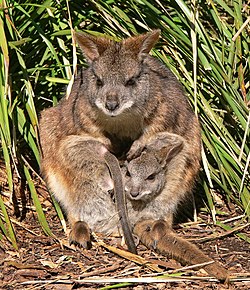
The parma wallaby (Notamacropus parma) is a small marsupial macropod mammal native to forests and densely-vegetated areas of northeastern New South Wales, Australia, close to the border with Queensland. An introduced population exists on New Zealand's Kawau Island. About the size of a stout cat, it lives mainly under thick plant cover, and is only active at night when it emerges to feed on grasses and small plants. It is the smallest of the wallabies (short, kangaroo-like marsupial mammals of the genus Notamacropus) and carries its young in a pouch, as with other marsupials. Shy and elusive, it was believed extinct until its rediscovery in the 1960s.
Parma wallabies are threatened by habitat loss, and, in addition to native predators (such as birds of prey, monitor lizards, and snakes), they are easily preyed upon by dingoes and non-native feral cats and red foxes.
The parma wallaby was first described by British naturalist John Gould in about 1840. Its epithet parma (Waterhouse 1845) comes after a word from a New South Wales Aboriginal language, but the exact source word and language have not been identified.
In 2019, a reassessment of macropod taxonomy determined that Osphranter and Notamacropus, formerly considered subgenera of Macropus, should be moved to the genus level. This change was accepted by the Australian Faunal Directory in 2020.
A shy cryptic creature of the wet sclerophyll forests of northern New South Wales (Australia), it was never commonly-encountered and, even before the end of the 19th century, it was believed to be extinct.
In 1965, workers on Kawau Island, New Zealand (near Auckland), trying to control a plague of introduced tammar wallabies (a widespread and fairly common species in Australia), were astonished to discover that some of the animals were not truly tammar wallabies, but a miraculously surviving population of parma wallabies - a species long-thought extinct. The extermination effort was put on-hold while individuals were captured and sent to institutions in Australia and around the world in the hope that they would breed in captivity and could eventually be reintroduced to their native habitat.
The renewed interest in the parma wallaby soon led to another milestone: in 1967 it was found that they still existed in the forests near Gosford, New South Wales. Further investigation showed that the parma wallaby was alive and well, and although not common, was to be found in forests along the Great Dividing Range from near Gosford almost as far north as the Queensland border.
The offspring of the Kawau Island population are smaller than their fully-wild, Australian relatives, even when provided with ample food; it appears that competition, for limited food resources on the island, selects for smaller individuals, an incipient example of the evolutionary phenomenon of insular dwarfism.
Parma wallaby
The parma wallaby (Notamacropus parma) is a small marsupial macropod mammal native to forests and densely-vegetated areas of northeastern New South Wales, Australia, close to the border with Queensland. An introduced population exists on New Zealand's Kawau Island. About the size of a stout cat, it lives mainly under thick plant cover, and is only active at night when it emerges to feed on grasses and small plants. It is the smallest of the wallabies (short, kangaroo-like marsupial mammals of the genus Notamacropus) and carries its young in a pouch, as with other marsupials. Shy and elusive, it was believed extinct until its rediscovery in the 1960s.
Parma wallabies are threatened by habitat loss, and, in addition to native predators (such as birds of prey, monitor lizards, and snakes), they are easily preyed upon by dingoes and non-native feral cats and red foxes.
The parma wallaby was first described by British naturalist John Gould in about 1840. Its epithet parma (Waterhouse 1845) comes after a word from a New South Wales Aboriginal language, but the exact source word and language have not been identified.
In 2019, a reassessment of macropod taxonomy determined that Osphranter and Notamacropus, formerly considered subgenera of Macropus, should be moved to the genus level. This change was accepted by the Australian Faunal Directory in 2020.
A shy cryptic creature of the wet sclerophyll forests of northern New South Wales (Australia), it was never commonly-encountered and, even before the end of the 19th century, it was believed to be extinct.
In 1965, workers on Kawau Island, New Zealand (near Auckland), trying to control a plague of introduced tammar wallabies (a widespread and fairly common species in Australia), were astonished to discover that some of the animals were not truly tammar wallabies, but a miraculously surviving population of parma wallabies - a species long-thought extinct. The extermination effort was put on-hold while individuals were captured and sent to institutions in Australia and around the world in the hope that they would breed in captivity and could eventually be reintroduced to their native habitat.
The renewed interest in the parma wallaby soon led to another milestone: in 1967 it was found that they still existed in the forests near Gosford, New South Wales. Further investigation showed that the parma wallaby was alive and well, and although not common, was to be found in forests along the Great Dividing Range from near Gosford almost as far north as the Queensland border.
The offspring of the Kawau Island population are smaller than their fully-wild, Australian relatives, even when provided with ample food; it appears that competition, for limited food resources on the island, selects for smaller individuals, an incipient example of the evolutionary phenomenon of insular dwarfism.
Recent media
Recent media