
Recent from talks
Particle horizon
Knowledge base stats:
Talk channels stats:
Members stats:
Particle horizon
The particle horizon (also called the cosmological horizon, the comoving horizon (in Scott Dodelson's text), or the cosmic light horizon) is the maximum distance from which light from particles could have traveled to the observer in the age of the universe. Much like the concept of a terrestrial horizon, it represents the boundary between the observable and the unobservable regions of the universe, so its distance at the present epoch defines the size of the observable universe. Due to the expansion of the universe, it is not simply the age of the universe times the speed of light (approximately 13.8 billion light-years), but rather the speed of light times the conformal time. The existence, properties, and significance of a cosmological horizon depend on the particular cosmological model.
The particle horizon is a distance in a comoving coordinate system, a system that has the expansion of the universe built-in. The expansion is defined by a (dimensionless) scale factor set to have a value of one today. The time that light takes to travel a distance dx in the comoving coordinate system will be in units of light years (). The total distance light can travel in the time t since the Big Bang at sums all the incremental distances:


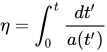
The comoving horizon increases monotonically and thus can be used a time parameter: the particle horizon is equal to the conformal time that has passed since the Big Bang, times the speed of light .


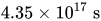
By convention, a subscript 0 indicates "today" so that the conformal time today . Note that the conformal time is not the age of the universe as generally understood. That age refers instead to a time as defined by the Robertson-Walker form of the cosmological metric, which time is presumed to be measured by a traditional clock and estimated to be around . By contrast is the age of the universe as measured by a Marzke-Wheeler "light clock".


The particle horizon recedes constantly as time passes and the conformal time grows. As such, the observed size of the universe always increases. Since proper distance at a given time is just comoving distance times the scale factor (with comoving distance normally defined to be equal to proper distance at the present time, so at present), the proper distance, to the particle horizon at time is given by


The value of the distance to the horizon depends on details in .
Hub AI
Particle horizon AI simulator
(@Particle horizon_simulator)
Particle horizon
The particle horizon (also called the cosmological horizon, the comoving horizon (in Scott Dodelson's text), or the cosmic light horizon) is the maximum distance from which light from particles could have traveled to the observer in the age of the universe. Much like the concept of a terrestrial horizon, it represents the boundary between the observable and the unobservable regions of the universe, so its distance at the present epoch defines the size of the observable universe. Due to the expansion of the universe, it is not simply the age of the universe times the speed of light (approximately 13.8 billion light-years), but rather the speed of light times the conformal time. The existence, properties, and significance of a cosmological horizon depend on the particular cosmological model.
The particle horizon is a distance in a comoving coordinate system, a system that has the expansion of the universe built-in. The expansion is defined by a (dimensionless) scale factor set to have a value of one today. The time that light takes to travel a distance dx in the comoving coordinate system will be in units of light years (). The total distance light can travel in the time t since the Big Bang at sums all the incremental distances:
The comoving horizon increases monotonically and thus can be used a time parameter: the particle horizon is equal to the conformal time that has passed since the Big Bang, times the speed of light .
By convention, a subscript 0 indicates "today" so that the conformal time today . Note that the conformal time is not the age of the universe as generally understood. That age refers instead to a time as defined by the Robertson-Walker form of the cosmological metric, which time is presumed to be measured by a traditional clock and estimated to be around . By contrast is the age of the universe as measured by a Marzke-Wheeler "light clock".
The particle horizon recedes constantly as time passes and the conformal time grows. As such, the observed size of the universe always increases. Since proper distance at a given time is just comoving distance times the scale factor (with comoving distance normally defined to be equal to proper distance at the present time, so at present), the proper distance, to the particle horizon at time is given by
The value of the distance to the horizon depends on details in .