
Recent from talks
1954 Geneva Conference
Knowledge base stats:
Talk channels stats:
Members stats:
1954 Geneva Conference
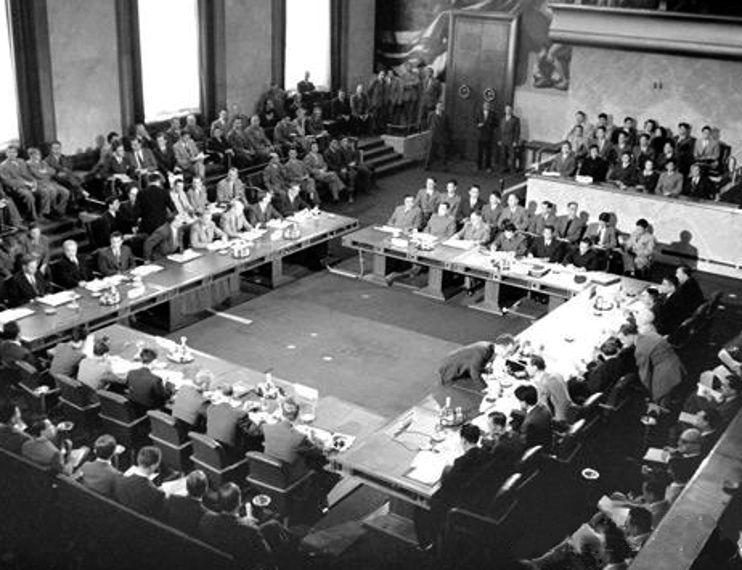
The Geneva Conference was intended to settle outstanding issues resulting from the Korean War and the First Indochina War and involved several nations. It took place in Geneva, Switzerland, from 26 April to 21 July 1954. The part of the conference on the Korean question ended without adopting any declarations or proposals and so is generally considered less relevant. On the other hand, the Geneva Accords that dealt with the dismantling of French Indochina proved to have long-lasting repercussions.
Diplomats from South Korea, North Korea, China, the Soviet Union, and the United States dealt with the Korean side of the conference. On the Indochina issue, the conference involved representatives from France, China, the Soviet Union, the United States, the United Kingdom, the Democratic Republic of Vietnam, the State of Vietnam, Laos, and Cambodia. Three binding ceasefire agreements about Indochina ended hostilities in Vietnam, Laos, and Cambodia. The Pathet Lao were confined to two provinces in northern Laos, and Khmer Issarak forces disbanded. Vietnam was provisionally partitioned at the 17th parallel, with troops and personnel of the Democratic Republic of Vietnam regrouping to the North, and those of the French Union (including the State of Vietnam) regrouping to the South. Alongside them, a non‑legally binding Final Declaration called for international supervision (via the International Control Commission), prohibited the introduction of foreign troops and bases in Vietnam, affirmed that the 17th parallel was only a provisional demarcation, and scheduled national elections for 1956. Worsening relations between the North and South would eventually lead to the Vietnam War.
On 18 February 1954, at the Berlin Conference, participants agreed that "the problem of restoring peace in Indochina will also be discussed at the Conference [on the Korean question] to which representatives of the United States, France, the United Kingdom, the Union of Soviet Socialist Republics and the Chinese People's Republic and other interested states will be invited."
The conference was held at the Palace of Nations in Geneva, commencing on 26 April 1954. The first agenda item was the Korean question to be followed by Indochina.
"China's belligerent policies in Korea and Indochina", coupled with their increasing diplomatic closeness to the Soviet Union, would actively make China's international presence rather isolated. Fearing further isolation from the emerging de-colonized world, and also a possible American intervention into Indochina, the PRC's Foreign Affairs Ministry (led by Zhou Enlai) would go into the conference with the key objective of breaking the US embargo of China and preventing American military intervention. Moreover, Zhou also stressed adopting a more "realistic" and moderate attitude which could deliver tangible results to the Indochina problem.
The armistice signed at the end of the Korean War required a political conference within three months—a timeline which was not met—"to settle through negotiation the questions of the withdrawal of all foreign forces from Korea, the peaceful settlement of the Korean question, etc."
As decolonization took place in Asia, France had to relinquish its power over Indochina (Laos, Cambodia, and Vietnam). While Laos and Cambodia were both given independence, France chose to stay in Vietnam. This ended with a war between French troops and the Vietnamese nationalists led by Ho Chi Minh. The latter's army, the Viet Minh, fought a guerrilla war against the French, who relied on Western technology. After a series of offensives, gradually whittling away at French held territory between 1950 and 1954, hostilities culminated in a decisive defeat for the French at the Battle of Dien Bien Phu. This resulted in a French withdrawal and the Geneva conference.
It was decided that Vietnam would be divided at the 17th parallel until 1956 when democratic elections would be held under international supervision and auspices. All parties involved agreed to this (Ho Chi Minh had strong support in the north, which was more populous than the south, and was thus confident that he would win an election), except for the U.S., which, in the spirit of the Cold War, feared seeing communism spreading in a domino effect throughout Asia as written in a National Intelligence Estimate dated 3 August 1954.
Hub AI
1954 Geneva Conference AI simulator
(@1954 Geneva Conference_simulator)
1954 Geneva Conference
The Geneva Conference was intended to settle outstanding issues resulting from the Korean War and the First Indochina War and involved several nations. It took place in Geneva, Switzerland, from 26 April to 21 July 1954. The part of the conference on the Korean question ended without adopting any declarations or proposals and so is generally considered less relevant. On the other hand, the Geneva Accords that dealt with the dismantling of French Indochina proved to have long-lasting repercussions.
Diplomats from South Korea, North Korea, China, the Soviet Union, and the United States dealt with the Korean side of the conference. On the Indochina issue, the conference involved representatives from France, China, the Soviet Union, the United States, the United Kingdom, the Democratic Republic of Vietnam, the State of Vietnam, Laos, and Cambodia. Three binding ceasefire agreements about Indochina ended hostilities in Vietnam, Laos, and Cambodia. The Pathet Lao were confined to two provinces in northern Laos, and Khmer Issarak forces disbanded. Vietnam was provisionally partitioned at the 17th parallel, with troops and personnel of the Democratic Republic of Vietnam regrouping to the North, and those of the French Union (including the State of Vietnam) regrouping to the South. Alongside them, a non‑legally binding Final Declaration called for international supervision (via the International Control Commission), prohibited the introduction of foreign troops and bases in Vietnam, affirmed that the 17th parallel was only a provisional demarcation, and scheduled national elections for 1956. Worsening relations between the North and South would eventually lead to the Vietnam War.
On 18 February 1954, at the Berlin Conference, participants agreed that "the problem of restoring peace in Indochina will also be discussed at the Conference [on the Korean question] to which representatives of the United States, France, the United Kingdom, the Union of Soviet Socialist Republics and the Chinese People's Republic and other interested states will be invited."
The conference was held at the Palace of Nations in Geneva, commencing on 26 April 1954. The first agenda item was the Korean question to be followed by Indochina.
"China's belligerent policies in Korea and Indochina", coupled with their increasing diplomatic closeness to the Soviet Union, would actively make China's international presence rather isolated. Fearing further isolation from the emerging de-colonized world, and also a possible American intervention into Indochina, the PRC's Foreign Affairs Ministry (led by Zhou Enlai) would go into the conference with the key objective of breaking the US embargo of China and preventing American military intervention. Moreover, Zhou also stressed adopting a more "realistic" and moderate attitude which could deliver tangible results to the Indochina problem.
The armistice signed at the end of the Korean War required a political conference within three months—a timeline which was not met—"to settle through negotiation the questions of the withdrawal of all foreign forces from Korea, the peaceful settlement of the Korean question, etc."
As decolonization took place in Asia, France had to relinquish its power over Indochina (Laos, Cambodia, and Vietnam). While Laos and Cambodia were both given independence, France chose to stay in Vietnam. This ended with a war between French troops and the Vietnamese nationalists led by Ho Chi Minh. The latter's army, the Viet Minh, fought a guerrilla war against the French, who relied on Western technology. After a series of offensives, gradually whittling away at French held territory between 1950 and 1954, hostilities culminated in a decisive defeat for the French at the Battle of Dien Bien Phu. This resulted in a French withdrawal and the Geneva conference.
It was decided that Vietnam would be divided at the 17th parallel until 1956 when democratic elections would be held under international supervision and auspices. All parties involved agreed to this (Ho Chi Minh had strong support in the north, which was more populous than the south, and was thus confident that he would win an election), except for the U.S., which, in the spirit of the Cold War, feared seeing communism spreading in a domino effect throughout Asia as written in a National Intelligence Estimate dated 3 August 1954.
Recent media