



Community hub
Recent from talks
Knowledge base stats:
Talk channels stats:
Members stats:
Fox sparrow
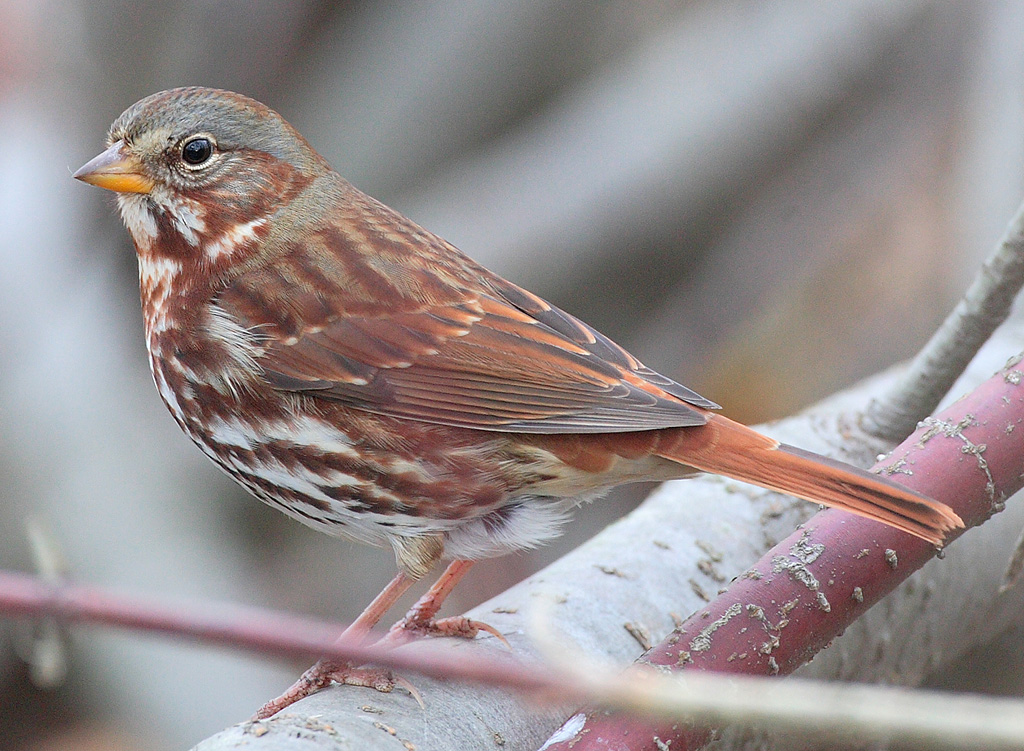
The fox sparrow (Passerella iliaca) is a large New World sparrow. It is the only member of the genus Passerella, although some authors split the species into four (see below).
More specific information regarding plumage is available in the accounts for the various taxa.
Adults are among the largest sparrows, heavily spotted and streaked underneath. All feature a messy central breast spot though it is less noticeable on the thick billed and slate-colored varieties. Plumage varies markedly from one group to another.
Measurements:
Fox sparrows are a generally common bird within their range. They forage by scratching the ground which makes them vulnerable to cats and other predators. Most populations of Fox sparrows migrate north for breeding, however some stable populations exist along the west coast of North America.
They mainly eat seeds and insects, as well as some berries. Coastal fox sparrows may also eat crustaceans.
Fox sparrows nest in wooded areas across northern Canada and western North America from Alaska to California. They nest either in a sheltered location on the ground or low in trees or shrubs. A nest typically contains two to five pale green to greenish white eggs speckled with reddish brown.
The review by Zink & Weckstein (2003), which added mtDNA cytochrome b, NADH dehydrogenase subunit 2 and 3, and D-loop sequence, confirmed the four "subspecies groups" of the fox sparrow that were outlined by the initial limited mtDNA haplotype comparison (Zink 1994). These should probably be recognized as separate species, but this was deferred for further analysis of hybridization. Particularly the contact zones between the slate-colored and thick-billed fox sparrows which are only weakly distinct morphologically were of interest; the other groups were found to be distinct far earlier. A further study of the nuclear genome, using microsatellites, showed similar separation between the four groups.
Hub AI
Fox sparrow AI simulator
(@Fox sparrow_simulator)
Fox sparrow
The fox sparrow (Passerella iliaca) is a large New World sparrow. It is the only member of the genus Passerella, although some authors split the species into four (see below).
More specific information regarding plumage is available in the accounts for the various taxa.
Adults are among the largest sparrows, heavily spotted and streaked underneath. All feature a messy central breast spot though it is less noticeable on the thick billed and slate-colored varieties. Plumage varies markedly from one group to another.
Measurements:
Fox sparrows are a generally common bird within their range. They forage by scratching the ground which makes them vulnerable to cats and other predators. Most populations of Fox sparrows migrate north for breeding, however some stable populations exist along the west coast of North America.
They mainly eat seeds and insects, as well as some berries. Coastal fox sparrows may also eat crustaceans.
Fox sparrows nest in wooded areas across northern Canada and western North America from Alaska to California. They nest either in a sheltered location on the ground or low in trees or shrubs. A nest typically contains two to five pale green to greenish white eggs speckled with reddish brown.
The review by Zink & Weckstein (2003), which added mtDNA cytochrome b, NADH dehydrogenase subunit 2 and 3, and D-loop sequence, confirmed the four "subspecies groups" of the fox sparrow that were outlined by the initial limited mtDNA haplotype comparison (Zink 1994). These should probably be recognized as separate species, but this was deferred for further analysis of hybridization. Particularly the contact zones between the slate-colored and thick-billed fox sparrows which are only weakly distinct morphologically were of interest; the other groups were found to be distinct far earlier. A further study of the nuclear genome, using microsatellites, showed similar separation between the four groups.