Hubbry Logo
Pat NixonPat NixonMain
Open search
Pat Nixon
Community hub
Pat Nixon
logo
8 pages, 0 posts
0 subscribers
Be the first to start a discussion here.
Pat Nixon
Pat Nixon
from Wikipedia

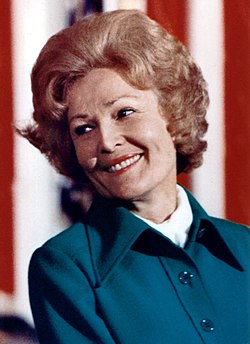
Thelma Catherine "Pat" Nixon (née Ryan; March 16, 1912 – June 22, 1993) was the first lady of the United States from 1969 to 1974 as the wife of President Richard Nixon. She also served as the second lady of the United States from 1953 to 1961 when her husband was vice president.

Key Information

Born in Ely, Nevada, she grew up with her two brothers in Artesia, California, graduating from Excelsior Union High School in Norwalk, California, in 1929. She attended Fullerton Junior College and later the University of Southern California. She paid for her schooling by working multiple jobs, including pharmacy manager, typist, radiographer, and retail clerk. In 1940, she married lawyer Richard Nixon and they had two daughters, Tricia and Julie. Dubbed the "Nixon team", Richard and Pat Nixon campaigned together in his successful congressional campaigns of 1946 and 1948. Richard Nixon was elected vice president in 1952 alongside General Dwight D. Eisenhower, whereupon Pat became second lady. Pat Nixon did much to add substance to the role, insisting on visiting schools, orphanages, hospitals, and village markets as she undertook many missions of goodwill across the world.

As first lady, Pat Nixon promoted a number of charitable causes, including volunteerism. She oversaw the collection of more than 600 pieces of historic art and furnishings for the White House, an acquisition larger than that of any other administration. She was the most traveled first lady in U.S. history, a record unsurpassed until 25 years later. She accompanied the president as the first first lady to visit China and the Soviet Union, and was the first president's wife to be officially designated a representative of the United States on her solo trips to Africa and South America, which gained her recognition as "Madame Ambassador"; she was also the first first lady to enter a combat zone. Though her husband was re-elected in a landslide victory in 1972, her tenure as first lady ended two years later, when President Nixon resigned amid the Watergate scandal.

Her public appearances became increasingly rare later in life. She and her husband settled in San Clemente, California, and later moved to New Jersey. She suffered two strokes, one in 1976 and another in 1983, and was diagnosed with lung cancer in 1992. She died in 1993, aged 81.

Early life

[edit]

Thelma Catherine Ryan was born in 1912 in the small mining town of Ely, Nevada.[1] Her father, William M. Ryan Sr., was a sailor, gold miner, and truck farmer of Irish ancestry; her mother, Katherine Halberstadt, was a German immigrant.[1] The nickname "Pat" was given to her by her father, because of her birth on the day before Saint Patrick's Day and her Irish ancestry.[1] When she enrolled in college in 1931 she started using the name "Pat" (and occasionally "Patricia") instead of "Thelma" but she did not legally change her name.[2][3]

After her birth, the Ryan family moved to California, and in 1914 settled on a small truck farm in Artesia (present-day Cerritos).[4] Thelma Ryan's high school yearbook page gives her nickname as "Buddy" and her ambition to run a boarding house.[5]

She worked on the family farm and also at a local bank as a janitor and bookkeeper. Her mother died of cancer in 1924.[6] Pat, who was only 12, assumed all the household duties for her father (who died himself of silicosis 5 years later) and her two older brothers, William Jr. (1910–1997) and Thomas (1911–1992). She also had a half-sister, Neva Bender (1909–1981), and a half-brother, Matthew Bender (1907–1973), from her mother's first marriage;[1] her mother's first husband had died during a flash flood in South Dakota.[1]

Education and career

[edit]

After graduating from Excelsior High School in 1929, she attended Fullerton College. She paid for her education by working odd jobs, including as a driver, a pharmacy manager, a telephone operator, and a typist.[1][7] She also earned money sweeping the floors of a local bank,[1] and from 1930 until 1931, she lived in New York City, working as a secretary and also as a radiographer.[6]

Determined "to make something out of myself",[8] she enrolled in 1931 at the University of Southern California (USC), where she majored in merchandising. A former professor noted that she "stood out from the empty-headed, overdressed little sorority girls of that era like a good piece of literature on a shelf of cheap paperbacks".[9] She held part-time jobs on campus, worked as a sales clerk in Bullock's-Wilshire department store,[10] and taught touch typing and shorthand at a high school.[6] She also supplemented her income by working as an extra and bit player in the film industry,[11][12] for which she took several screen tests.[13] In this capacity, she made brief appearances in films such as Becky Sharp (1935), The Great Ziegfeld (1936), and Small Town Girl (1936).[13][14] In some cases she ended up on the cutting room floor, such as with her spoken lines in Becky Sharp.[13][15] She told Hollywood columnist Erskine Johnson in 1959 that her time in films was "too fleeting even for recollections embellished by the years" and that "my choice of a career was teaching school and the many jobs I pursued were merely to help with college expenses."[15] During the 1968 presidential campaign, she explained to the writer Gloria Steinem, "I never had time to think about things like... who I wanted to be, or who I admired, or to have ideas. I never had time to dream about being anyone else. I had to work."[16]

In 1937, Pat Ryan graduated cum laude from USC with a Bachelor of Science degree in merchandising,[1] together with a certificate to teach at the high school level, which USC deemed equivalent to a master's degree.[17] Pat accepted a position as a high school teacher at Whittier Union High School in Whittier, California.[11]

Marriage and family, early campaigns

[edit]

While in Whittier, Pat Ryan met Richard Nixon, a young lawyer who had recently graduated from the Duke University School of Law. The two became acquainted at a Little Theater group when they were cast together in The Dark Tower.[6] Known as Dick, he asked Pat to marry him the first night they went out. "I thought he was nuts or something!" she recalled.[18] He courted the redhead he called his "wild Irish Gypsy" for two years,[19] even driving her to and from her dates with other men.[8]

They eventually married on June 21, 1940, at the Mission Inn in Riverside, California.[20] She said that she had been attracted to the young Nixon because he "was going places, he was vital and ambitious ... he was always doing things".[8] Later, referring to Richard Nixon, she said, "Oh but you just don't realize how much fun he is! He's just so much fun!" Following a brief honeymoon in Mexico, the two lived in a small apartment in Whittier.[20] As U.S. involvement in World War II began, the couple moved to Washington, D.C., with Richard taking a position as a lawyer for the Office of Price Administration (OPA); Pat worked as a secretary for the American Red Cross, but also qualified as a price analyst for the OPA.[20] He then joined the United States Navy as a commissioned officer and, while he was stationed in San Francisco, she resumed work for the OPA as an economic analyst.[20]

Veteran UPI reporter Helen Thomas suggested that in public, the Nixons "moved through life ritualistically", but privately, however, they were "very close".[21] In private, Richard Nixon was described as being "unabashedly sentimental", often praising Pat for her work, remembering anniversaries and surprising her with frequent gifts.[21] During state dinners, he ordered the protocol changed so that Pat could be served first.[22] Pat, in turn, felt that her husband was vulnerable and sought to protect him, although she did have a nickname for him which he despised, so she rarely used it: "Little Dicky".[22] Of his critics, she said that "Lincoln had worse critics. He was big enough not to let it bother him. That's the way my husband is."[22]

Pat campaigned at her husband's side in 1946 when he entered politics and successfully ran for a seat in the United States House of Representatives. That same year, she gave birth to a daughter and namesake, Patricia, known as Tricia. In 1948, Pat had the couple's second and last child, Julie. When asked about her husband's career, Pat once stated, "The only thing I could do was help him, but [politics] was not a life I would have chosen."[23] Pat participated in the campaign by doing research on his opponent, incumbent Jerry Voorhis.[1] She also wrote and distributed campaign literature.[24] Nixon was elected in his first campaign to represent California's 12th congressional district. During the next six years, Pat saw her husband move from the U.S. House of Representatives to the United States Senate, and then be nominated as Dwight D. Eisenhower's vice presidential candidate.

Although Pat Nixon was a Methodist, she and her husband attended whichever Protestant church was nearest to their home, especially after moving to Washington. They attended the Metropolitan Memorial Methodist Church because it sponsored her daughters' Brownie troop, occasional Baptist services with Billy Graham, and Norman Vincent Peale's Marble Collegiate Church.[25]

Second Lady of the United States, 1953–1961

[edit]
Vice President and Pat Nixon during a visit to Ghana, 1957

At the time of her husband coming under consideration for the vice presidential nomination, Pat Nixon was against her husband accepting the selection, as she despised campaigns and had been relieved that as a newly elected senator he would not have another one for six years.[26] She thought she had prevailed in convincing him, until she heard the announcement of the pick from a news bulletin while at the 1952 Republican National Convention.[26] During the presidential campaign of 1952, Pat Nixon's attitude toward politics changed when her husband was accused of accepting illegal campaign contributions. Pat encouraged him to fight the charges, and he did so by delivering the famed "Checkers speech", so-called for the family's dog, a cocker spaniel given to them by a political supporter. This was Pat's first national television appearance, and she, her daughters, and the dog were featured prominently. Defending himself as a man of the people, Nixon stressed his wife's abilities as a stenographer,[16] then said, "I should say this, that Pat doesn't have a mink coat. But she does have a respectable Republican cloth coat, and I always tell her she would look good in anything."[27][28]

Pat Nixon accompanied her husband abroad during his vice presidential years. She traveled to 53 nations, often bypassing luncheons and teas and instead visiting hospitals, orphanages, and even a leper colony in Panama.[1] On a trip to Venezuela, crowds pelted the Nixons' limousine with rocks and spit on the couple for being representatives of the U.S. government.[9]

A November 1, 1958, article in The Seattle Times was typical of the media's favorable coverage of the future first lady, stating that "Mrs. Nixon is always reported to be gracious and friendly. And she sure is friendly. She greets a stranger as a friend. She doesn't just shake hands but clasps a visitor's hand in both her hands. Her manner is direct ... Mrs. Nixon also upheld her reputation of always looking neat, no matter how long her day has been." A year and a half later, during her husband's campaign for the presidency, The New York Times called her "a paragon of wifely virtues" whose "efficiency makes other women feel slothful and untalented".[29]

Pat Nixon was named Outstanding Homemaker of the Year (1953), Mother of the Year (1955), and the Nation's Ideal Housewife (1957). She once said that, on a rare evening to herself, she pressed all of her husband's suits, adding, "Of course, I didn't have to. But when I don't have work to do, I just think up some new project."[8]

Her husband's campaigns—1960, 1962 and 1968

[edit]

In the 1960 election, Vice President Nixon ran for president of the United States against Democratic opponent Senator John F. Kennedy. Pat was featured prominently in the effort; an entire advertising campaign was built around the slogan "Pat for First Lady".[1] Nixon conceded the election to Kennedy, although the race was very close and there were allegations of voter fraud. Pat had urged her husband to demand a recount of votes, though Nixon declined.[30] Pat was most upset about the television cameras, which recorded her reaction when her husband lost—"millions of television viewers witnessed her desperate fight to hold a smile upon her lips as her face came apart and the bitter tears flowed from her eyes", as one reporter put it.[8] This permanently dimmed Pat Nixon's view of politics.[1]

In 1962, the Nixons embarked on another campaign, this time for Governor of California. Prior to Richard Nixon's announcement of his candidacy, Pat's brother Tom Ryan said, "Pat told me that if Dick ran for governor she was going to take her shoe to him."[31] She eventually agreed to another run, citing that it meant a great deal to her husband,[31] but Richard Nixon lost the gubernatorial election to Pat Brown.

Six years later, Richard Nixon ran again for the presidency. Pat was reluctant to face another campaign, her eighth since 1946.[32] Her husband was a deeply controversial figure in American politics,[33] and Pat had witnessed and shared the praise and vilification he had received without having established an independent public identity for herself.[16] Although she supported him in his career, she feared another "1960", when Nixon lost to Kennedy.[32] She consented, however, and participated in the campaign by traveling on campaign trips with her husband.[34] Richard Nixon made a political comeback with his narrow presidential victory of 1968 over Vice-President Hubert Humphrey—and the country had a new First Lady.

First Lady of the United States, 1969–1974

[edit]

Major initiatives

[edit]

Pat Nixon felt that the First Lady should always set a public example of high virtue as a symbol of dignity, but she refused to revel in the trappings of the position.[35] When considering ideas for a project as First Lady, Pat refused to do (or be) something simply to emulate her predecessor, Lady Bird Johnson.[36] She decided to continue what she called "personal diplomacy", which meant traveling and visiting people in other states or other nations.[37]

Pat Nixon greets young White House visitors, 1969

One of her major initiatives as First Lady was the promotion of volunteerism, in which she encouraged Americans to address social problems at the local level through volunteering at hospitals, civic organizations, and rehabilitation centers.[38] She stated, "Our success as a nation depends on our willingness to give generously of ourselves for the welfare and enrichment of the lives of others."[39] She undertook a "Vest Pockets for Volunteerism" trip, where she visited ten different volunteer programs.[39] Susan Porter, in charge of the First Lady's scheduling, noted that Pat "saw volunteers as unsung heroes who hadn't been encouraged or given credit for their sacrifices and who needed to be".[39] Her second volunteerism tour—she traveled 4,130 miles (6,647 km) within the United States—helped to boost the notion that not all students were protesting the Vietnam War.[40] She herself belonged to several volunteer groups, including Women in Community Services and Urban Services League,[39] and was an advocate of the Domestic Volunteer Service Act of 1973,[1] a bill that encouraged volunteerism by providing benefits to a number of volunteer organizations.[41] Some reporters viewed her choice of volunteerism as safe and dull compared to the initiatives undertaken by Lady Bird Johnson and Jacqueline Kennedy.[42]

Pat Nixon became involved in the development of recreation areas and parkland, was a member of the President's Committee on Employment of the Handicapped, and lent her support to organizations dedicated to improving the lives of handicapped children.[1] For her first Thanksgiving in the White House, Pat organized a meal for 225 senior citizens who did not have families.[43] The following year, she invited wounded servicemen to a second annual Thanksgiving meal in the White House.[43] Though presidents since George Washington had been issuing Thanksgiving proclamations, Pat became the only First Lady to issue one.[43]

Life in the White House

[edit]
The First Lady with Queen Elizabeth II, 1970
Nixon with Canadian First Lady Margaret Trudeau holding a baby Justin Trudeau, April 1972

After her husband was elected president in 1968, Pat Nixon met with the outgoing First Lady, Lady Bird Johnson. Together, they toured the private quarters of the White House on December 12.[44] She eventually asked Sarah Jackson Doyle, an interior decorator who had worked for the Nixons since 1965 and who decorated the family's 10-room apartment on Fifth Avenue in New York with French and English antiques, to serve as a design consultant.[45] She hired Clement Conger from the State Department to be the Executive Mansion's new curator, replacing James Ketchum, who had been hired by Jacqueline Kennedy.[46]

Pat Nixon greets well-wishers on a trip to Hawaii, 1972

Pat Nixon developed and led a coordinated effort to improve the authenticity of the White House as an historic residence and museum. She added more than 600 paintings, antiques and furnishings to the Executive Mansion and its collections, the largest number of acquisitions by any administration;[1] this greatly, and dramatically, expanded upon Jacqueline Kennedy's more publicized efforts. She created the Map Room and renovated the China room, and refurbished nine other rooms, including the Red Room, Blue Room and Green Room.[47] She worked with engineers to develop an exterior lighting system for the entire White House, making it glow a soft white.[47] She ordered the American flag atop the White House flown day and night, even when the president was not in residence.[47]

She ordered pamphlets describing the rooms of the house for tourists so they could understand everything, and had them translated into Spanish, French, Italian and Russian for foreigners.[47] She had ramps installed for the handicapped and physically disabled. She instructed the police who served as tour guides to attend sessions at the Winterthur Museum, Garden and Library (to learn how tours were guided "in a real museum"),[47] and arranged for them to wear less menacing uniforms, with their guns hidden underneath.[47] The tour guides were to speak slowly to deaf groups, to help those who lip-read, and Pat ordered that the blind be able to touch the antiques.[47]

Pat addresses the 1972 Republican National Convention. She was the first First Lady since Eleanor Roosevelt to address a party convention, and the first Republican First Lady to do so.

The First Lady had long been irritated by the perception that the White House and access to the President and First Lady were exclusively for the wealthy and famous;[47] she routinely came down from the family quarters to greet tourists, shake hands, sign autographs, and pose for photos.[48] Her daughter Julie Eisenhower reflected, "she invited so many groups to the White House to give them recognition, not famous ones, but little-known organizations..."[49]

She invited former First Lady Jacqueline Kennedy and her children Caroline and John Jr. to dine with her family and view the White House's official portraits of her and her husband, the late President Kennedy.[50] It was the first time that the three Kennedys had returned to the White House since the president's assassination eight years earlier.[51][52] Pat had ordered the visit to be kept secret from the media until after the trip's conclusion in an attempt to maintain privacy for the Kennedys. She also invited President Kennedy's mother Rose Kennedy to see her son's official portrait.[50]

Pat Nixon with White House curator Clement Conger, whom she hired, in the Red Room after her redecorations, 1971

She opened the White House for evening tours so that the public could see the interior design work that had been implemented. The tours that were conducted in December displayed the White House's Christmas decor. In addition, she instituted a series of performances by artists at the White House in varied American traditions, from opera to bluegrass; among the guests were The Carpenters in 1972. These events were described as ranging from "creative to indifferent, to downright embarrassing".[8] When they entered the White House in 1969, the Nixons began inviting families to non-denominational Sunday church services in the East Room of the White House.[47] She also oversaw the White House wedding of her daughter, Tricia, to Edward Ridley Finch Cox in 1971.[53]

In October 1969, she announced her appointment of Constance Stuart as her staff director and press secretary.[54] To the White House residence staff, the Nixons were perceived as more stiff and formal than other first families, but nonetheless kind.[55]

She spoke out in favor of women running for political office and encouraged her husband to nominate a woman to the Supreme Court, saying "woman power is unbeatable; I've seen it all across this country".[56] She was the first of the American First Ladies to publicly support the Equal Rights Amendment,[57] though her views on abortion were mixed. Following the Court's 1973 Roe v. Wade decision, Pat stated she was pro-choice.[1] However, in 1972, she said, "I'm really not for abortion. I think it's a personal thing. I mean abortion on demand—wholesale."[58]

In 1972, she became the first Republican First Lady to address a national convention.[1] Her efforts in the 1972 reelection campaign—traveling across the country and speaking on behalf of her husband—were copied by future candidates' spouses.[1]

Travels

[edit]
Escorted by armed guards, Pat Nixon (far right) arrives via helicopter on the ground in South Vietnam, July 31, 1969. It was the first time a first lady had entered a combat zone.

Pat Nixon held the record as the most-traveled First Lady until her mark was surpassed by Hillary Rodham Clinton.[1] In President Nixon's first term, Pat traveled to 39 of 50 states, and in the first year alone, shook hands with a quarter of a million people.[59] She undertook many missions of goodwill to foreign nations as well. Her first foreign trip took in Guam, India, the Philippines, Indonesia, Thailand, Pakistan, Romania, and England.[60] On such trips, Pat refused to be serviced by an entourage, feeling that they were an unnecessary barrier and a burden for taxpayers.[60] Soon after, during a trip to South Vietnam, Pat became the first First Lady to enter a combat zone.[1] She had tea with the wife of President Nguyễn Văn Thiệu in a palace, visited an orphanage, and lifted off in an open-door helicopter—armed by military guards with machine guns—to witness U.S. troops fighting in a jungle below.[60] She later admitted to experiencing a "moment of fear going into a battle zone", because, as author and historian Carl Sferrazza Anthony noted, "Pat Nixon was literally in a line of fire."[60] She later visited an army hospital, where, for two hours, she walked through the wards and spoke with each wounded patient.[21] The First Lady of South Vietnam, Madame Thieu, said Pat Nixon's trip "intensified our morale".[21]

Pat Nixon famously visited Peru in June 1970 where she aided in taking relief supplies to earthquake victims (above) and visited children in hospitals (below). The trip was noted for its lasting diplomatic impact.

After hearing about the Great Peruvian earthquake of 1970, which caused an avalanche and additional destruction, Pat initiated a "volunteer American relief drive" and flew to the country, where she aided in taking relief supplies to earthquake victims.[61] She toured damaged regions and embraced homeless townspeople; they trailed her as she climbed up hills of rubble and under fallen beams.[62] Her trip was heralded in newspapers around the world for her acts of compassion and disregard for her personal safety or comfort,[8] and her presence was a direct boost to political relations. One Peruvian official commented: "Her coming here meant more than anything else President Nixon could have done,"[48] and an editorial in Peru's Lima Prensa said that Peruvians could never forget Pat Nixon.[48] Fran Lewine of the Associated Press wrote that no First Lady had ever undertaken a "mercy mission" resulting in such "diplomatic side effects".[48] On the trip, the Peruvian government presented her with the Grand Cross of the Order of the Sun, the highest Peruvian distinction and the oldest such honor in the Americas.[1]

She became the first First Lady to visit Africa in 1972, on a 10,000-mile (16,093 km), eight-day journey to Ghana, Liberia, and the Ivory Coast.[63] Upon arrival in Liberia, Pat was honored with a 19-gun salute, a tribute reserved only for heads of government, and she reviewed troops.[63] She later donned a traditional native costume and danced with locals. She was awarded the Grand Cordon of the Most Venerable Order of Knighthood, Liberia's highest honor.[63] In Ghana, she again danced with local residents, and addressed the nation's Parliament.[63] In the Ivory Coast, she was met by a quarter of a million people shouting "Vive Madame Nixon!"[63] She conferred with leaders of all three African nations.[63] Upon her return home, White House staffer Charles Colson sent a memo to the President reading in part, "Mrs. Nixon has now broken through where we have failed ... People—men and women—identify with her, and in return with you."[64]

The Nixons walked on the Great Wall of China during their historic trip in February 1972

Another notable journey was the Nixons' historic visit to the People's Republic of China in 1972. While President Nixon was in meetings, Pat toured through Beijing in her red coat. According to Carl Sferrazza Anthony, China was Pat Nixon's "moment", her turning point as an acclaimed First Lady in the United States.[65] She accompanied her husband to the Nixon–Brezhnev summit meetings in the Soviet Union later in the year. Though security constraints left her unable to walk freely through the streets as she did in China, Pat was still able to visit with children and walk arm-in-arm with Soviet First Lady Viktoria Brezhneva.[65] Later, she visited Brazil and Venezuela in 1974 with the unique diplomatic standing of personal representative of the president. The Nixons' last major trip was in June 1974, to Austria, Egypt, Saudi Arabia, Syria, Israel, and Jordan.[66]

Fashion and style

[edit]
Pat Nixon posing in the White House, 1970

The traditional role of a First Lady as the nation's hostess puts her personal appearance and style under scrutiny, and the attention to Pat was lively. Women's Wear Daily stated that Pat had a "good figure and good posture", as well as "the best-looking legs of any woman in public life today".[67] Some fashion writers tended to have a lackluster opinion of her well tailored, but nondescript, American-made clothes. "I consider it my duty to use American designers", she said,[68] and favored them because, "they are now using so many materials which are great for traveling because they're non crushable".[69] She preferred to buy readymade garments rather than made-to-order outfits. "I'm a size 10," she told The New York Times. "I can just walk in and buy. I've bought things in various stores in various cities. Only some of my clothes are by designers."[56] She did, however, wear the custom work of some well-known talents, notably Geoffrey Beene, at the suggestion of Clara Treyz, her personal shopper.[56] Many fashion observers concluded that Pat Nixon did not greatly advance the cause of American fashion. Nixon's yellow-satin inaugural gown by Harvey Berin was criticized as "a schoolteacher on her night out", but Treyz defended her wardrobe selections by saying, "Mrs. Nixon must be ladylike."[70][71]

Nixon did not sport the outrageous fashions of the 1970s, because she was concerned about appearing conservatively dressed, especially as her husband's political star rose. "Always before, it was sort of fun to get some ... thing that was completely different, high-style", she told a reporter. "But this is not appropriate now. I avoid the spectacular."[72]

Watergate

[edit]

At the time the Watergate scandal broke to the media, Nixon "barely noticed" the reports of a break-in at the Democratic National Committee headquarters.[73] Later, when asked by the press about Watergate, she replied curtly, "I know only what I read in the newspapers."[74] In 1974, when a reporter asked "Is the press the cause of the president's problems?", she shot back, "What problems?"[75] Privately, she felt that the power of her husband's staff was increasing, and President Nixon was becoming more removed from what was occurring in the administration.[74]

The Fords escort the Nixons as they depart the White House on Nixon's final day as president, August 9, 1974.

Pat Nixon did not know of the secret tape recordings her husband had made. Julie Nixon Eisenhower stated that the First Lady would have ordered the tapes destroyed immediately, had she known of their existence.[76] Once she did learn of the tapes, she vigorously opposed making them public, and compared them to "private love letters—for one person alone".[77] Believing in her husband's innocence, she also encouraged him not to resign and instead fight all the impeachment charges that were eventually leveled against him. She said to her friend Helene Drown, "Dick has done so much for the country. Why is this happening?"[66]

After President Nixon told his family he would resign the office of the presidency, she replied "But why?"[78] She contacted White House curator Clement Conger to cancel any further development of a new official china pattern from the Lenox China Company, and began supervising the packing of the family's personal belongings.[79] On August 7, 1974, the family met in the solarium of the White House for their last dinner. Pat sat on the edge of a couch and held her chin high, a sign of tension to her husband.[80] When the president walked in, she threw her arms around him, kissed him, and said, "We're all very proud of you, Daddy."[80] Later Pat Nixon said of the photographs taken that evening, "Our hearts were breaking and there we are smiling."[81]

On the morning of August 9 in the East Room, Nixon gave a televised 20-minute farewell speech to the White House staff, during which time he read from Theodore Roosevelt's biography and praised his own parents.[82] The First Lady could hardly contain her tears; she was most upset about the cameras, because they recorded her anguish, as they had during the 1960 election defeat. The Nixons walked onto the Executive Mansion's South Lawn with Vice President Gerald Ford and Betty Ford. The outgoing president departed from the White House on Marine One. As the family walked towards the helicopter, Pat, with one arm around her husband's waist and one around Betty's, said to Betty "You'll see many of these red carpets, and you'll get so you hate 'em."[83] The helicopter transported them to Andrews Air Force Base; from there they flew to California.[84]

Pat Nixon later told her daughter Julie, "Watergate is the only crisis that ever got me down ... And I know I will never live to see the vindication."[85]

Public perception

[edit]
Pat Nixon viewing pandas in a Chinese zoo in 1972.

Historian Carl Sferrazza Anthony noted that ordinary citizens responded to, and identified with, Pat Nixon.[48] When a group of people from a rural community visited the White House to present a quilt to the First Lady, many were overcome with nervousness; upon hearing their weeping, Pat hugged each individual tightly, and the tension dissipated.[48] When a young boy doubted that the Executive Mansion was her house because he could not see her washing machine, Pat led him through the halls and up an elevator, into the family quarters and the laundry room.[48] She mixed well with people of different races, and made no distinctions on that basis.[64] During the Nixons' trip to China in 1972, Chinese Premier Zhou Enlai was sufficiently smitten with her so as to give two rare giant pandas to the United States as a gift from China.[65]

Pat Nixon was listed on the Gallup Organization's top-ten list of the most admired women fourteen times, from 1959 to 1962 and 1968 to 1979.[86] She was ranked third in 1969, second in 1970 and 1971, and first in 1972. She remained on the top-ten list until 1979, five years after her husband left office.[86] To many, she was seen as an example of the "American Dream", having risen from a poor background, with her greatest popularity among the "great silent majority" of voters.[73] Mary Brooks, the director of the United States Mint and a long-time friend of Pat's, illustrated some of the cultural divides present at the time when she described the First Lady as "a good example to the women of this country–if they're not part of those Women's Liberation groups".[8] Additionally, it was the view of veteran UPI correspondent Helen Thomas that Pat "was the warmest First Lady I covered and the one who loved people the most. I think newspeople who covered her saw a woman who was sharp, responsive, sensitive."[87]

Pat Nixon was awarded the Grand Cross of the Order of the Sun in 1971 by the government of Peru, becoming the first Western woman to earn the distinction.

Press accounts framed Pat Nixon as an embodiment of Cold War domesticity, in stark contrast to the second-wave feminism of the time.[88] Journalists often portrayed her as dutiful and selfless[89] and seeing herself as a wife first and individual second.[42] Time magazine described her as "the perfect wife and mother–pressing [her husband's] pants, making dresses for daughters Tricia and Julie, doing her own housework even as the Vice President's wife".[90] In the early years of her tenure as First Lady she was tagged "Plastic Pat", a derogatory nickname applied because, according to critics, she was always smiling while her face rarely expressed emotion[91][92] and her body language made her seem reserved, and at times, artificial.[93] Some observers described Pat Nixon as "a paper doll, a Barbie doll–plastic, antiseptic, unalive" and that she "put every bit of the energy and drive of her youth into playing a role, and she may no longer recognize it as such".[8]

As for the criticisms, she said, "I am who I am and I will continue to be."[8] She unguardedly revealed some of her opinions of her own life in a 1968 interview aboard a campaign plane with Gloria Steinem: "Now, I have friends in all the countries of the world. I haven't just sat back and thought of myself or my ideas or what I wanted to do. Oh no, I've stayed interested in people. I've kept working. Right here in the plane I keep this case with me, and the minute I sit down, I write my thank you notes. Nobody gets by without a personal note. I don't have time to worry about who I admire or who I identify with. I've never had it easy. I'm not like all you ... all those people who had it easy."[16]

Despite her largely demure public persona as a traditional wife and homemaker, she was not as self-effacing and timid as her critics often claimed. When a news photographer wanted her to strike yet another pose while wearing an apron, she firmly responded, "I think we've had enough of this kitchen thing, don't you?"[94] Some journalists, such as columnist and White House Correspondent Robert E. Thompson, felt that Pat was an ideal balance for the 1970s; Thompson wrote that she proved that "women can play a vital role in world affairs" while still retaining a "feminine manner".[73] Other journalists felt that Pat represented the failings of the feminine mystique, and portrayed her as being out of step with her times.[89] Those who opposed the Vietnam War identified her with the Nixon administration's policies, and, as a result, occasionally picketed her speaking events. After she had spoken to some of them in one instance in 1970, however, one of the students told the press that "she wanted to listen. I felt like this is a woman who really cares about what we are doing. I was surprised."[95] Veteran CBS correspondent Mike Wallace expressed regret that the one major interview he was never able to conduct was that of Pat Nixon.[96]

Later life

[edit]
Pat Nixon's official White House portrait, painted in 1978 by Henriette Wyeth Hurd

After returning to San Clemente, California, in 1974 and settling into the Nixons' home, La Casa Pacifica, Pat Nixon rarely appeared in public and only granted occasional interviews to the press. In late May 1975, Pat went to her girlhood hometown of Artesia to dedicate the Patricia Nixon Elementary School.[97] In her remarks, she said, "I'm proud to have the school carry my name. I always thought that only those who have gone had schools named after them. I am happy to tell you that I'm not gone—I mean, not really gone."[97] It was Pat's only solo public appearance in five and a half years in California.[97]

On July 7, 1976, at La Casa Pacifica, Nixon suffered a stroke, which resulted in the paralysis of her entire left side. Physical therapy enabled her to eventually regain all movement.[1] She said that her recovery was "the hardest thing I have ever done physically".[98] In 1979, she and her husband moved to a townhouse on East 65th Street in Manhattan, New York.[99] They lived there only briefly and in 1981 moved to a 6,000 square feet (557 m2) house in Saddle River, New Jersey.[99] This gave the couple additional space, and enabled them to be near their children and grandchildren.[99] Pat, however, sustained another stroke in 1983[100] and two lung infections the following year.[101]

Nixon (seated second from left) attends the opening of the Ronald Reagan Library, November 1991

Appearing "frail and slightly bent",[102] she appeared in public for the opening of the Richard Nixon Library & Birthplace (now Richard Nixon Presidential Library and Museum) in Yorba Linda, California, on July 19, 1990. The dedication ceremony included 50,000 friends and well-wishers, as well as former Presidents Ford, Reagan, and Bush and their wives.[103] The library includes a Pat Nixon room, a Pat Nixon amphitheater, and rose gardens planted with the red-black Pat Nixon Rose developed by a French company in 1972, when she was first lady.[104] Pat also attended the opening of the Ronald Reagan Presidential Library in Simi Valley, California, in November 1991. Former First Lady Barbara Bush reflected, "I loved Pat Nixon, who was a sensational, gracious, and thoughtful First Lady",[105] and at the dedication of the Reagan Library, Bush remembered, "There was one sad thing. Pat Nixon did not look well at all. Through her smile you could see that she was in great pain and having a terrible time getting air into her lungs."[106]

The Nixons moved to a gated complex in Park Ridge, New Jersey, in 1991. Pat's health was failing, and the house was smaller and contained an elevator.[99] A heavy smoker most of her adult life who nevertheless never allowed herself to be seen with a cigarette in public,[104] she eventually endured bouts of oral cancer,[107] emphysema, and ultimately lung cancer, with which she was diagnosed in December 1992 while hospitalized with respiratory problems.[6]

Death and funeral

[edit]

Pat Nixon died at her Park Ridge, New Jersey, home at 5:45 a.m. on June 22, 1993.[108] She was 81 years old. Her daughters and husband were by her side.

The funeral service for Pat Nixon took place on the grounds of the Richard Nixon Library in Yorba Linda on June 26, 1993. Speakers at the ceremony, including California Governor Pete Wilson, Kansas senator Bob Dole, and the Reverend Dr. Billy Graham, eulogized the former First Lady. In addition to her husband and immediate family, former presidents Ronald Reagan and Gerald Ford and their wives, Nancy and Betty, were also in attendance, as was former Senator George McGovern, who had lost the Presidential election to Richard Nixon in 1972.[109][110] President Bill Clinton and First Lady Hillary Clinton did not attend the funeral and former presidents Jimmy Carter and George H. W. Bush and their wives Rosalynn and Barbara also did not attend. Lady Bird Johnson was unable to attend because she was in the hospital recovering from a stroke, and Jacqueline Kennedy Onassis did not attend either.[109] President Nixon sobbed openly, profusely, and at times uncontrollably during the ceremony. It was a rare display of emotion from the former president, and Helen McCain Smith and Ed Nixon both said they had never seen him more distraught.[111][112]

Nixon's tombstone gives her name as "Patricia Ryan Nixon", the name by which she was popularly known. Her husband survived her by ten months, dying on April 22, 1994. He was also 81.[113] Her epitaph reads:

Even when people can't speak your language, they can tell if you have love in your heart.

[edit]
Pat Nixon reaches out from her limousine to a young girl during an October 1972 campaign stop in Atlanta.

In 1994, the Pat Nixon Park was established in Cerritos, California. The site where her girlhood home stood is on the property.[38] The Cerritos City Council voted in April 1996 to erect a statue of the former first lady, one of the few statues created in the image of a first lady.[114]

Pat has been portrayed by Joan Allen in the 1995 film Nixon (for which Allen earned a nomination for the Academy Award for Best Supporting Actress), Patty McCormack in the 2008 film Frost/Nixon and Nicole Sullivan in the 2009 film Black Dynamite. She was sung by soprano Carolann Page in John Adams' opera Nixon in China 1987 world premiere in Houston, Texas; a New York Times critic noted that the performance captured "the First Lady's shy mannerisms" while one from the Los Angeles Times described the subject as the "chronically demure First Lady".[115][116] The part was later sung by Scottish soprano Janis Kelly in the 2011 Metropolitan Opera premiere in New York. This New York Times critic wrote that Kelly "was wonderful as Pat Nixon. During the affecting Act II scene in which she is guided by Chinese escorts and journalists to a glass factory, a people's commune and a health clinic, she is finally taken to a school. She speaks of coming from a poor family and tells the obliging children that for a while she was a schoolteacher. In Mr. Adams's tender music, as sung by Ms. Kelly, you sense Mrs. Nixon wistfully pondering the much different life she might have had."[117]

Historical assessments

[edit]

Since 1982 Siena College Research Institute has periodically conducted surveys asking historians to assess American first ladies according to a cumulative score on the independent criteria of their background, value to the country, intelligence, courage, accomplishments, integrity, leadership, being their own women, public image, and value to the president.[118] In terms of cumulative assessment, Nixon has been ranked:

  • 37th-best of 42 in 1982[119]
  • 18th-best of 37 in 1993[119]
  • 33rd-best of 38 in 2003[119]
  • 35th-best of 38 in 2008[119]
  • 33rd-best of 39 in 2014[120]
  • 28th-best of 40 in 2020[121]

In the 2014 survey, Nixon and her husband were ranked the 29th-highest out of 39 first couples in terms of being a "power couple".[122]

Footnotes

[edit]

References

[edit]

Further reading

[edit]
[edit]
Revisions and contributorsEdit on WikipediaRead on Wikipedia
from Grokipedia
Thelma Catherine "Pat" Ryan Nixon (March 16, 1912 – June 22, 1993) was an American educator who served as of the from 1953 to 1961 and as from 1969 to 1974, during her husband 's vice presidency and presidency. Born in , to Irish immigrant parents, she earned a bachelor's degree in education from the and taught high school before meeting in 1938 at a community theater audition; the couple married on June 21, 1940, and had two daughters, and Julie. Pat Nixon played a pivotal role in her husband's political career, campaigning vigorously alongside him in his successful congressional bids in 1946 and 1948, the 1952 vice-presidential race, and the , often traveling thousands of miles to connect with voters despite her initial reluctance for public life. As , she supported diplomatic efforts and family initiatives, and later as , she expanded the role through extensive to over 80 countries—more than any predecessor—acting as a , including solo visits to in 1972 and delivering after the 1970 Peru earthquake, where she personally distributed supplies and visited victims in hazardous areas. Known for her emphasis on volunteerism and , Nixon promoted programs, supported women's opportunities in and employment without abandoning traditional , and became the first to visit a combat zone in , interacting with troops to boost morale. Her tenure included pioneering efforts like issuing a Proclamation amid domestic unrest and fostering cultural exchanges, such as facilitating with China, though she maintained a low-profile stance focused on practical rather than ideological . Throughout the Watergate crisis leading to her husband's 1974 resignation, she remained steadfast in private support, embodying resilience amid intense scrutiny.

Early Life and Education

Childhood and Family Background

Thelma Catherine Ryan, later known as Pat Nixon, was born on March 16, 1912, in , to William Ryan Sr., an Irish immigrant who worked as a , and Katherine "Kate" Halberstadt Bender Ryan, whose family had German roots from her parents' origins in . William Sr. nicknamed his daughter "Pat" or "St. Patrick's Babe" shortly after her birth, owing to its proximity to and the family's Irish heritage. The family, which included Pat and her two older brothers, William Jr. (born 1910) and Tom, relocated from Nevada to in search of better opportunities, eventually settling on a modest 10.5-acre truck farm in Artesia (now part of Cerritos) near , where they engaged in rigorous agricultural labor with limited amenities. Kate Ryan, who had been previously married and borne children from that union—details of which she withheld from Pat, including aspects of her German ancestry—died of in 1925 when Pat was 13 years old. In the aftermath, Pat assumed full responsibility for household management and care for her father and brothers, performing domestic tasks alongside farm work that shaped her early emphasis on self-reliance and duty. William Sr. fell ill shortly thereafter, requiring months of nursing by Pat, who was 18 when he died in 1930, leaving her to navigate through part-time employment to support her education. These successive losses amid a backdrop of economic hardship instilled in Pat a practical resilience, as evidenced by her later reflections on the era's demands for and perseverance.

Formal Education

Thelma Catherine Ryan, later known as Pat Nixon, completed her secondary education at Excelsior Union High School in Norwalk, California, graduating in June 1929 at age 17. Following her father's death in 1930, she enrolled at Fullerton Junior College (now Fullerton College) in 1931, adopting the name "Pat" upon registration, and completed two years of coursework there while working part-time jobs to support herself. In 1934, Ryan transferred to the (USC) in on a research scholarship that covered her $240 annual tuition and some living expenses; she supplemented this by holding multiple campus and off-campus positions, such as assisting a with grading, modeling for a seamstress, working as a pharmacist's assistant, and serving as an aide at Los Angeles County Hospital. She graduated cum laude from USC in June 1937 with a degree in merchandising, alongside a teaching credential that qualified her for elementary education roles. This achievement marked her as one of the few future First Ladies to earn a degree through self-financed effort during the , though she briefly pursued but did not complete postgraduate studies in journalism.

Pre-Political Career and Marriage

Early Professional Work

Following her graduation from the in June 1937 with a bachelor's degree in education, Thelma "Pat" Ryan accepted a position at Whittier Union High School in , where she instructed students in commercial subjects including typing, bookkeeping, business principles, and stenography. Her annual salary was $1,800, and the role allowed flexibility during summer vacations for additional pursuits. Ryan continued at the high school for several years into the late 1930s, demonstrating her commitment to education amid the economic challenges of the era. Prior to her college education and teaching career, Ryan supported herself and her family through a series of demanding jobs after her mother's death in 1930, when she was 18. These included roles as a cleaning woman, , stenographer, , pharmacist's assistant, sales , model, and even occasional work as a extra and amateur detective. During her time at USC from 1934 to 1937, she balanced studies with part-time employment, such as grading papers for a professor, working as a department store sales at , and appearing as an extra in motion pictures to cover tuition and living expenses. After marrying in June 1940, Ryan briefly continued her professional activities before his naval service began in January 1942; during , she relocated to Washington, D.C., and , where she served as an economist and price control specialist for the federal , earning $2,000 annually. This wartime role involved enforcing and price regulations to combat , reflecting her adaptability and economic acumen in supporting the while her husband was deployed.

Meeting Richard Nixon and Family Formation

Pat Ryan first encountered Richard Nixon on January 18, 1938, during tryouts for a production at the Whittier Community Theatre in Whittier, California, where both were auditioning for roles in the play The Dark Tower. Nixon, a 25-year-old attorney who had recently returned to Whittier after graduating from Duke University School of Law, was immediately captivated by the 25-year-old Ryan, a high school teacher and recent University of Southern California graduate, describing her in later letters as possessing an "Irish gypsy" spirit. Their lasted approximately two years, marked by Nixon's persistent and ardent pursuit despite Ryan's initial rejections and dates with other men; Nixon reportedly even offered to drive her to those appointments to remain in her company and learned activities like to impress her. Throughout this period, Nixon wrote numerous love letters expressing deep affection and idealism, which contrasted with his reserved public persona and helped gradually win her over. Ryan, independent and focused on her career, eventually reciprocated, leading to their engagement. The couple married on June 21, 1940, in a Quaker ceremony at the Mission Inn in , attended by family and close friends; Nixon's parents hosted a modest reception afterward. They honeymooned briefly before Nixon entered the U.S. Navy in June 1942 for service, during which their correspondence continued to strengthen their bond amid separations. Family formation followed Nixon's postwar return; their first daughter, Patricia "Tricia" Nixon, was born on February 21, 1946, in Whittier, while Nixon campaigned for Congress. Their second daughter, Julie Nixon, arrived on July 5, 1948, in Washington, D.C., as Nixon served as a freshman congressman, with the family residing in a modest home amid his rising political profile. The Nixons prioritized their daughters' upbringing, emphasizing education and public service values, though Pat often managed household duties alone during Richard's frequent absences for political work.

Political Ascendancy

Service as Second Lady (1953–1961)

Pat Nixon assumed the role of following Nixon's inauguration as on January 20, 1953. She accompanied her husband on numerous official trips, contributing to U.S. diplomatic efforts through personal engagements. Her activities emphasized goodwill diplomacy, including visits to schools, hospitals, orphanages, and local communities during foreign tours. Over the eight years, Pat Nixon traveled to 53 countries alongside the , a scope unmatched by previous Second Ladies. These journeys included high-profile missions, such as the 1957 goodwill tour to , where the Nixons visited and other nations to strengthen ties amid dynamics. She often participated independently, hosting events and meeting with local leaders, women, and youth groups to promote mutual understanding. Domestically, she attended luncheons, charity functions, and supported volunteer initiatives, continuing her long involvement with the , which dated to the . As an honorary member of groups like the Wives Red Cross, she advocated for and aid programs. President Eisenhower valued her effectiveness, frequently dispatching the Nixons as a unit for international representation. Pat Nixon's approach marked a shift in the Second Lady's role from ceremonial to active and , setting precedents for future spouses by prioritizing substantive engagement over protocol.

Involvement in Key Campaigns (1946–1968)

Pat Nixon actively supported her husband's entry into politics during his 1946 campaign for the U.S. in California's 12th district, assisting with opponent research and distributing campaign literature alongside 's whistle-stop tours. Their joint efforts contributed to his narrow victory on November 5, 1946, by 15,592 votes. She continued this role in the 1948 reelection, which won with 65% of the vote, and the 1950 race, where he defeated Democrat by nearly 700,000 votes on November 7, 1950, often campaigning as the "Nixon team" to appeal to voters. In the 1952 vice-presidential campaign, Pat Nixon traveled extensively with her husband on Dwight D. Eisenhower's ticket, logging over 27,000 miles across the country via and plane, delivering informal speeches focused on and women's issues to bolster support amid the slush fund controversy. During the September 23, 1952, "Checkers" speech, credited Pat's frugality and dedication, noting she had no mink coat but a "respectable Republican cloth coat," which humanized their image and swayed , leading to Eisenhower's endorsement and the ticket's landslide win with 55% of the popular vote. She repeated this intensive stumping in the reelection, covering key states despite family demands, as the Nixons secured another victory with 57% of the vote. For the 1960 presidential bid against , Pat Nixon emerged as a prominent surrogate, visiting all 50 states, giving over 100 speeches—many to women's groups—and emphasizing her husband's experience and integrity, though the campaign ended in a razor-thin loss of 112,827 votes nationwide on November 8, 1960. She maintained involvement in the 1962 California gubernatorial race, supporting Richard Nixon's unsuccessful challenge to incumbent , lost by 300,000 votes. Despite personal reluctance after seven prior campaigns and emerging health issues like , Pat Nixon co-chaired the women's division in 1968, making numerous appearances, including rallies and media interviews targeting female voters, which aided the narrow victory over by 510,314 votes.

First Lady of the United States (1969–1974)

Inaugural Role and Major Initiatives


Pat Nixon assumed the role of First Lady on January 20, 1969, following her husband Richard Nixon's inauguration as president. She immediately focused on enhancing public access to the White House, initiating changes to make it more visitor-friendly, including the addition of wheelchair ramps, sign language and audio interpretations for tours, and multilingual guidebooklets. These efforts expanded accessibility for disabled and non-English-speaking visitors, with provisions allowing blind individuals to touch select antiques under guided supervision.
A key early initiative involved promoting volunteerism as a means to address social challenges beyond legislative solutions, emphasizing the "spirit of people helping people." Nixon supported organizations such as the , Girl Scouts, and through public endorsements and visits to volunteer-led facilities. She personally reviewed hundreds of weekly letters from the public, ensuring responses within three days, and issued commendations to volunteer groups while hosting meetings at the . In 1969, she became the first to visit an active combat zone in , where she met wounded soldiers at a and toured an orphanage. Nixon oversaw significant White House restoration projects, acquiring over 600 historic furnishings and artworks for the collection and renovating rooms on the Ground and State Floors, including the Map Room and . She introduced public Spring and Fall Garden Tours, holiday candlelight tours, an annual display, and exterior illuminations to engage visitors. These measures contributed to a substantial increase in public engagement, with Nixon personally greeting over 250,000 visitors during her tenure.

White House Management and Domestic Duties

Pat Nixon assumed responsibility for the oversight and refurbishment of the interiors during her tenure as from 1969 to 1974. Collaborating with White House curator Clement Conger and the Committee for the Preservation of the , she established a policy in 1970 mandating that all furnishings adhere to period-appropriate standards, which facilitated the acquisition of over 600 historic antiques and artworks to restore authenticity to the executive mansion. This initiative included targeted renovations, such as the redecoration of the Red Room in 1971 and the Blue Room in 1972, emphasizing preservation over modernization. In managing domestic operations, Nixon expanded public access to the White House, opening tours to visitors from diverse backgrounds on most weekdays and mornings, a policy that increased attendance and democratized entry to the residence previously limited by stricter protocols. She personally greeted groups, including handicapped individuals and service members, fostering an inclusive atmosphere within the household's daily functions. Additionally, she hosted Sunday worship services in the , inviting hundreds of families and promoting community engagement as a core domestic priority. Nixon fulfilled traditional hostess duties by orchestrating state dinners, luncheons, and receptions, handling the social calendar with a focus on efficiency and protocol amid the administration's demands. Her approach prioritized volunteerism in household support, drawing from her prior experience, while maintaining a low-profile management style that deferred operational details to staff under her direction. This encompassed oversight of activities, ensuring the First Family's private life remained insulated from public scrutiny despite the residence's role as a venue for over 400 official events during the term.

International Engagements and Travels

![President Richard and Pat Nixon on the Great Wall of China]float-right As from 1953 to 1961, Pat Nixon accompanied on extensive goodwill tours across more than 50 countries, focusing on cultural exchanges, meetings with local leaders, and visits to schools, hospitals, and community sites to foster diplomatic relations. In April 1958, during a Latin American tour, the Nixons faced a mob attack in , , where their limousine was pelted with rocks and spit; Pat Nixon remained composed, later recalling the incident as a test of resolve amid anti-American sentiment. Earlier, in , they visited for its independence celebrations, marking the first vice-presidential trip to , where she engaged with local women and children to promote mutual understanding. These journeys, often under challenging conditions, highlighted her role in soft diplomacy, including a pioneering visit to a leprosy hospital in as the first foreign dignitary to do so. Transitioning to First Lady in 1969, Pat Nixon continued intensive international travel, logging more miles than any predecessor except by her tenure's end, with visits to over 80 nations emphasizing , volunteerism promotion, and people-to-people connections. In June 1970, following a devastating earthquake in on May 31 that killed tens of thousands, she traveled to the disaster zone, distributing aid, inspecting relief efforts, and visiting injured victims in s despite contracting a respiratory illness from the dust; her hands-on involvement drew praise for demonstrating U.S. commitment to allies in crisis. She also made solo engagements, such as a 1972 tour of four African nations—, Côte d'Ivoire, , and the —the first by a to the , where she dedicated a Liberian and advocated for women's . Her most historic trip occurred in February 1972, accompanying President Nixon to the from February 21 to 28, the first such U.S. presidential visit after decades of isolation; while the president conducted high-level talks, Pat Nixon toured schools, factories, a communal farm, and the , where her admiration for giant pandas helped initiate "" by prompting Chinese leaders to gift a pair to the U.S. Additional journeys included Europe in 1969, where she met Queen Elizabeth II and British Prime Minister ; the in 1972 for summit diplomacy; and the in 1974, visiting , , , , and to support peace initiatives amid regional tensions. Throughout, her engagements prioritized substantive interactions over protocol, often focusing on ordinary citizens to humanize U.S. . ![Pat Nixon in Peru earthquake zone, 1970]center

Public Persona, Fashion, and Media Relations

Pat Nixon projected a public image of quiet dignity and unwavering loyalty as , emphasizing her roles as supportive wife, mother, and volunteer without seeking personal acclaim. Her reserved nature, rooted in a preference for over publicity, led to perceptions of ; she was frequently labeled "Plastic Pat" by media critics who interpreted her composed smile and measured responses as artificial detachment. This portrayal, amplified by an adversarial press corps often at odds with the Nixon administration, contrasted with accounts from contemporaries who praised her genuine warmth and resilience amid political scrutiny. Despite such characterizations, Nixon's extensive travels—visiting 53 countries—and hands-on involvement in causes like drug abuse prevention underscored a substantive, action-oriented over performative flair. In fashion, Nixon adopted a style blending elegance with practicality, favoring tailored suits, simple sheath dresses, and accessories like pearl necklaces that conveyed middle-class accessibility rather than extravagance. She pioneered the First Lady's use of pantsuits for public appearances, including at in 1972, reflecting adaptation to contemporary trends while maintaining modesty; her hemlines, initially shorter in 1969, lengthened as the term progressed amid shifting cultural norms. For her January 20, 1969, inaugural events, she wore a mimosa silk gown with a matching embroidered in gold and silver thread, designed by American couturier Harvey Berod, symbolizing refined patriotism without ostentation. Nixon's wardrobe, often sourced from U.S. designers like Karen Stark and , prioritized durability for her global itinerary—totaling over 600,000 miles—and aligned with her longstanding advocacy for economical dressing, as epitomized by the "Republican cloth coat" motif from earlier campaigns. Nixon's emphasized substance over spectacle, avoiding formal press conferences in favor of selective interviews and leveraging her travels for unscripted public interactions. Her press office, established upon entering the on January 20, 1969, coordinated coverage of her initiatives, resulting in features on her volunteer efforts and family life, though she granted only 14 interviews to women reporters during the full term. Notable engagements included a 1970 ABC News exclusive exploring her daily routines and a pre-presidency 1968 discussion with on women's roles, where Nixon expressed support for equal pay and workplace opportunities while defending traditional family structures. Relations soured under the Watergate-era press hostility, with outlets amplifying the "enigmatic" narrative to portray her as aloof, yet her strategic reticence preserved focus on policy over personality, earning commendations from aides for deftly navigating biased coverage without retaliation.

Impact of Watergate and Resignation

Pat Nixon remained a steadfast supporter of her husband amid the , which began with the June 17, 1972, break-in at the headquarters in the and escalated through revelations of a cover-up involving officials, including taped conversations confirming Richard Nixon's knowledge and obstruction of justice by March 1974. She publicly protested his innocence, declaring in interviews her belief in his accomplishments and refusing to entertain doubts about his integrity despite mounting evidence from congressional investigations and the House Judiciary Committee's approval of three articles of on July 27–30, 1974. Her loyalty persisted even as public approval for the Nixon administration plummeted, with Gallup polls showing presidential approval ratings dropping to 24% by August 1974, though Pat Nixon's personal popularity endured, as evidenced by her ranking as the "Most Admired Woman in the World" in a 1972 Gallup survey that held steady through the crisis. As impeachment loomed and bipartisan support eroded—marked by the release of the "smoking gun" tape on August 5, 1974, revealing Nixon's early involvement in the cover-up—Pat Nixon opposed her husband's decision to resign, urging him to fight onward in a private family discussion on August 7, 1974. Richard Nixon later recounted in a 1983 interview that she "came down very emphatically against resigning," portraying her as "a fighter to the last," a stance rooted in her decades of standing by him through prior political battles, including the 1952 Checkers speech and 1960 election loss. Her plea reflected a shared resolve to contest the political tide, but Nixon proceeded with resignation on August 9, 1974, after notifying staff and Vice President Gerald Ford, ending Pat Nixon's tenure as First Lady after 1,983 days in office. The resignation thrust the Nixon family into immediate exile from public life, with Pat Nixon departing the via helicopter alongside her husband on August 9, 1974, amid throngs of spectators and intense media glare that amplified scrutiny of their private conduct, including unsubstantiated claims in Bob and Carl Bernstein's 1976 book of her alleged reclusiveness and heavy drinking—allegations later challenged as reliant on anonymous sources lacking corroboration. While the scandal cast a shadow over Richard Nixon's legacy, Pat Nixon's role as a non-participant insulated her from direct legal or ethical taint, preserving her image of composure; she avoided public commentary on the events, focusing instead on family unity during the transition to their , estate, . This abrupt conclusion curtailed her ongoing initiatives, such as volunteerism and , redirecting her energies toward a low-profile existence that foreshadowed her partial withdrawal from visibility following a debilitating on July 7, 1976, which paralyzed her left side but left her speech intact.

Post-Presidency and Later Years

Immediate Aftermath and Public Withdrawal

After President Richard Nixon's resignation on August 9, 1974, Pat Nixon accompanied him to their private estate, , in , where the couple entered a period of seclusion lasting approximately nine months. She focused on supporting her husband through intensifying legal proceedings related to Watergate and his acute health crisis in late 1974, when led to life-threatening complications and deep depression. Pat Nixon's public visibility diminished sharply, with no national engagements and only rare local involvement, such as attending the dedication of Pat Nixon Elementary School in San Clemente in 1975. Accounts from visitors during this time described her as buoyant and engaged in domestic pursuits like and managing the household, reflecting a deliberate shift toward private family life amid the scandal's fallout. This withdrawal from broader public duties persisted, as she lent her name to few causes and avoided media attention, prioritizing recovery and seclusion over former roles.

Health Challenges and Private Life

Following Richard Nixon's resignation on August 9, 1974, Pat Nixon retreated from public life, spending the initial months in seclusion at the family's estate in , where she prioritized family support amid her husband's own health recovery from complications. The couple maintained a low profile, with Pat Nixon avoiding media engagements and formal appearances, focusing instead on private pursuits such as reading and gardening, which she resumed after subsequent health setbacks. In 1980, the Nixons relocated to a four-story on Manhattan's East Side before settling in , continuing a pattern of deliberate that some observers described as reclusive, though she occasionally attended family events and supported her husband's writing endeavors. Pat Nixon's major post-presidency health challenge began on July 7, 1976, when she suffered a at , resulting in moderate to severe partial on her left side, including her arm, while her speech remained unaffected. Hospitalized at Long Beach Memorial Medical Center with elevated readings of 175 over 100 to 110, diagnostic tests confirmed normal brain waves, and she showed gradual improvement under intensive monitoring and therapy. Through rigorous physical rehabilitation, she regained significant mobility, defying initial prognoses of permanent left-arm , though residual effects persisted. Subsequent years brought recurrent respiratory difficulties, including , asthmatic , bronchial , and lung infections, necessitating multiple hospitalizations and, in 1987, corrective to address complications. These conditions compounded the physical toll of her earlier , limiting her activity but not her resolve to maintain a composed life, as evidenced by her continued engagement with grandchildren and quiet domestic routines in .

Death, Funeral, and Legacy

Final Illness and Passing

In December 1992, Pat Nixon was hospitalized for respiratory problems and diagnosed with , after which she made no further public appearances. Her condition was compounded by longstanding lung disease, including , which had led to repeated hospitalizations for asthmatic , bronchial , and infections; she underwent in 1987 to remove a small cancerous tumor from her lung. Nixon, a heavy smoker in private despite never being photographed doing so publicly, was readmitted to the hospital in February 1993 for treatment. Her health declined rapidly thereafter, and she died of on June 22, 1993—one day after the 53rd anniversary of her marriage to —at her home in , at the age of 81. The former president was at her bedside, along with family members, when she passed.

Funeral Arrangements

Pat Nixon's remains were transported from her home in , to the Library & Birthplace in , following her death on June 22, 1993. The body lay in repose at the library for public viewing on the evening of June 25, drawing approximately 5,000 visitors. The funeral service took place the following morning, June 26, 1993, in the library's grassy amphitheater. This hourlong, invitation-only ceremony featured a casket adorned with floral arrangements and included musical performances by the Master Chorale of Orange County and the Choir, with the proceedings broadcast via loudspeakers for onlookers outside the grounds. Interment followed immediately after the service on the library grounds, where Nixon was buried alongside the site reserved for her husband. Her grave marker bears the inscription "Patricia Ryan Nixon: 1912-1993." The arrangements emphasized privacy for family and close associates while accommodating public mourning, reflecting the library's status as a private institution at the time.

Historical Evaluations and Reassessments

During her tenure as from January 20, 1969, to August 9, 1974, Pat Nixon enjoyed widespread admiration, achieving a 90% approval rating in a Gallup poll and being named the "Most Admired Woman in the World" in 1972, while appearing in Gallup's top ten list of most admired women fourteen times overall. Contemporary media portrayals, however, often critiqued her reserved demeanor and composed style, dubbing her "Plastic Pat" to suggest artificiality, a label that overlooked her substantive efforts in volunteerism, renovations, and extensive travels to promote U.S. interests. These evaluations reflected a divide between polling data favoring her poise and accessibility initiatives—such as adding ramps for the disabled and multilingual guides to the —and journalistic skepticism amid the polarized climate of the era. The and Richard Nixon's resignation in 1974 cast a long shadow over her legacy, reducing historical attention to her independent contributions and reinforcing narratives of personal endurance in a strained , as critics emphasized her emotional restraint over her diplomatic achievements, including solo trips to and . Early post-presidency assessments largely subsumed her role within the broader Nixon administration's controversies, with limited scholarly focus until the , leading to her being "written off in history" despite consistent public regard during her White House years. Recent scholarly reassessments, notably Mary C. Brennan's 2011 biography Pat Nixon: Embattled , portray her as a resilient figure who navigated political adversity through tireless advocacy for causes like volunteerism and the , challenging the "plastic" stereotype by highlighting her agency in supporting her husband's agenda amid media hostility. Heath Hardage Lee's 2024 biography The Mysterious Mrs. Nixon further reevaluates her as an underestimated diplomat who logged more travel miles than any prior , visiting 32 nations and conducting "soft diplomacy" in places like during the 1970 earthquake relief efforts, while countering post-Watergate myths of withdrawal with evidence of her pre-existing preference for privacy rooted in a self-made background of and early losses. These works attribute prior underappreciation to biases in media and academic institutions, which privileged scandal-driven narratives over empirical records of her influence on public access to the and international goodwill.

Cultural Depictions and Enduring Influence

Pat Nixon's portrayals in film and television have been sparse, often secondary to depictions of her husband, reflecting her historically private persona and reluctance to seek the spotlight. In the 1989 ABC docudrama The Final Days, based on Bob Woodward and Carl Bernstein's book, actress Susan Brown portrayed Nixon as a steadfast, composed supporter amid Richard Nixon's Watergate turmoil, with her prim hairstyle and demeanor evoking the real First Lady's reserved style. This representation underscored her role as a loyal helpmate rather than a central figure, aligning with contemporary media views of her as accommodating yet enigmatic. Biographical works have provided more substantive cultural examinations, particularly in recent scholarship challenging earlier caricatures. Heath Hardage Lee's 2024 biography The Mysterious Mrs. Nixon: The Life and Times of Washington's Most Private First Lady reassesses her as a progressive diplomat and humanitarian, countering mid-20th-century dismissals like "Plastic Pat" that portrayed her as stiff or superficial. The book draws on archival materials to highlight her agency, though it notes the scarcity of personal records due to her aversion to self-promotion, which has limited pop culture adaptations. Nixon's enduring influence manifests in her expansion of the First Lady's diplomatic and institutional roles, setting precedents for volunteerism, global outreach, and stewardship. She oversaw the acquisition of more than 600 historic artifacts and furnishings between 1969 and 1974, significantly enriching the executive mansion's collection and emphasizing preservation over modernization. This initiative influenced subsequent restorations, prioritizing amid political pressures. Her travels, including the first visit by a First Lady to a combat zone in on July 3, 1969, modeled active engagement with military personnel and humanitarian efforts abroad, paving the way for later spouses' international advocacy. Nixon also championed volunteer programs, such as expanding the Foster Grandparent Program, which paired seniors with , fostering a legacy of that outlasted her tenure. In 1972, she became the first to address a national party convention, speaking at the on August 23 to promote women's issues and , subtly advancing the evolving public scope of the role. These actions, grounded in personal initiative rather than partisan spectacle, contributed to a more substantive template for First Ladies' influence, though often overshadowed by the Nixon administration's scandals.

References

Add your contribution
Related Hubs
User Avatar
No comments yet.