


Community hub
Recent from talks
Contribute something
Nothing was collected or created yet.
Patagona
View on Wikipedia
| Patagona | |
|---|---|

| |
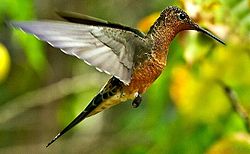
| A migratory giant hummingbird (Patagona gigas) in Chile | |
Scientific classification 
| |
| Kingdom: | Animalia |
| Phylum: | Chordata |
| Class: | Aves |
| Clade: | Strisores |
| Order: | Apodiformes |
| Family: | Trochilidae |
| Subfamily: | Patagoninae |
| Genus: | Patagona G.R. Gray, 1840 |
| Species | |
The giant hummingbirds are hummingbirds of the genus Patagona. The genus includes two species, the sedentary giant hummingbird and the migratory giant hummingbird, which are the largest and second largest species of hummingbird respectively.[2]
Taxonomy
[edit]The giant hummingbird was described and illustrated in 1824 by the French ornithologist Louis Pierre Vieillot based on a specimen that Vieillot mistakenly believed had been collected in Brazil.[3] The type locality was designated as Valparaíso in Chile by Carl Eduard Hellmayr in 1945.[4][5] The giant hummingbird was the only species placed in the genus Patagona when introduced by George Robert Gray in 1840.[6][7]
Molecular phylogenetic studies have shown that the giant hummingbird has no close relatives and is sister to the hummingbird subfamily Trochilinae, a large clade containing the tribes Lampornithini (mountain gems), Mellisugini (bees) and Trochilini (emeralds).[8]
Two subspecies were previously recognised:[7]
- P. g. peruviana Boucard, 1893 – southwest Colombia to north Chile and northwest Argentina
- P. g. gigas (Vieillot, 1824) – central, south Chile and west-central Argentina
These subspecies are thought to have emerged as a result of partial geographical separation of populations by volcanic activity in the Andes predating the Miocene; however, there remain areas of contact between the species, hence the lack of full speciation.[9] The proposed phylogenetic system for hummingbirds suggested by McGuire et al. (2009)[10] accommodated the possible elevation of these subspecies to species rank.
Description
[edit]
Giant hummingbirds can be identified by their large size and characteristics such as the presence of an eye-ring, straight bill longer than the head, dull colouration, very long wings (approaching the tail tip when stowed), long and moderately forked tail,[11] tarsi feathered to the toes and large, sturdy feet. There is no difference between the sexes.[9][12] Juveniles have small corrugations on the lateral beak culmen.[13]
Prior to the giant hummingbird being split into the Northern and Southern species, it was described as weighing 18–24 g (0.63–0.85 oz) and having a wingspan of approximately 21.5 cm (8.5 in) and length of 23 cm (9.1 in).[14] Although the Northern species is larger,[2] both are approximately the same length as a European starling or a northern cardinal, though giant hummingbirds are considerably lighter because it has a slender build and long bill, making the body a smaller proportion of the total length. This weight is almost twice that of the heaviest hummingbird species outside of the genus Patagona[15] and ten times that of the smallest, the bee hummingbird.[16]
The giant hummingbird occasionally glides in flight, a behavior very rare among hummingbirds. Its elongated wings allow more efficient glides than do those of other hummingbirds.[17] The giant hummingbird's voice is a distinctive loud, sharp and whistling "chip".[18]
Behaviour
[edit]Hummingbirds are extremely agile and acrobatic flyers, regularly partaking in sustained hovering flight, often used not only to feed on the wing but to protect their territory[19] and court mates.[16] The giant hummingbird is typical in that it will brazenly defend its energy-rich flower territory from other species and other giant hummingbirds. These birds are typically seen alone, in pairs or small family groups.[18]
Flight, anatomy and physiology
[edit]The giant hummingbird hovers at an average of 15 wing beats per second, a slow rate for a hummingbird.[14] Its resting heart rate is 300 beats per minute, with a peak rate in flight of 1020 beats per minute.[14] Energy requirements for hummingbirds do not scale evenly with size increases, meaning a larger bird such as giant hummingbird requires more energy per gram to hover than a smaller bird.[20]
The giant hummingbird requires an estimated 4.3 calories of food energy per hour to sustain its flight.[20] This requirement along with the low oxygen availability and thin air (generating little lift) at the high altitudes where the giant hummingbird usually lives suggest that it is close to the viable maximum size for a hummingbird.[21]
Food and feeding
[edit].jpg)
The giant hummingbird feeds mainly on nectar, visiting a range of flowers.[18] The female giant hummingbird has been observed ingesting sources of calcium (sand, soil, slaked lime and wood ash) after the reproductive season to replenish the calcium used in egg production; the low calcium content of nectar necessitates these extra sources.[22] Similarly, a nectar-based diet is low in protein and various dietary minerals, and this is countered by consuming insects.[22]
It regularly feeds from the flowers of the genus Puya in Chile, with which it has a symbiotic relationship, trading pollination for food.[18][23] As a large hovering bird, particularly at high altitudes, the giant hummingbird has extremely high metabolic requirements. It is known to feed from columnar cacti, including Oreocereus celsianus and Echinopsis atacamensis ssp. pasacana, and Salvia haenkei.[19][24][25]


Considering the energy-rich nature of nectar as a food source, it attracts a large range of visitors apart from the hummingbird, which has coevolved with a plant to be the flower's most efficient pollinator.[19][23][24] These other visitors, because they are not designed to access the well-hidden nectar, often damage the flowers (for example, piercing them at the base) and prevent further nectar production.[23] Because of its high energy requirements, the giant hummingbird alters its foraging behaviour as a direct response to nectar robbing from other birds and animals, and this reduces the viability of the hummingbird in an area with many nectar robbers, as well as indirectly affecting the plants by reducing pollination.[23] If alien species are introduced that become nectar thieves, it is reasonable to predict that their activities will significantly impact the local ecosystem. This could prove to be a future risk for the giant hummingbird populations because they sit close to the physical limit in their metabolic demands.[21]
Breeding
[edit]There is little known of the giant hummingbird's breeding behaviour, but some generalisations can be inferred from other hummingbird species. Hummingbird males tend to have polygynous, occasionally promiscuous, behaviours,[16] and no involvement after copulation.[26] The female builds the nest and lays a clutch of two eggs during the summer.[27] A giant hummingbird nest is small considering the size of the bird, typically made near water sources and perched on a branch of a tree or shrub parallel to the ground.[18]
References
[edit]- ^ Juan I. Areta; Matthew R. Halley; Guy M. Kirwan; Heraldo V. Norambuena; Niels K. Krabbe; Vítor Q. Piacentini (2024). "The world's largest hummingbird was described 131 years ago". Bulletin of the British Ornithologists' Club. 144 (3): 328–332. doi:10.25226/bboc.v144i3.2024.a14.
- ^ a b Williamson, Jessie L.; Gyllenhaal, Ethan F.; Bauernfeind, Selina M.; Bautista, Emil; Baumann, Matthew J.; Gadek, Chauncey R.; Marra, Peter P.; Ricote, Natalia; Valqui, Thomas; Bozinovic, Francisco; Singh, Nadia D.; Witt, Christopher C. (2024-05-21). "Extreme elevational migration spurred cryptic speciation in giant hummingbirds". Proceedings of the National Academy of Sciences. 121 (21) e2313599121. Bibcode:2024PNAS..12113599W. doi:10.1073/pnas.2313599121. ISSN 0027-8424. PMC 11126955. PMID 38739790.
- ^ Vieillot, Louis Pierre (1824). La Galerie des Oiseaux (in French). Vol. 1. Paris: Constant Chantepie. p. 296–297; Plate 180.
- ^ Hellmayr, Carl Eduard (1932). The Birds of Chile. Field Museum Natural History Publications. Zoological Series. Volume 19. Vol. 19. p. 230.
- ^ Peters, James Lee, ed. (1945). Check-List of Birds of the World. Vol. 5. Cambridge, Massachusetts: Harvard University Press. p. 95.
- ^ Gray, George Robert (1840). A List of the Genera of Birds: with an Indication of the Typical Species of Each Genus. London: R. and J.E. Taylor. p. 14.
- ^ a b Gill, Frank; Donsker, David; Rasmussen, Pamela, eds. (August 2022). "Hummingbirds". IOC World Bird List Version 12.2. International Ornithologists' Union. Retrieved 13 September 2022.
- ^ McGuire, J.; Witt, C.; Remsen, J.V.; Corl, A.; Rabosky, D.; Altshuler, D.; Dudley, R. (2014). "Molecular phylogenetics and the diversification of hummingbirds". Current Biology. 24 (8): 910–916. Bibcode:2014CBio...24..910M. doi:10.1016/j.cub.2014.03.016. PMID 24704078.
- ^ a b Osés, C. S. (2003). Taxonomy, phylogeny, and biogeography of the Andean hummingbird genera Coeligena Lesson, 1832; Pterophanes Gould, 1849; Ensifera Lesson 1843; and Patagona Gray, 1840 (Aves: Trochiliformes) (1st ed.). Bonn, Germany: Bonn University. Retrieved 18 April 2015.
- ^ McGuire, Jimmy A.; Witt, Christopher C.; Remsen, J. V.; Dudley, R.; Altshuler, Douglas L. (5 August 2008). "A higher-level taxonomy for hummingbirds". Journal of Ornithology. 150 (1): 155–165. doi:10.1007/s10336-008-0330-x.
- ^ Clark, Christopher J. (2010). "The evolution of tail shape in hummingbirds". The Auk. 127 (1): 44–56. doi:10.1525/auk.2009.09073.
- ^ Von Wehrden, H. (2008). "The giant hummingbird (Patagona gigas) in the mountains of central Argentina and a climatic envelope model for its distribution". Wilson Journal of Ornithology. 120 (3): 648–651. doi:10.1676/07-111.1.
- ^ Oritz-Crespo, F. I. (1972). "A new method to separate immature and adult hummingbirds". The Auk. 89 (4): 851–857. doi:10.2307/4084114. JSTOR 4084114.
- ^ a b c Lasiewski, Robert C.; Weathers, Wesley W.; Bernstein, Marvin H. (1967). "Physiological responses of the giant hummingbird, Patagona gigas". Comparative Biochemistry and Physiology. 23 (3): 797–813. doi:10.1016/0010-406X(67)90342-8. PMID 6079418.
- ^ Fernández, María José; Dudley, Robert; Bozinovic, Francisco (2011). "Comparative energetics of the giant hummingbird". Physiological and Biochemical Zoology. 84 (3): 333–340. doi:10.1086/660084. PMID 21527824. S2CID 31616893.
- ^ a b c Healy, Susan; Hurly, T. Andrew (2006). "Hummingbirds". Current Biology. 16 (11): R392–R393. Bibcode:2006CBio...16.R392H. doi:10.1016/j.cub.2006.05.015. PMID 16753546.
- ^ Templin, R.J. (2000). "The spectrum of animal flight: insects to pterosaurs". Progress in Aerospace Sciences. 36 (5–6): 393–436. Bibcode:2000PrAeS..36..393T. doi:10.1016/S0376-0421(00)00007-5.
- ^ a b c d e Ricardo, R. (2010). Multi-ethnic Bird Guide of the Subantarctic Forests of South America (2nd ed.). University of North Texas Press. pp. 171–173.
- ^ a b c Schlumpberger, B. O.; Badano, E.I. (2005). "Diversity of floral visitors to Echinopsis atacamensis Subsp. Pasacana (Cactaceae)". Haseltonia. 11: 18–26. doi:10.2985/1070-0048(2005)11[18:DOFVTE]2.0.CO;2. S2CID 86659001.
- ^ a b Hainsworth, F.R.; Wolf, L.L. (1972). "Power for hovering flight in relation to body size in hummingbirds". The American Naturalist. 106 (951): 589–596. Bibcode:1972ANat..106..589H. doi:10.1086/282799. S2CID 84151001.
- ^ a b Altshuler, D.L.; Dudley, R. (2006). "The physiology and biomechanics of avian flight at high altitude". Integrative and Comparative Biology. 46 (1): 62–71. doi:10.1093/icb/icj008. PMID 21672723.
- ^ a b Estades, C.F.; Vukasovic, M.A.; Tomasevic, J. A. (2008). "Giant hummingbirds (Patagona gigas) ingest calcium-rich minerals". Wilson Journal of Ornithology. 120 (3): 651–653. doi:10.1676/07-054.1. S2CID 86241862.
- ^ a b c d González-Gómez, P. L.; Valdivia, C. E. (2005). "Direct and indirect effects of nectar robbing on the pollinating behavior of Patagona gigas (Trochilidae)". Biotropica. 37 (4): 693–696. Bibcode:2005Biotr..37..693G. doi:10.1111/j.1744-7429.2005.00088.x. S2CID 84689385.
- ^ a b Larrea-Alcázar, Daniel M.; López, Ramiro P. (2011). "Pollination biology of Oreocereus celsianus (Cactaceae), a columnar cactus inhabiting the high subtropical Andes". Plant Systematics and Evolution. 295 (1–4): 129–137. Bibcode:2011PSyEv.295..129L. doi:10.1007/s00606-011-0485-4.
- ^ Wester, P.; Claßen-Bockhoff, R. (2006). "Hummingbird pollination in Salvia haenkei (Lamiaceae) lacking the typical lever mechanism". Plant Systematics and Evolution. 257 (3–4): 133–146. Bibcode:2006PSyEv.257..133W. doi:10.1007/s00606-005-0366-9. S2CID 1095801.
- ^ Vleck, C. M. (1981). "Hummingbird incubation: female attentiveness and egg temperature". Oecologia. 51 (2): 199–205. Bibcode:1981Oecol..51..199V. doi:10.1007/bf00540601. PMID 28310082. S2CID 25220383.
- ^ Fierro-Calderón, K.; Martin, T. E. (2007). "Reproductive biology of the violet-chested hummingbird in Venezuela and comparisons with other tropical and temperate hummingbirds". The Condor. 109 (3): 680–685. doi:10.1650/8305.1. S2CID 6748956.