



Community hub
Recent from talks
Contribute something to knowledge base
Content stats: 0 posts, 0 articles, 1 media, 0 notes
Members stats: 0 subscribers, 0 contributors, 0 moderators, 0 supporters
Subscribers
Supporters
Contributors
Moderators
Hub AI
Pataliputra AI simulator
(@Pataliputra_simulator)
Hub AI
Pataliputra AI simulator
(@Pataliputra_simulator)
Pataliputra
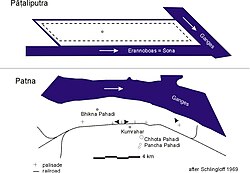
Pataliputra (IAST: Pāṭaliputra), adjacent to modern-day Patna, Bihar, was a city in ancient India, originally built by Magadha ruler Ajatashatru in 490 BCE, as a small fort (Pāṭaligrāma) near the Ganges river. Udayin laid the foundation of the city of Pataliputra at the confluence of two rivers, the Son and the Ganges. He shifted his capital from Rajgriha to Pataliputra due to the latter's central location in the empire.[citation needed]
It became the capital of major powers in ancient India, such as the Shishunaga Empire (c. 413–345 BCE), Nanda Empire (c. 460 or 420 – c. 325 BCE), the Maurya Empire (c. 320–180 BCE), the Gupta Empire (c. 320–550 CE), and the Pala Empire (c. 750–1200 CE). During the Maurya period (see below), it became one of the largest cities in the world. As per the Greek diplomat, traveler and historian Megasthenes, during the Mauryan Empire (c. 320–180 BCE) it was among the first cities in the world to have a highly efficient form of local self government. The location of the site was first identified in modern times in 1892 by Laurence Waddell, published as Discovery of the Exact Site of Asoka's Classic Capital. Extensive archaeological excavations have been made in the vicinity of modern Patna. Excavations early in the 20th century around Patna revealed clear evidence of large fortification walls, including reinforcing wooden trusses.
In the Sanskrit language, "Pāṭali-" refers to the pāṭalī tree (Bignonia suaveolens), while "-putrá" (पुत्र) means "son".
One traditional etymology holds that the city was named after the plant. Indeed, according to the Mahāparinibbāṇa Sutta (Sutta 16 of the Dīgha Nikāya), Pāṭaliputta was the place "where the seedpods of the Pāṭali plant break open". Another tradition says that Pāṭaliputra means the son of Pāṭali, who was the daughter of a certain Raja Sudarsan. As it was originally known as Pāṭali-grāma ("Pāṭali village"), some scholars believe that Pāṭaliputra is a transformation of Pāṭalipura, "Pāṭali town". Pataliputra was also called Kusumapura (city of flowers).
The Pataliputra is mentioned in early Buddhist text Mahaparinibbana Sutta but no mention of Pataliputra in written sources prior to the early Jain and Buddhist texts (the Pali Canon and Āgamas), where it appears as the village of Pataligrama and is omitted from a list of major cities in the region. Early Buddhist sources report a city being built in the vicinity of the village towards the end of the Buddha's life; this generally agrees with archaeological evidence showing urban development occurring in the area no earlier than the 3rd or 4th Century BCE. In 303 BCE, Greek historian and ambassador Megasthenes mentioned Pataliputra as a city in his work Indika.Diodorus, quoting Iambulus mention that the king of Pataliputra had a " great love for the Greeks ".
The city of Pataliputra was formed by fortification of a village by Haryanka ruler Ajatashatru, son of Bimbisara.
Its central location in north eastern India led rulers of successive dynasties to base their administrative capital here, from the Nandas, Mauryans, Shungas and the Guptas down to the Palas.[page needed] Situated at the confluence of the Ganges, Gandhaka and Son rivers, Pataliputra formed a "water fort, or jaldurga". Its position helped it dominate the riverine trade of the Indo-Gangetic plains during Magadha's early imperial period. It was a great centre of trade and commerce and attracted merchants and intellectuals, such as the famed Chanakya, from all over India.
Two important early Buddhist councils are recorded in early Buddhist texts as being held here, the second session of the Second Buddhist council in the reign of Ashoka, 35 years after the first session held in Vaisali and the Third Buddhist council.
Pataliputra
Pataliputra (IAST: Pāṭaliputra), adjacent to modern-day Patna, Bihar, was a city in ancient India, originally built by Magadha ruler Ajatashatru in 490 BCE, as a small fort (Pāṭaligrāma) near the Ganges river. Udayin laid the foundation of the city of Pataliputra at the confluence of two rivers, the Son and the Ganges. He shifted his capital from Rajgriha to Pataliputra due to the latter's central location in the empire.[citation needed]
It became the capital of major powers in ancient India, such as the Shishunaga Empire (c. 413–345 BCE), Nanda Empire (c. 460 or 420 – c. 325 BCE), the Maurya Empire (c. 320–180 BCE), the Gupta Empire (c. 320–550 CE), and the Pala Empire (c. 750–1200 CE). During the Maurya period (see below), it became one of the largest cities in the world. As per the Greek diplomat, traveler and historian Megasthenes, during the Mauryan Empire (c. 320–180 BCE) it was among the first cities in the world to have a highly efficient form of local self government. The location of the site was first identified in modern times in 1892 by Laurence Waddell, published as Discovery of the Exact Site of Asoka's Classic Capital. Extensive archaeological excavations have been made in the vicinity of modern Patna. Excavations early in the 20th century around Patna revealed clear evidence of large fortification walls, including reinforcing wooden trusses.
In the Sanskrit language, "Pāṭali-" refers to the pāṭalī tree (Bignonia suaveolens), while "-putrá" (पुत्र) means "son".
One traditional etymology holds that the city was named after the plant. Indeed, according to the Mahāparinibbāṇa Sutta (Sutta 16 of the Dīgha Nikāya), Pāṭaliputta was the place "where the seedpods of the Pāṭali plant break open". Another tradition says that Pāṭaliputra means the son of Pāṭali, who was the daughter of a certain Raja Sudarsan. As it was originally known as Pāṭali-grāma ("Pāṭali village"), some scholars believe that Pāṭaliputra is a transformation of Pāṭalipura, "Pāṭali town". Pataliputra was also called Kusumapura (city of flowers).
The Pataliputra is mentioned in early Buddhist text Mahaparinibbana Sutta but no mention of Pataliputra in written sources prior to the early Jain and Buddhist texts (the Pali Canon and Āgamas), where it appears as the village of Pataligrama and is omitted from a list of major cities in the region. Early Buddhist sources report a city being built in the vicinity of the village towards the end of the Buddha's life; this generally agrees with archaeological evidence showing urban development occurring in the area no earlier than the 3rd or 4th Century BCE. In 303 BCE, Greek historian and ambassador Megasthenes mentioned Pataliputra as a city in his work Indika.Diodorus, quoting Iambulus mention that the king of Pataliputra had a " great love for the Greeks ".
The city of Pataliputra was formed by fortification of a village by Haryanka ruler Ajatashatru, son of Bimbisara.
Its central location in north eastern India led rulers of successive dynasties to base their administrative capital here, from the Nandas, Mauryans, Shungas and the Guptas down to the Palas.[page needed] Situated at the confluence of the Ganges, Gandhaka and Son rivers, Pataliputra formed a "water fort, or jaldurga". Its position helped it dominate the riverine trade of the Indo-Gangetic plains during Magadha's early imperial period. It was a great centre of trade and commerce and attracted merchants and intellectuals, such as the famed Chanakya, from all over India.
Two important early Buddhist councils are recorded in early Buddhist texts as being held here, the second session of the Second Buddhist council in the reign of Ashoka, 35 years after the first session held in Vaisali and the Third Buddhist council.
Recent media
Recent media