
Recent from talks
Pattern (sewing)
Knowledge base stats:
Talk channels stats:
Members stats:
Pattern (sewing)
In sewing and fashion design, a pattern is the template from which the parts of a garment are traced onto woven or knitted fabric before being cut out and assembled. Patterns are usually made of paper, and are sometimes made of sturdier materials like paperboard or cardboard if they need to be more robust to withstand repeated use. The process of making or cutting patterns is sometimes referred to as patternmaking, but it can also be written as pattern making or pattern cutting.
A sloper pattern, also called a block pattern, is a custom-fitted, basic pattern from which patterns for many different styles can be developed. The process of changing the size of a finished pattern is called pattern grading.
Several companies, like Butterick and Simplicity, specialize in selling pre-graded patterns directly to consumers. These patterns are usually printed on tissue paper and include multiple sizes that overlap each other. An illustrated instruction sheet for use and assembly of the item is usually included. The pattern may include multiple style options in one package.
Clothing brands make their patterns with in-house patternmakers, third-party specialists, or (often when manufacturing in overseas factories) will rely on the factory’s in-house patternmakers. While commercial production patterns are engineered to fit several standard average body sizes, in bespoke clothing, patterns must be adjusted or developed for each individual client.
A patternmaker typically employs one of two methods to create a pattern.
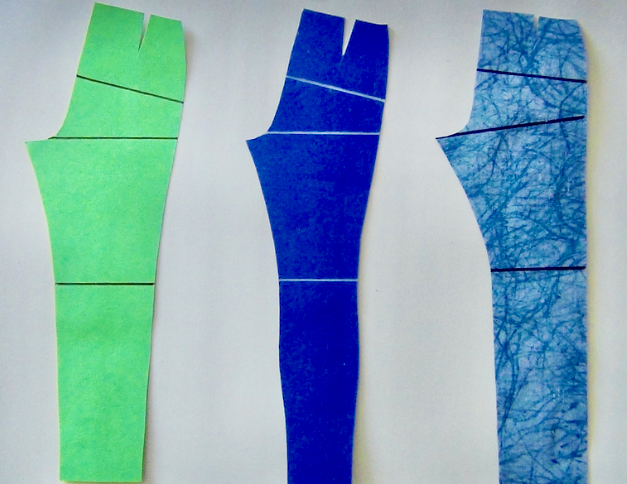
The flat-pattern method is where the entire pattern is drafted on a flat surface from measurements, using rulers, curves, and straight-edges. A pattern maker would also use various tools such as a notcher, drill, and awl to mark the pattern. Usually, flat patterning begins with the creation of a "sloper" or "block" pattern: a simple, fitted garment made to the wearer's measurements. For women, this will usually be a jewel-neck bodice and narrow skirt, and for men, an upper sloper and a pants sloper. The final sloper pattern is usually made of cardboard or paperboard, without seam allowances or style details (thicker paper or cardboard allows repeated tracing and pattern development from the original sloper). Once the shape of the sloper has been refined by making a series of mock-up garments called toiles (UK) or muslins (US) or Nessel in German, the final sloper can be used to create patterns for many styles of garments with varying necklines, sleeves, dart placements, and so on. The flat pattern drafting method is the most commonly used method in menswear; menswear rarely involves draping.
The draping method involves creating a mock-up pattern made of a strong fabric (such as calico) in a linen weave. The fabric is far coarser than muslin, but less coarse and thick than canvas or denim. However, it is still very cheap, owing to its unfinished and undyed appearance. Then, by pinning this fabric directly on a form, the fabric outline and markings will be then transferred onto a paper pattern, or the fabric itself will be used as the pattern. Designers drafting a sculpted evening gown or dress which uses a lot of fabric--typically cut on the bias--will use the draping technique, as it is very difficult to achieve this with a flat pattern. This method is also used for collars.
Each pattern manufacturer has their own size ranges. A distinction is made between a basic pattern, a first pattern, and a production pattern. Patternmakers grade the first cuts to the desired size with the aid of CAD software (computer-aided design). The production pattern must contain all the information necessary for production and all the necessary parts. The collections are produced in sets of sizes. The customer has the garment altered by a tailor after purchase, if necessary.
Hub AI
Pattern (sewing) AI simulator
(@Pattern (sewing)_simulator)
Pattern (sewing)
In sewing and fashion design, a pattern is the template from which the parts of a garment are traced onto woven or knitted fabric before being cut out and assembled. Patterns are usually made of paper, and are sometimes made of sturdier materials like paperboard or cardboard if they need to be more robust to withstand repeated use. The process of making or cutting patterns is sometimes referred to as patternmaking, but it can also be written as pattern making or pattern cutting.
A sloper pattern, also called a block pattern, is a custom-fitted, basic pattern from which patterns for many different styles can be developed. The process of changing the size of a finished pattern is called pattern grading.
Several companies, like Butterick and Simplicity, specialize in selling pre-graded patterns directly to consumers. These patterns are usually printed on tissue paper and include multiple sizes that overlap each other. An illustrated instruction sheet for use and assembly of the item is usually included. The pattern may include multiple style options in one package.
Clothing brands make their patterns with in-house patternmakers, third-party specialists, or (often when manufacturing in overseas factories) will rely on the factory’s in-house patternmakers. While commercial production patterns are engineered to fit several standard average body sizes, in bespoke clothing, patterns must be adjusted or developed for each individual client.
A patternmaker typically employs one of two methods to create a pattern.
The flat-pattern method is where the entire pattern is drafted on a flat surface from measurements, using rulers, curves, and straight-edges. A pattern maker would also use various tools such as a notcher, drill, and awl to mark the pattern. Usually, flat patterning begins with the creation of a "sloper" or "block" pattern: a simple, fitted garment made to the wearer's measurements. For women, this will usually be a jewel-neck bodice and narrow skirt, and for men, an upper sloper and a pants sloper. The final sloper pattern is usually made of cardboard or paperboard, without seam allowances or style details (thicker paper or cardboard allows repeated tracing and pattern development from the original sloper). Once the shape of the sloper has been refined by making a series of mock-up garments called toiles (UK) or muslins (US) or Nessel in German, the final sloper can be used to create patterns for many styles of garments with varying necklines, sleeves, dart placements, and so on. The flat pattern drafting method is the most commonly used method in menswear; menswear rarely involves draping.
The draping method involves creating a mock-up pattern made of a strong fabric (such as calico) in a linen weave. The fabric is far coarser than muslin, but less coarse and thick than canvas or denim. However, it is still very cheap, owing to its unfinished and undyed appearance. Then, by pinning this fabric directly on a form, the fabric outline and markings will be then transferred onto a paper pattern, or the fabric itself will be used as the pattern. Designers drafting a sculpted evening gown or dress which uses a lot of fabric--typically cut on the bias--will use the draping technique, as it is very difficult to achieve this with a flat pattern. This method is also used for collars.
Each pattern manufacturer has their own size ranges. A distinction is made between a basic pattern, a first pattern, and a production pattern. Patternmakers grade the first cuts to the desired size with the aid of CAD software (computer-aided design). The production pattern must contain all the information necessary for production and all the necessary parts. The collections are produced in sets of sizes. The customer has the garment altered by a tailor after purchase, if necessary.
Recent media