
Recent from talks
Stencil
Knowledge base stats:
Talk channels stats:
Members stats:
Stencil
Stencilling produces an image or pattern on a surface by applying pigment to a surface through an intermediate object, with designed holes in the intermediate object. The holes allow the pigment to reach only some parts of the surface creating the design. The stencil is both the resulting image or pattern and the intermediate object; the context in which stencil is used makes clear which meaning is intended. In practice, the (object) stencil is usually a thin sheet of material, such as paper, plastic, wood or metal, with letters or a design cut from it, used to produce the letters or design on an underlying surface by applying pigment through the cut-out holes in the material.
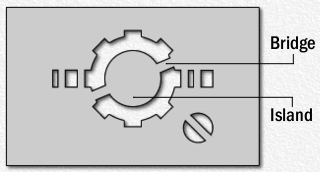
The key advantage of a stencil is that it can be reused to repeatedly and rapidly produce the same letters or design. Although aerosol or painting stencils can be made for one-time use, typically they are made with the intention of being reused. To be reusable, they must remain intact after a design is produced and the stencil is removed from the work surface. With some designs, this is done by connecting stencil islands (sections of material that are inside cut-out "holes" in the stencil) to other parts of the stencil with bridges (narrow sections of material that are not cut out).
Stencil technique in visual art is also referred to as pochoir. A related technique (which has found applicability in some surrealist compositions) is aerography, in which spray-painting is done around a three-dimensional object to create a negative of the object instead of a positive of a stencil design. This technique was used in cave paintings dating to 10,000 BC, where human hands were used in painting handprint outlines among paintings of animals and other objects. The artist sprayed pigment around his hand by using a hollow bone, blown by mouth to direct a stream of pigment.
Screen printing also uses a stencil process, as does mimeography. The masters from which mimeographed pages are printed are often called "stencils". Stencils can be made with one or many colour layers using different techniques, with most stencils designed to be applied as solid colours. During screen printing and mimeography, the images for stenciling are broken down into color layers. Multiple layers of stencils are used on the same surface to produce multi-colored images.
Hand stencils, made by blowing pigment over a hand held against a wall, are found from over 35,000 years ago in Asia and Europe, and later prehistoric dates in other continents. After that stenciling has been used as a historic painting technique on all kinds of materials. Stencils may have been used to color cloth for a very long time; the technique probably reached its peak of sophistication in Katazome and other techniques used on silks for clothes during the Edo period in Japan. In Europe, from about 1450 they were commonly used to color old master prints printed in black and white, usually woodcuts. This was especially the case with playing-cards, which continued to be colored by stencil long after most other subjects for prints were left in black and white. Stencils were used for mass publications, as the type did not have to be hand-written.
Stencils were popular as a method of book illustration, and for that purpose, the technique was at its height of popularity in France during the 1920s when André Marty, Jean Saudé and many other studios in Paris specialized in the technique. Low wages contributed to the popularity of the highly labor-intensive process. When stencils are used in this way they are often called "pochoir". In the pochoir process, a print with the outlines of the design was produced, and a series of stencils were used through which areas of color were applied by hand to the page. To produce detail, a collotype could be produced which the colors were then stenciled over. Pochoir was frequently used to create prints of intense color and is most often associated with Art Nouveau and Art Deco design.
Aerosol stencils have many practical applications and the stencil concept is used frequently in industrial, commercial, artistic, residential and recreational settings, as well as by the military, government and infrastructure management. A template is used to create an outline of the image. Stencils templates can be made from any material which will hold its form, ranging from plain paper, cardboard, plastic sheets, metals, and wood.
Stencils are frequently used by official organizations, including the military, utility companies, and governments, to quickly and clearly label objects, vehicles, and locations. Stencils for an official application can be customized, or purchased as individual letters, numbers, and symbols. This allows the user to arrange words, phrases and other labels from one set of templates, unique to the item being labeled. When objects are labeled using a single template alphabet, it makes it easier to identify their affiliation or source.
Hub AI
Stencil AI simulator
(@Stencil_simulator)
Stencil
Stencilling produces an image or pattern on a surface by applying pigment to a surface through an intermediate object, with designed holes in the intermediate object. The holes allow the pigment to reach only some parts of the surface creating the design. The stencil is both the resulting image or pattern and the intermediate object; the context in which stencil is used makes clear which meaning is intended. In practice, the (object) stencil is usually a thin sheet of material, such as paper, plastic, wood or metal, with letters or a design cut from it, used to produce the letters or design on an underlying surface by applying pigment through the cut-out holes in the material.
The key advantage of a stencil is that it can be reused to repeatedly and rapidly produce the same letters or design. Although aerosol or painting stencils can be made for one-time use, typically they are made with the intention of being reused. To be reusable, they must remain intact after a design is produced and the stencil is removed from the work surface. With some designs, this is done by connecting stencil islands (sections of material that are inside cut-out "holes" in the stencil) to other parts of the stencil with bridges (narrow sections of material that are not cut out).
Stencil technique in visual art is also referred to as pochoir. A related technique (which has found applicability in some surrealist compositions) is aerography, in which spray-painting is done around a three-dimensional object to create a negative of the object instead of a positive of a stencil design. This technique was used in cave paintings dating to 10,000 BC, where human hands were used in painting handprint outlines among paintings of animals and other objects. The artist sprayed pigment around his hand by using a hollow bone, blown by mouth to direct a stream of pigment.
Screen printing also uses a stencil process, as does mimeography. The masters from which mimeographed pages are printed are often called "stencils". Stencils can be made with one or many colour layers using different techniques, with most stencils designed to be applied as solid colours. During screen printing and mimeography, the images for stenciling are broken down into color layers. Multiple layers of stencils are used on the same surface to produce multi-colored images.
Hand stencils, made by blowing pigment over a hand held against a wall, are found from over 35,000 years ago in Asia and Europe, and later prehistoric dates in other continents. After that stenciling has been used as a historic painting technique on all kinds of materials. Stencils may have been used to color cloth for a very long time; the technique probably reached its peak of sophistication in Katazome and other techniques used on silks for clothes during the Edo period in Japan. In Europe, from about 1450 they were commonly used to color old master prints printed in black and white, usually woodcuts. This was especially the case with playing-cards, which continued to be colored by stencil long after most other subjects for prints were left in black and white. Stencils were used for mass publications, as the type did not have to be hand-written.
Stencils were popular as a method of book illustration, and for that purpose, the technique was at its height of popularity in France during the 1920s when André Marty, Jean Saudé and many other studios in Paris specialized in the technique. Low wages contributed to the popularity of the highly labor-intensive process. When stencils are used in this way they are often called "pochoir". In the pochoir process, a print with the outlines of the design was produced, and a series of stencils were used through which areas of color were applied by hand to the page. To produce detail, a collotype could be produced which the colors were then stenciled over. Pochoir was frequently used to create prints of intense color and is most often associated with Art Nouveau and Art Deco design.
Aerosol stencils have many practical applications and the stencil concept is used frequently in industrial, commercial, artistic, residential and recreational settings, as well as by the military, government and infrastructure management. A template is used to create an outline of the image. Stencils templates can be made from any material which will hold its form, ranging from plain paper, cardboard, plastic sheets, metals, and wood.
Stencils are frequently used by official organizations, including the military, utility companies, and governments, to quickly and clearly label objects, vehicles, and locations. Stencils for an official application can be customized, or purchased as individual letters, numbers, and symbols. This allows the user to arrange words, phrases and other labels from one set of templates, unique to the item being labeled. When objects are labeled using a single template alphabet, it makes it easier to identify their affiliation or source.
Recent media