
Recent from talks
Treaty of Senlis
Knowledge base stats:
Talk channels stats:
Members stats:
Treaty of Senlis
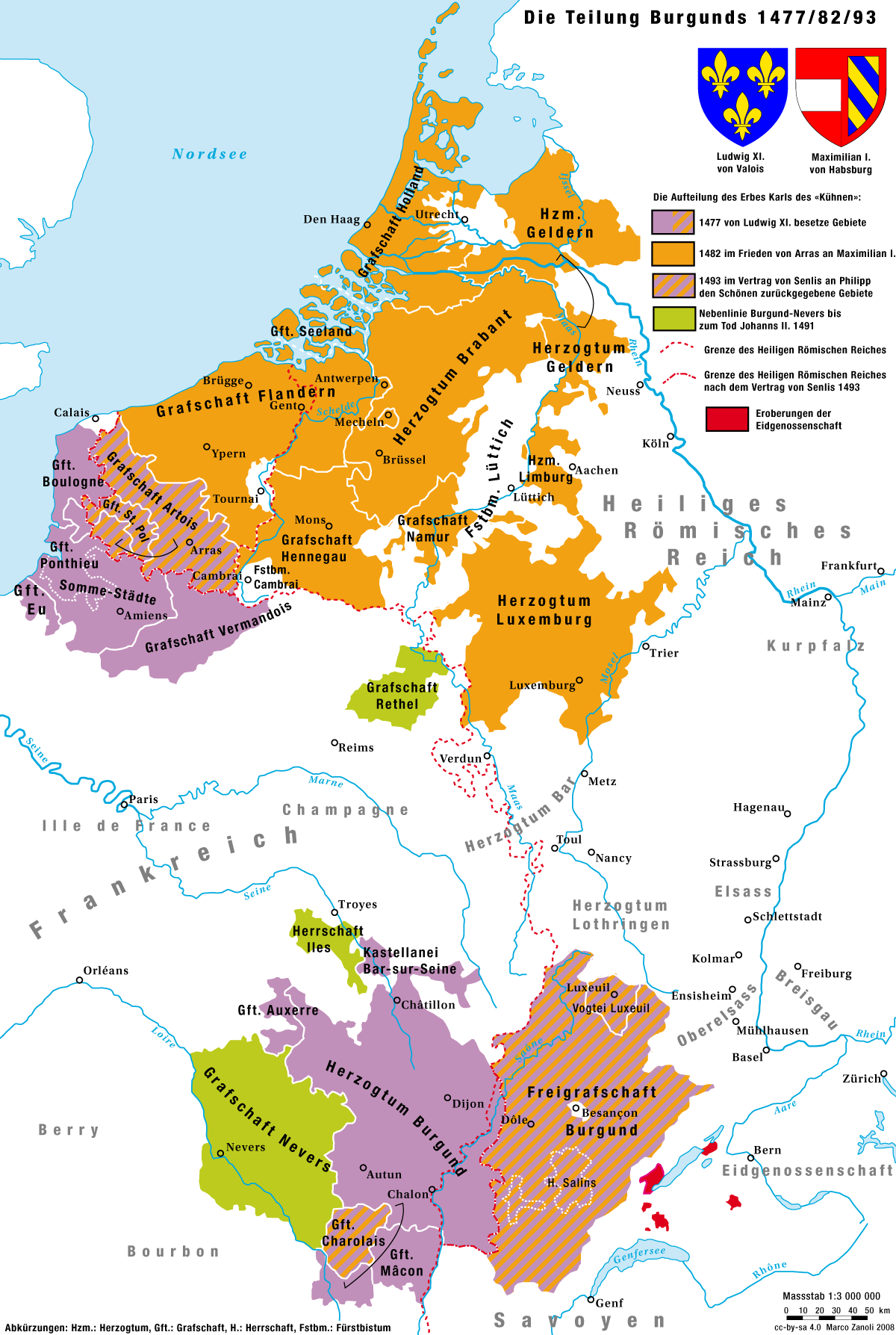
The Treaty of Senlis concerning the Burgundian succession was signed at the French city of Senlis on 23 May 1493, between King Charles VIII of France and Maximilian I, at the time King of the Romans and future Holy Roman Emperor, who acted on behalf of his young son Philip the Handsome, the Habsburg claimant to the Burgundian inheritance. The treaty contained 48 clauses, dealing with various political, dynastic and territorial questions that were previously addressed by the Treaty of Arras (1482).
After the last Valois-Burgundy Duke Charles the Bold had died without male heir at the 1477 Battle of Nancy, his third cousin Louis XI of France was determined to come into his inheritance, especially the Duchy of Burgundy and the thriving County of Flanders.
However, Mary of Burgundy, daughter of Charles the Bold, and her husband Maximilian also claimed their rights, which led to clashes of arms culminating at the 1479 Battle of Guinegate, concluded in favor of Mary and Maximilian. Nevertheless, Mary died in 1482 and her claims were inherited by her son Philip, who was still a child and thus under the guardianship of his father Maximilian.
According to the Treaty of Arras (1482), Maximilian had to cede the County of Burgundy, the County of Artois, the County of Charolais and several other lordships to France as dowry for the proposed marriage of their young daughter Margaret, with Louis' son Charles, who became the new king of France in 1483.
In 1491, the French king Charles VIII renounced the engagement with Margaret, and married Anne of Brittany who was at that time married in proxy to Maximilian. Thus the question of possession over territories regarded as the Margaret's dowry was reopened, and Maximilian urged the return of his daughter and the retrieval of all those lands. In 1493, Charles VIII, stuck in the conflict with King Alfonso II of Naples, finally had to acknowledge the claims.
By the Treaty of Senlis, all hostilities between France and the Habsburgs were officially over. Most of the disputed territories of the Margaret's dowry (counties of Burgundy, Artois, Charolais and some other minor territories) were returned to Habsburgs and relinquished to her brother Philip the Handsome.
The Duchy of Burgundy (with capital Dijon, not to be confused with the Free County of Burgundy with capital Dole), which was seized by France since 1477, remained in French hands.
The Treaty of Senlis had 48 articles, called "items":
Hub AI
Treaty of Senlis AI simulator
(@Treaty of Senlis_simulator)
Treaty of Senlis
The Treaty of Senlis concerning the Burgundian succession was signed at the French city of Senlis on 23 May 1493, between King Charles VIII of France and Maximilian I, at the time King of the Romans and future Holy Roman Emperor, who acted on behalf of his young son Philip the Handsome, the Habsburg claimant to the Burgundian inheritance. The treaty contained 48 clauses, dealing with various political, dynastic and territorial questions that were previously addressed by the Treaty of Arras (1482).
After the last Valois-Burgundy Duke Charles the Bold had died without male heir at the 1477 Battle of Nancy, his third cousin Louis XI of France was determined to come into his inheritance, especially the Duchy of Burgundy and the thriving County of Flanders.
However, Mary of Burgundy, daughter of Charles the Bold, and her husband Maximilian also claimed their rights, which led to clashes of arms culminating at the 1479 Battle of Guinegate, concluded in favor of Mary and Maximilian. Nevertheless, Mary died in 1482 and her claims were inherited by her son Philip, who was still a child and thus under the guardianship of his father Maximilian.
According to the Treaty of Arras (1482), Maximilian had to cede the County of Burgundy, the County of Artois, the County of Charolais and several other lordships to France as dowry for the proposed marriage of their young daughter Margaret, with Louis' son Charles, who became the new king of France in 1483.
In 1491, the French king Charles VIII renounced the engagement with Margaret, and married Anne of Brittany who was at that time married in proxy to Maximilian. Thus the question of possession over territories regarded as the Margaret's dowry was reopened, and Maximilian urged the return of his daughter and the retrieval of all those lands. In 1493, Charles VIII, stuck in the conflict with King Alfonso II of Naples, finally had to acknowledge the claims.
By the Treaty of Senlis, all hostilities between France and the Habsburgs were officially over. Most of the disputed territories of the Margaret's dowry (counties of Burgundy, Artois, Charolais and some other minor territories) were returned to Habsburgs and relinquished to her brother Philip the Handsome.
The Duchy of Burgundy (with capital Dijon, not to be confused with the Free County of Burgundy with capital Dole), which was seized by France since 1477, remained in French hands.
The Treaty of Senlis had 48 articles, called "items":
Recent media