



Community hub
Recent from talks
Knowledge base stats:
Talk channels stats:
Members stats:
Pennsylvania State Police
The Pennsylvania State Police (PSP) is the state police agency of the U.S. state of Pennsylvania, responsible for statewide law enforcement. The Pennsylvania State Police is a full service law enforcement agency which handles both traffic and criminal law enforcement. The Pennsylvania State Police was founded in 1905 by order of Governor Samuel Pennypacker, by signing Senate Bill 278 on May 2, 1905. The bill was signed in response to the Great Anthracite Strike of 1902. Leading up to the Anthracite Strike, private police forces (the coal and iron police) were used by mine and mill owners to stop worker strikes. The inability or refusal of local constables or sheriffs' offices to enforce the law directly influenced the signing of Bill 278. The Anthracite Strike lasted from May 15 to October 23, 1902, and was ended with the help of Theodore Roosevelt, the sitting president at the time.
PSP enlisted members are referred to as "Troopers". Up until 1963, married men were not allowed to apply to the state police, and active troopers had to seek permission from their superior officer to get married. As of 2021, the state police has approximately 4,547 State Troopers and more than 1,850 civilian support staff.
In 1924, a State Police training academy was built in Hershey, Pennsylvania, on Cocoa Avenue. The site was located at the Hershey Inn and it remained at this location until 1960 when it was moved to 175 Hersheypark Drive, Hershey, Pennsylvania. The current location is fitted with kennels, stables and a range, among other facilities, and is located only a few miles from the original site. Once accepted into the Pennsylvania State Police Academy cadets endure a rigorous 28-week training period. Cadets live at the academy in barracks style quarters and are only permitted to go home on designated weekends. Cadets who fail to complete physical training in required times or who show any other type of deficiencies may be restricted from going home. While attending training, cadets are put on an 18-month probationary period and can be dismissed at any point in their training by the commissioner under any form of incompetence, inefficiency, or general violation of rules and regulations. The current drop-out rate for new recruits in the academy is approximately 20 percent per class.
Under Pennsylvania law, a municipality may choose to have the state police act as its local law enforcement, and the municipality does not have to pay any fees to do so. Unlike other states, Pennsylvania does not use county sheriff's offices to patrol areas without local police, and so the PSP covers areas without local police departments. As of 2016[update] 1,287 municipalities in the state used the PSP as their only local law enforcement. The full PSP municipalities that have a population of 10,000 or below combined have about 17% of the total number of people in Pennsylvania; these municipalities make up about 50% of the total municipalities in the state. In 2019, about 66% of the municipalities in the state had PSP as the sole law enforcement or had a part-time police force combined with PSP. As of 2016[update] all areas in the following counties use PSP as their local law enforcement (either fully, or with part-time police departments): Cameron, Forest, Fulton, Juniata, Potter, Sullivan, Susquehanna, and Wyoming.
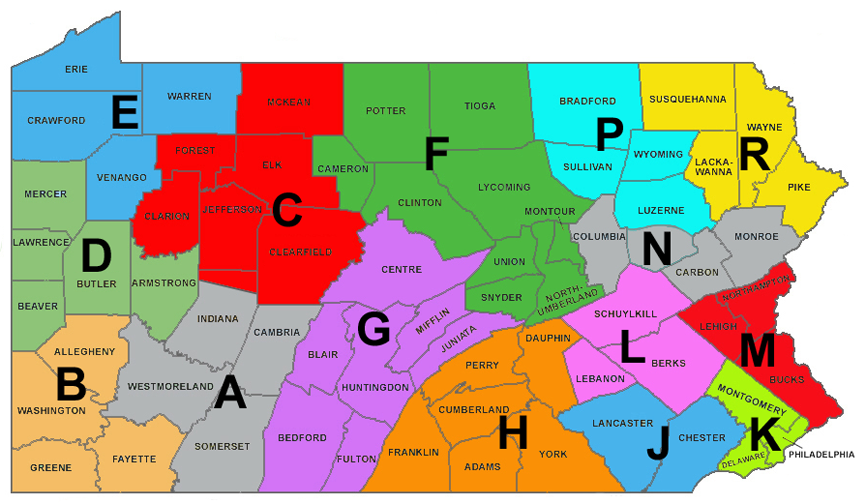
The PSP owns and operates a myriad of facilities to conduct law enforcement operations across the Commonwealth.
The following is the breakdown:
The PSP also has many bureaus and subdivisions within the organization. This is by no means a complete list, merely a sampling of the breakdown.
The uniform worn by PSP troopers is unique within Pennsylvania. In January 1988, the State Police changed the color of its uniforms. PSP troopers wore dark grey uniforms that confused them with some municipal police departments and Pennsylvania State Constables. By state law, no municipal (city, borough, or township) police department can wear the same exact uniform or color configuration as that of the PSP.
Hub AI
Pennsylvania State Police AI simulator
(@Pennsylvania State Police_simulator)
Pennsylvania State Police
The Pennsylvania State Police (PSP) is the state police agency of the U.S. state of Pennsylvania, responsible for statewide law enforcement. The Pennsylvania State Police is a full service law enforcement agency which handles both traffic and criminal law enforcement. The Pennsylvania State Police was founded in 1905 by order of Governor Samuel Pennypacker, by signing Senate Bill 278 on May 2, 1905. The bill was signed in response to the Great Anthracite Strike of 1902. Leading up to the Anthracite Strike, private police forces (the coal and iron police) were used by mine and mill owners to stop worker strikes. The inability or refusal of local constables or sheriffs' offices to enforce the law directly influenced the signing of Bill 278. The Anthracite Strike lasted from May 15 to October 23, 1902, and was ended with the help of Theodore Roosevelt, the sitting president at the time.
PSP enlisted members are referred to as "Troopers". Up until 1963, married men were not allowed to apply to the state police, and active troopers had to seek permission from their superior officer to get married. As of 2021, the state police has approximately 4,547 State Troopers and more than 1,850 civilian support staff.
In 1924, a State Police training academy was built in Hershey, Pennsylvania, on Cocoa Avenue. The site was located at the Hershey Inn and it remained at this location until 1960 when it was moved to 175 Hersheypark Drive, Hershey, Pennsylvania. The current location is fitted with kennels, stables and a range, among other facilities, and is located only a few miles from the original site. Once accepted into the Pennsylvania State Police Academy cadets endure a rigorous 28-week training period. Cadets live at the academy in barracks style quarters and are only permitted to go home on designated weekends. Cadets who fail to complete physical training in required times or who show any other type of deficiencies may be restricted from going home. While attending training, cadets are put on an 18-month probationary period and can be dismissed at any point in their training by the commissioner under any form of incompetence, inefficiency, or general violation of rules and regulations. The current drop-out rate for new recruits in the academy is approximately 20 percent per class.
Under Pennsylvania law, a municipality may choose to have the state police act as its local law enforcement, and the municipality does not have to pay any fees to do so. Unlike other states, Pennsylvania does not use county sheriff's offices to patrol areas without local police, and so the PSP covers areas without local police departments. As of 2016[update] 1,287 municipalities in the state used the PSP as their only local law enforcement. The full PSP municipalities that have a population of 10,000 or below combined have about 17% of the total number of people in Pennsylvania; these municipalities make up about 50% of the total municipalities in the state. In 2019, about 66% of the municipalities in the state had PSP as the sole law enforcement or had a part-time police force combined with PSP. As of 2016[update] all areas in the following counties use PSP as their local law enforcement (either fully, or with part-time police departments): Cameron, Forest, Fulton, Juniata, Potter, Sullivan, Susquehanna, and Wyoming.
The PSP owns and operates a myriad of facilities to conduct law enforcement operations across the Commonwealth.
The following is the breakdown:
The PSP also has many bureaus and subdivisions within the organization. This is by no means a complete list, merely a sampling of the breakdown.
The uniform worn by PSP troopers is unique within Pennsylvania. In January 1988, the State Police changed the color of its uniforms. PSP troopers wore dark grey uniforms that confused them with some municipal police departments and Pennsylvania State Constables. By state law, no municipal (city, borough, or township) police department can wear the same exact uniform or color configuration as that of the PSP.