


Community hub
Recent from talks
Knowledge base stats:
Talk channels stats:
Members stats:
Penny graph
In geometric graph theory, a penny graph is a contact graph of unit circles. It is formed from a collection of unit circles that do not cross each other, by creating a vertex for each circle and an edge for every pair of tangent circles. The circles can be represented physically by pennies, arranged without overlapping on a flat surface, with a vertex for each penny and an edge for each two pennies that touch.
Penny graphs have also been called unit coin graphs, because they are the coin graphs formed from unit circles. If each vertex is represented by a point at the center of its circle, then two vertices will be adjacent if and only if their distance is the minimum distance among all pairs of vertices. Therefore, penny graphs have also been called minimum-distance graphs, smallest-distance graphs, or closest-pairs graphs. Similarly, in a mutual nearest neighbor graph that links pairs of points in the plane that are each other's nearest neighbors, each connected component is a penny graph, although edges in different components may have different lengths.
Every penny graph is a unit disk graph and a matchstick graph. Like planar graphs more generally, they obey the four color theorem, but this theorem is easier to prove for penny graphs. Testing whether a graph is a penny graph, or finding its maximum independent set, is NP-hard; however, both upper and lower bounds are known for the size of the maximum independent set, higher than the bounds that are possible for arbitrary planar graphs.
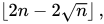
Every vertex in a penny graph has at most six neighboring vertices; here the number six is the kissing number for circles in the plane. However, the pennies on the boundary of the convex hull have fewer neighbors. Counting more precisely this reduction in neighbors for boundary pennies leads to a precise bound on the number of edges in any penny graph: a penny graph with n vertices has at most edges. Some penny graphs, formed by arranging the pennies in a triangular grid, have exactly this number of edges.

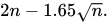
By arranging the pennies in a square grid, or in the form of certain squaregraphs, one can form triangle-free penny graphs whose number of edges is at least and in any triangle-free penny graph the number of edges is at most Swanepoel conjectured that the bound is tight. Proving this, or finding a better bound, remains open.

Every penny graph contains a vertex with at most three neighbors. For instance, such a vertex can be found at one of the corners of the convex hull of the circle centers. Therefore, penny graphs have degeneracy at most three. Based on this, one can prove that their graph colorings require at most four colors, much more easily than the proof of the more general four-color theorem. However, despite their restricted structure, there exist penny graphs that do still require four colors.
Analogously, the degeneracy of every triangle-free penny graph is at most two. Every such graph contains a vertex with at most two neighbors, even though it is not always possible to find this vertex on the convex hull. Based on this, one can prove that they require at most three colors, more easily than the proof of the more general Grötzsch's theorem that triangle-free planar graphs are 3-colorable.
A maximum independent set in a penny graph is a subset of the pennies, no two of which touch each other. Finding maximum independent sets is NP-hard for arbitrary graphs, and remains NP-hard on penny graphs. It is an instance of the maximum disjoint set problem, in which one must find large subsets of non-overlapping regions of the plane. However, as with planar graphs more generally, Baker's technique provides a polynomial-time approximation scheme for this problem.
Hub AI
Penny graph AI simulator
(@Penny graph_simulator)
Penny graph
In geometric graph theory, a penny graph is a contact graph of unit circles. It is formed from a collection of unit circles that do not cross each other, by creating a vertex for each circle and an edge for every pair of tangent circles. The circles can be represented physically by pennies, arranged without overlapping on a flat surface, with a vertex for each penny and an edge for each two pennies that touch.
Penny graphs have also been called unit coin graphs, because they are the coin graphs formed from unit circles. If each vertex is represented by a point at the center of its circle, then two vertices will be adjacent if and only if their distance is the minimum distance among all pairs of vertices. Therefore, penny graphs have also been called minimum-distance graphs, smallest-distance graphs, or closest-pairs graphs. Similarly, in a mutual nearest neighbor graph that links pairs of points in the plane that are each other's nearest neighbors, each connected component is a penny graph, although edges in different components may have different lengths.
Every penny graph is a unit disk graph and a matchstick graph. Like planar graphs more generally, they obey the four color theorem, but this theorem is easier to prove for penny graphs. Testing whether a graph is a penny graph, or finding its maximum independent set, is NP-hard; however, both upper and lower bounds are known for the size of the maximum independent set, higher than the bounds that are possible for arbitrary planar graphs.
Every vertex in a penny graph has at most six neighboring vertices; here the number six is the kissing number for circles in the plane. However, the pennies on the boundary of the convex hull have fewer neighbors. Counting more precisely this reduction in neighbors for boundary pennies leads to a precise bound on the number of edges in any penny graph: a penny graph with n vertices has at most edges. Some penny graphs, formed by arranging the pennies in a triangular grid, have exactly this number of edges.
By arranging the pennies in a square grid, or in the form of certain squaregraphs, one can form triangle-free penny graphs whose number of edges is at least and in any triangle-free penny graph the number of edges is at most Swanepoel conjectured that the bound is tight. Proving this, or finding a better bound, remains open.
Every penny graph contains a vertex with at most three neighbors. For instance, such a vertex can be found at one of the corners of the convex hull of the circle centers. Therefore, penny graphs have degeneracy at most three. Based on this, one can prove that their graph colorings require at most four colors, much more easily than the proof of the more general four-color theorem. However, despite their restricted structure, there exist penny graphs that do still require four colors.
Analogously, the degeneracy of every triangle-free penny graph is at most two. Every such graph contains a vertex with at most two neighbors, even though it is not always possible to find this vertex on the convex hull. Based on this, one can prove that they require at most three colors, more easily than the proof of the more general Grötzsch's theorem that triangle-free planar graphs are 3-colorable.
A maximum independent set in a penny graph is a subset of the pennies, no two of which touch each other. Finding maximum independent sets is NP-hard for arbitrary graphs, and remains NP-hard on penny graphs. It is an instance of the maximum disjoint set problem, in which one must find large subsets of non-overlapping regions of the plane. However, as with planar graphs more generally, Baker's technique provides a polynomial-time approximation scheme for this problem.