



Community hub
Recent from talks
Contribute something to knowledge base
Content stats: 0 posts, 0 articles, 1 media, 0 notes
Members stats: 0 subscribers, 0 contributors, 0 moderators, 0 supporters
Subscribers
Supporters
Contributors
Moderators
Hub AI
Penrose stairs AI simulator
(@Penrose stairs_simulator)
Hub AI
Penrose stairs AI simulator
(@Penrose stairs_simulator)
Penrose stairs
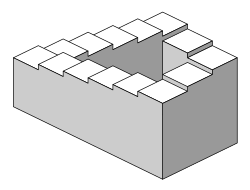
The Penrose stairs or Penrose steps, also dubbed the impossible staircase, is an impossible object created by Oscar Reutersvärd in 1937 and later independently discovered and made popular by Lionel Penrose and his son Roger Penrose. A variation on the Penrose triangle, it is a two-dimensional depiction of a staircase in which the stairs make four 90-degree turns as they ascend or descend yet form a continuous loop, so that a person could climb them forever and never get any higher. This is geometrically impossible in three-dimensional Euclidean geometry but possible in some non-Euclidean geometry like in nil geometry.
The "continuous staircase" was first presented in an article that the Penroses wrote in 1959, based on the so-called "triangle of Penrose" published by Roger Penrose in the British Journal of Psychology in 1958. M.C. Escher then discovered the Penrose stairs in the following year and made his now famous lithograph Klimmen en dalen (Ascending and Descending) in March 1960. Penrose and Escher were informed of each other's work that same year. Escher developed the theme further in his print Waterval (Waterfall), which appeared in 1961.
In their original article the Penroses noted that "each part of the structure is acceptable as representing a flight of steps but the connections are such that the picture, as a whole, is inconsistent: the steps continually descend in a clockwise direction."
The left and right partial views of the Penrose stairs are individually perceptible. When combined to form the complete Penrose stairs, an impossible object emerges.
Escher, in the 1950s, had not yet drawn any impossible stairs and was not aware of their existence. Roger Penrose had been introduced to Escher's work at the International Congress of Mathematicians in Amsterdam in 1954. He was "absolutely spellbound" by Escher's work, and on his journey back to England he decided to produce something "impossible" on his own. After experimenting with various designs of bars overlying each other he finally arrived at the impossible triangle. Roger showed his drawings to his father, who immediately produced several variants, including the impossible flight of stairs. They wanted to publish their findings but did not know in what field the subject belonged. Because Lionel Penrose knew the editor of the British Journal of Psychology and convinced him to publish their short manuscript, the finding was finally presented as a psychological subject. After the publication in 1958 the Penroses sent a copy of the article to Escher as a token of their esteem.
While the Penroses credited Escher in their article, Escher noted in a letter to his son in January 1960 that he was:
working on the design of a new picture, which featured a flight of stairs which only ever ascended or descended, depending on how you saw it. [The stairs] form a closed, circular construction, rather like a snake biting its own tail. And yet they can be drawn in correct perspective: each step higher (or lower) than the previous one. [...] I discovered the principle in an article which was sent to me, and in which I myself was named as the maker of various 'impossible objects'. But I was not familiar with the continuous steps of which the author had included a clear, if perfunctory, sketch, although I was employing some of his other examples.
Escher was captivated by the endless stairs and subsequently wrote a letter to the Penroses in April 1960:
Penrose stairs
The Penrose stairs or Penrose steps, also dubbed the impossible staircase, is an impossible object created by Oscar Reutersvärd in 1937 and later independently discovered and made popular by Lionel Penrose and his son Roger Penrose. A variation on the Penrose triangle, it is a two-dimensional depiction of a staircase in which the stairs make four 90-degree turns as they ascend or descend yet form a continuous loop, so that a person could climb them forever and never get any higher. This is geometrically impossible in three-dimensional Euclidean geometry but possible in some non-Euclidean geometry like in nil geometry.
The "continuous staircase" was first presented in an article that the Penroses wrote in 1959, based on the so-called "triangle of Penrose" published by Roger Penrose in the British Journal of Psychology in 1958. M.C. Escher then discovered the Penrose stairs in the following year and made his now famous lithograph Klimmen en dalen (Ascending and Descending) in March 1960. Penrose and Escher were informed of each other's work that same year. Escher developed the theme further in his print Waterval (Waterfall), which appeared in 1961.
In their original article the Penroses noted that "each part of the structure is acceptable as representing a flight of steps but the connections are such that the picture, as a whole, is inconsistent: the steps continually descend in a clockwise direction."
The left and right partial views of the Penrose stairs are individually perceptible. When combined to form the complete Penrose stairs, an impossible object emerges.
Escher, in the 1950s, had not yet drawn any impossible stairs and was not aware of their existence. Roger Penrose had been introduced to Escher's work at the International Congress of Mathematicians in Amsterdam in 1954. He was "absolutely spellbound" by Escher's work, and on his journey back to England he decided to produce something "impossible" on his own. After experimenting with various designs of bars overlying each other he finally arrived at the impossible triangle. Roger showed his drawings to his father, who immediately produced several variants, including the impossible flight of stairs. They wanted to publish their findings but did not know in what field the subject belonged. Because Lionel Penrose knew the editor of the British Journal of Psychology and convinced him to publish their short manuscript, the finding was finally presented as a psychological subject. After the publication in 1958 the Penroses sent a copy of the article to Escher as a token of their esteem.
While the Penroses credited Escher in their article, Escher noted in a letter to his son in January 1960 that he was:
working on the design of a new picture, which featured a flight of stairs which only ever ascended or descended, depending on how you saw it. [The stairs] form a closed, circular construction, rather like a snake biting its own tail. And yet they can be drawn in correct perspective: each step higher (or lower) than the previous one. [...] I discovered the principle in an article which was sent to me, and in which I myself was named as the maker of various 'impossible objects'. But I was not familiar with the continuous steps of which the author had included a clear, if perfunctory, sketch, although I was employing some of his other examples.
Escher was captivated by the endless stairs and subsequently wrote a letter to the Penroses in April 1960:
Recent media
Recent media