Recent from talks
Nothing was collected or created yet.
Forward secrecy
View on Wikipedia
In cryptography, forward secrecy (FS), also known as perfect forward secrecy (PFS), is a feature of specific key-agreement protocols that gives assurances that session keys will not be compromised even if long-term secrets used in the session key exchange are compromised, limiting damage.[1][2][3] For TLS, the long-term secret is typically the private key of the server. Forward secrecy protects past sessions against future compromises of keys or passwords. By generating a unique session key for every session a user initiates, the compromise of a single session key will not affect any data other than that exchanged in the specific session protected by that particular key. This by itself is not sufficient for forward secrecy which additionally requires that a long-term secret compromise does not affect the security of past session keys.
Forward secrecy protects data on the transport layer of a network that uses common transport layer security protocols, including OpenSSL,[4] when its long-term secret keys are compromised, as with the Heartbleed security bug. If forward secrecy is used, encrypted communications and sessions recorded in the past cannot be retrieved and decrypted should long-term secret keys or passwords be compromised in the future, even if the adversary actively interfered, for example via a man-in-the-middle (MITM) attack.
The value of forward secrecy is that it protects past communication. This reduces the motivation for attackers to compromise keys. For instance, if an attacker learns a long-term key, but the compromise is detected and the long-term key is revoked and updated, relatively little information is leaked in a forward secure system.
The value of forward secrecy depends on the assumed capabilities of an adversary. Forward secrecy has value if an adversary is assumed to be able to obtain secret keys from a device (read access) but is either detected or unable to modify the way session keys are generated in the device (full compromise). In some cases an adversary who can read long-term keys from a device may also be able to modify the functioning of the session key generator, as in the backdoored Dual Elliptic Curve Deterministic Random Bit Generator. If an adversary can make the random number generator predictable, then past traffic will be protected but all future traffic will be compromised.
The value of forward secrecy is limited not only by the assumption that an adversary will attack a server by only stealing keys and not modifying the random number generator used by the server but it is also limited by the assumption that the adversary will only passively collect traffic on the communications link and not be active using a man-in-the-middle attack. Forward secrecy typically uses an ephemeral Diffie–Hellman key exchange to prevent reading past traffic. The ephemeral Diffie–Hellman key exchange is often signed by the server using a static signing key. If an adversary can steal (or obtain through a court order) this static (long term) signing key, the adversary can masquerade as the server to the client and as the client to the server and implement a classic man-in-the-middle attack.[5]
History
[edit]The term "perfect forward secrecy" was coined by C. G. Günther in 1990[6] and further discussed by Whitfield Diffie, Paul van Oorschot, and Michael James Wiener in 1992,[7] where it was used to describe a property of the Station-to-Station protocol.[8]
Forward secrecy has also been used to describe the analogous property of password-authenticated key agreement protocols where the long-term secret is a (shared) password.[9]
In 2000 the IEEE first ratified IEEE 1363, which establishes the related one-party and two-party forward secrecy properties of various standard key agreement schemes.[10]
Definition
[edit]An encryption system has the property of forward secrecy if plain-text (decrypted) inspection of the data exchange that occurs during key agreement phase of session initiation does not reveal the key that was used to encrypt the remainder of the session.
Example
[edit]The following is a hypothetical example of a simple instant messaging protocol that employs forward secrecy:
- Alice and Bob each generate a pair of long-term, asymmetric public and private keys, then verify public-key fingerprints in person or over an already-authenticated channel. Verification establishes with confidence that the claimed owner of a public key is the actual owner.
- Alice and Bob use a key exchange algorithm such as Diffie–Hellman, to securely agree on an ephemeral session key. They use the keys from step 1 only to authenticate one another during this process.
- Alice sends Bob a message, encrypting it with a symmetric cipher using the session key negotiated in step 2.
- Bob decrypts Alice's message using the key negotiated in step 2.
- The process repeats for each new message sent, starting from step 2 (and switching Alice and Bob's roles as sender/receiver as appropriate). Step 1 is never repeated.
Forward secrecy (achieved by generating new session keys for each message) ensures that past communications cannot be decrypted if one of the keys generated in an iteration of step 2 is compromised, since such a key is only used to encrypt a single message. Forward secrecy also ensures that past communications cannot be decrypted if the long-term private keys from step 1 are compromised. However, masquerading as Alice or Bob would be possible going forward if this occurred, possibly compromising all future messages.
Attacks
[edit]Forward secrecy is designed to prevent the compromise of a long-term secret key from affecting the confidentiality of past conversations. However, forward secrecy cannot defend against a successful cryptanalysis of the underlying ciphers being used, since a cryptanalysis consists of finding a way to decrypt an encrypted message without the key, and forward secrecy only protects keys, not the ciphers themselves.[11] A patient attacker can capture a conversation whose confidentiality is protected through the use of public-key cryptography and wait until the underlying cipher is broken (e.g. large quantum computers could be created which allow the discrete logarithm problem to be computed quickly), a.k.a. harvest now, decrypt later attacks. This would allow the recovery of old plaintexts even in a system employing forward secrecy.
Non-interactive forward-secure key exchange protocols face additional threats that are not relevant to interactive protocols. In a message suppression attack, an attacker in control of the network may itself store messages while preventing them from reaching the intended recipient; as the messages are never received, the corresponding private keys may not be destroyed or punctured, so a compromise of the private key can lead to successful decryption. Proactively retiring private keys on a schedule mitigates, but does not eliminate, this attack. In a malicious key exhaustion attack, the attacker sends many messages to the recipient and exhausts the private key material, forcing a protocol to choose between failing closed (and enabling denial of service attacks) or failing open (and giving up some amount of forward secrecy).[12]
Non-interactive forward secrecy
[edit]Most key exchange protocols are interactive, requiring bidirectional communication between the parties. A protocol that permits the sender to transmit data without first needing to receive any replies from the recipient may be called non-interactive, or asynchronous, or zero round trip (0-RTT).[13][14]
Interactivity is onerous for some applications—for example, in a secure messaging system, it may be desirable to have a store-and-forward implementation, rather than requiring sender and recipient to be online at the same time; loosening the bidirectionality requirement can also improve performance even where it is not a strict requirement, for example at connection establishment or resumption. These use cases have stimulated interest in non-interactive key exchange, and, as forward security is a desirable property in a key exchange protocol, in non-interactive forward secrecy.[15][16] This combination has been identified as desirable since at least 1996.[17] However, combining forward secrecy and non-interactivity has proven challenging;[18] it had been suspected that forward secrecy with protection against replay attacks was impossible non-interactively, but it has been shown to be possible to achieve all three desiderata.[14]
Broadly, two approaches to non-interactive forward secrecy have been explored, pre-computed keys and puncturable encryption.[16]
With pre-computed keys, many key pairs are created and the public keys shared, with the private keys destroyed after a message has been received using the corresponding public key. This approach has been deployed as part of the Signal protocol.[19]
In puncturable encryption, the recipient modifies their private key after receiving a message in such a way that the new private key cannot read the message but the public key is unchanged. Ross J. Anderson informally described a puncturable encryption scheme for forward secure key exchange in 1997,[20] and Green & Miers (2015) formally described such a system,[21] building on the related scheme of Canetti, Halevi & Katz (2003), which modifies the private key according to a schedule so that messages sent in previous periods cannot be read with the private key from a later period.[18] Green & Miers (2015) make use of hierarchical identity-based encryption and attribute-based encryption, while Günther et al. (2017) use a different construction that can be based on any hierarchical identity-based scheme.[22] Dallmeier et al. (2020) experimentally found that modifying QUIC to use a 0-RTT forward secure and replay-resistant key exchange implemented with puncturable encryption incurred significantly increased resource usage, but not so much as to make practical use infeasible.[23]
Weak perfect forward secrecy
[edit]Weak perfect forward secrecy (Wpfs) is the weaker property whereby when agents' long-term keys are compromised, the secrecy of previously established session-keys is guaranteed, but only for sessions in which the adversary did not actively interfere. This new notion, and the distinction between this and forward secrecy was introduced by Hugo Krawczyk in 2005.[24][25] This weaker definition implicitly requires that full (perfect) forward secrecy maintains the secrecy of previously established session keys even in sessions where the adversary did actively interfere, or attempted to act as a man in the middle.
Protocols
[edit]Forward secrecy is present in several protocol implementations, such as SSH and as an optional feature in IPsec (RFC 2412). Off-the-Record Messaging, a cryptography protocol and library for many instant messaging clients, as well as OMEMO which provides additional features such as multi-user functionality in such clients, both provide forward secrecy as well as deniable encryption.
In Transport Layer Security (TLS), cipher suites based on Diffie–Hellman key exchange (DHE-RSA, DHE-DSA) and elliptic curve Diffie–Hellman key exchange (ECDHE-RSA, ECDHE-ECDSA) are available. In theory, TLS can use forward secrecy since SSLv3, but many implementations do not offer forward secrecy or provided it with lower grade encryption.[26] TLS 1.3 removed support for RSA for key exchange, leaving Diffie-Hellman (with forward-secrecy) as the sole algorithm for key exchange.[27]
OpenSSL supports forward secrecy using elliptic curve Diffie–Hellman since version 1.0,[28] with a computational overhead of approximately 15% for the initial handshake.[29]
The Signal Protocol uses the Double Ratchet Algorithm to provide forward secrecy.[30]
On the other hand, among popular protocols currently in use, WPA Personal did not support forward secrecy before WPA3.[31]
Use
[edit]Since late 2011, Google provided forward secrecy with TLS by default to users of its Gmail service, Google Docs service, and encrypted search services.[28] Since November 2013, Twitter provided forward secrecy with TLS to its users.[32] Wikis hosted by the Wikimedia Foundation have all provided forward secrecy to users since July 2014[33] and are requiring the use of forward secrecy since August 2018.
Facebook reported as part of an investigation into email encryption that, as of May 2014, 74% of hosts that support STARTTLS also provide forward secrecy.[34] TLS 1.3, published in August 2018, dropped support for ciphers without forward secrecy. As of February 2019[update], 96.6% of web servers surveyed support some form of forward secrecy, and 52.1% will use forward secrecy with most browsers.[35]
At WWDC 2016, Apple announced that all iOS apps would need to use App Transport Security (ATS), a feature which enforces the use of HTTPS transmission. Specifically, ATS requires the use of an encryption cipher that provides forward secrecy.[36] ATS became mandatory for apps on January 1, 2017.[37]
The Signal messaging application employs forward secrecy in its protocol, notably differentiating it from messaging protocols based on PGP.[38]
Forward secrecy is supported on 92.6% of websites on modern browsers, while 0.3% of websites do not support forward secrecy at all as of May 2024.[39]
See also
[edit]References
[edit]- ^ "Perfect Forward Secrecy Explained: How it Works, In IPsec, SSL". Bootcamp Security. 2024-10-17. Retrieved 2025-05-08.
- ^ Boyd, Colin; Gellert, Kai (2021-04-19). "A Modern View on Forward Security". The Computer Journal. 64 (4): 639–652. doi:10.1093/comjnl/bxaa104. hdl:11250/2730309. ISSN 0010-4620.
- ^ Krawczyk, Hugo (2005), "Perfect Forward Secrecy", in van Tilborg, Henk C. A. (ed.), Encyclopedia of Cryptography and Security, Boston, MA: Springer US, pp. 457–458, doi:10.1007/0-387-23483-7_298, ISBN 978-0-387-23483-0, retrieved 2025-05-08
- ^ "/docs/man1.1.1/man3/SSL_set_tmp_dh.html". www.openssl.org. Retrieved 2024-05-25.
- ^ "tls - Does Perfect Forward Secrecy (PFS) make Man-in-the-Middle (MitM) attacks more difficult?". Information Security Stack Exchange. Retrieved 2020-10-11.
- ^ Günther, C. G. (1990). An identity-based key-exchange protocol. Advances in Cryptology EUROCRYPT '89 (LNCS 434). pp. 29–37.
- ^ Menzies, Alfred; van Oorscot, Paul C; Vanstone, SCOTT (1997). Handbook of Applied Cryptography. CRC Pres. ISBN 978-0-8493-8523-0.
- ^ Diffie, Whitfield; van Oorschot, Paul C.; Wiener, Michael J. (June 1992). "Authentication and Authenticated Key Exchanges" (PDF). Designs, Codes and Cryptography. 2 (2): 107–125. CiteSeerX 10.1.1.59.6682. doi:10.1007/BF00124891. S2CID 7356608. Retrieved 2013-09-07.
- ^ Jablon, David P. (October 1996). "Strong Password-Only Authenticated Key Exchange". ACM Computer Communication Review. 26 (5): 5–26. CiteSeerX 10.1.1.81.2594. doi:10.1145/242896.242897. S2CID 2870433.
- ^ "IEEE 1363-2000 - IEEE Standard Specifications for Public-Key Cryptography". IEEE. Retrieved 2018-06-14.
- ^ Nilsson, Dennis K.; Roosta, Tanya; Lindqvist, Ulf; Valdes, Alfonso (2008-03-31). "Key management and secure software updates in wireless process control environments". Proceedings of the first ACM conference on Wireless network security. WiSec '08. Alexandria, VA, USA: Association for Computing Machinery. pp. 100–108. doi:10.1145/1352533.1352550. ISBN 978-1-59593-814-5. S2CID 15382932.
- ^ Boyd & Gellert 2020, p. 645.
- ^ Boyd & Gellert 2020, p. 639-640.
- ^ a b Günther et al. 2017, p. 1.
- ^ Boyd & Gellert 2020, p. 640.
- ^ a b Boyd & Gellert 2020, p. 643.
- ^ Back 1996.
- ^ a b Green & Miers 2015, p. 1.
- ^ Boyd & Gellert 2020, p. 644-645.
- ^ Anderson 2002.
- ^ Boyd & Gellert 2020, p. 643-644.
- ^ Günther et al. 2017, p. 5.
- ^ Dallmeier et al. 2020, p. 18-19.
- ^ Krawczyk, Hugo (2005). HMQV: A High-Performance Secure Diffie-Hellman Protocol. Advances in Cryptology – CRYPTO 2005. Lecture Notes in Computer Science. Vol. 3621. pp. 546–566. doi:10.1007/11535218_33. ISBN 978-3-540-28114-6.
- ^ Cremers, Cas; Feltz, Michèle (2015). "Beyond eCK: perfect forward secrecy under actor compromise and ephemeral-key reveal" (PDF). Designs, Codes and Cryptography. 74 (1): 183–218. CiteSeerX 10.1.1.692.1406. doi:10.1007/s10623-013-9852-1. hdl:20.500.11850/73097. S2CID 53306672. Retrieved 8 December 2015.
- ^ Discussion on the TLS mailing list in October 2007
- ^ "A Detailed Look at RFC 8446 (a.k.a. TLS 1.3)". The Cloudflare Blog. 2018-08-10. Retrieved 2019-02-26.
- ^ a b "Protecting data for the long term with forward secrecy". Retrieved 2012-11-05.
- ^ Vincent Bernat (28 November 2011). "SSL/TLS & Perfect Forward Secrecy". Retrieved 2012-11-05.
- ^ Unger, Nik; Dechand, Sergej; Bonneau, Joseph; Fahl, Sascha; Perl, Henning; Goldberg, Ian; Smith, Matthew (17–21 May 2015). "SoK: Secure Messaging". 2015 IEEE Symposium on Security and Privacy (PDF). San Jose, CA: Institute of Electrical and Electronics Engineers. p. 241. doi:10.1109/SP.2015.22. ISBN 978-1-4673-6949-7. S2CID 2471650. Retrieved 4 December 2015.
- ^ "Wi-Fi Gets More Secure: Everything You Need to Know About WPA3 - IEEE Spectrum". IEEE. Retrieved 2024-05-04.
- ^ Hoffman-Andrews, Jacob. "Forward Secrecy at Twitter". Twitter. Retrieved 25 November 2013.
- ^ "Tech/News/2014/27 - Meta". Wikimedia Foundation. 2014-06-30. Retrieved 30 June 2014.
- ^ "The Current State of SMTP STARTTLS Deployment". Facebook. Retrieved 7 June 2014.
- ^ Qualys SSL Labs. "SSL Pulse". Archived from the original (3 February 2019) on 15 February 2019. Retrieved 25 February 2019.
- ^ "iOS 9.0".
- ^ "App Transport Security REQUIRED January 2017 | Apple Developer Forums". forums.developer.apple.com. Retrieved 2016-10-20.
- ^ Evans, Jon (22 January 2017). "WhatsApp, Signal, and dangerously ignorant journalism". TechCrunch. Retrieved 18 April 2018.
- ^ "Qualys SSL Labs - SSL Pulse". www.ssllabs.com. Retrieved 2024-05-25.
Bibliography
[edit]- Anderson, Ross (2002). "Two Remarks on Public Key Cryptology" (PDF).
- Canetti, Ran; Halevi, Shai; Katz, Jonathan (2003). "A Forward-Secure Public-Key Encryption Scheme". Advances in Cryptology — EUROCRYPT 2003. Lecture Notes in Computer Science. Vol. 2656. pp. 255–271. doi:10.1007/3-540-39200-9_16. ISBN 978-3-540-14039-9.
- Green, Matthew D.; Miers, Ian (2015). "Forward Secure Asynchronous Messaging from Puncturable Encryption". 2015 IEEE Symposium on Security and Privacy. pp. 305–320. doi:10.1109/SP.2015.26. ISBN 978-1-4673-6949-7. S2CID 9171925.
- Günther, Felix; Hale, Britta; Jager, Tibor; Lauer, Sebastian (2017). "0-RTT Key Exchange with Full Forward Secrecy" (PDF).
- Back, Adam (6 September 1996). "non-interactive forward secrecy". Cypherpunks (Mailing list).
- Boyd, Colin; Gellert, Kai (24 August 2020). "A Modern View on Forward Security". The Computer Journal. 64 (4) (published April 2021): 639–652. doi:10.1093/comjnl/bxaa104. hdl:11250/2730309. Archived from the original on 7 June 2021. Retrieved 8 June 2021.
- Dallmeier, Fynn; Drees, Jan P.; Gellert, Kai; Handrik, Tobias; Jager, Tibor; Klauke, Jonas; Nachtigall, Simon; Renzelmann, Timo; Wolf, Rudi (2020). "Forward-Secure 0-RTT Goes Live: Implementation and Performance Analysis in QUIC" (PDF).
External links
[edit]- RFC 2412 IETF, H. Orman. The OAKLEY Key Determination Protocol
- Perfect Forward Secrecy can block the NSA from secure web pages, but no one uses it Computerworld June 21, 2013
- SSL: Intercepted today, decrypted tomorrow Netcraft June 25, 2013
- Deploying Forward Secrecy SSL Labs June 25, 2013
- SSL Labs test for web browsers
- SSL Labs test for web servers
Forward secrecy
View on GrokipediaFundamentals
Definition
Forward secrecy is a security property in authenticated key exchange protocols that ensures the compromise of long-term secrets does not enable an adversary to recover session keys from previously completed sessions.[6] This property holds even if the long-term keys used for authentication are later exposed, as long as the session keys were securely established and discarded after use.[6] Key properties of forward secrecy include the use of ephemeral keys generated independently for each session, which are deleted immediately after deriving the session key, thereby preventing retrospective decryption of past communications.[6] These session keys are derived in a way that depends on the ephemeral keys but not directly on the long-term keys, ensuring independence across sessions.[6] The protection applies exclusively to past sessions and does not extend to future ones.[6] The mathematical foundation typically involves deriving session keys from ephemeral private values in a key exchange, such as in the Diffie-Hellman protocol, where the shared secret is computed as , with and as ephemeral exponents chosen by each party and discarded after the computation.[7] Security relies on the computational Diffie-Hellman assumption, which states that an adversary cannot efficiently compute given and .[6] Forward secrecy, also known as perfect forward secrecy (PFS), provides this guarantee in the context of authenticated key exchanges, which resist active adversaries including man-in-the-middle attacks through authentication mechanisms. Forward secrecy differs from backward secrecy (also known as future secrecy), which protects future sessions from compromise of current secrets by ensuring that newly generated keys are independent of previously compromised material.[8] It is also distinct from key confirmation, an authentication property that verifies both parties possess the same session key but does not address secrecy against future compromises.[9] Forward secrecy is essential in protocols like TLS to secure session-specific communications against long-term key exposure.Importance and Related Concepts
Forward secrecy is crucial for safeguarding encrypted communications against long-term key compromises, particularly in scenarios involving mass surveillance or targeted attacks by adversaries who may passively collect traffic over extended periods.[10] By generating ephemeral session keys that are discarded after use, it ensures that even if a server's long-term private keys are later exposed, past sessions remain undecryptable, thereby mitigating the impact of breaches and enhancing overall privacy.[11] This property makes mass surveillance efforts more resource-intensive, as attackers cannot retroactively decrypt historical data without compromising keys in real-time.[12] Unlike entity authentication, which verifies the identities of communicating parties during session establishment but does not isolate session keys from long-term credential compromises, forward secrecy specifically protects session confidentiality post-authentication.[11] It also differs from non-repudiation, which focuses on proving the origin and integrity of messages to prevent denial by senders, without addressing future key exposure risks.[13] In contrast to IND-CCA security, which guarantees semantic security against chosen-ciphertext attacks during a session but offers no protection against subsequent long-term key revelations that could decrypt prior traffic, forward secrecy provides an additional layer of temporal isolation.[14] The primary trade-off of forward secrecy involves increased computational overhead from generating and managing ephemeral keys for each session, which can elevate latency in resource-constrained environments compared to static key reuse.[15] However, this cost is often justified in key rotation scenarios, where frequent ephemeral exchanges limit the window of vulnerability and support scalable, secure systems without perpetual exposure from a single breach.[16] In practice, forward secrecy enables secure cloud storage systems by ensuring that user data encrypted with session keys remains protected even if service provider keys are compromised years later, reducing perpetual breach risks.[17] Similarly, for VoIP applications, it protects real-time conversations from retrospective decryption, allowing privacy-preserving calls without ongoing threats from network operator or endpoint compromises.[18]Historical Development
Origins
The concept of forward secrecy emerged in the early 1990s as a response to growing concerns over secure communication systems vulnerable to long-term key compromises. It was formally introduced in 1992 by Whitfield Diffie, Paul C. van Oorschot, and Michael J. Wiener in their seminal work on authentication and authenticated key exchanges, where they defined it as a property ensuring that disclosure of long-term secret keys does not compromise the secrecy of prior session keys. This conceptualization arose amid debates on key escrow mechanisms proposed for secure telephone systems, emphasizing the need for ephemeral session keys independent of persistent master keys to mitigate risks from government-mandated recovery schemes. A key precursor to forward secrecy was the Diffie-Hellman key exchange protocol, published in 1976 by Whitfield Diffie and Martin Hellman, which enabled the generation of temporary shared secrets without revealing long-term private keys, laying the groundwork for ephemeral exchanges essential to achieving forward secrecy. Earlier theoretical foundations can be traced to Claude Shannon's 1949 communication theory of secrecy systems, which described perfect secrecy as the inability to derive plaintext from ciphertext without the key; however, this was not extended to dynamic, session-specific keys until later developments in public-key cryptography. The primary motivations for forward secrecy stemmed from 1990s U.S. government proposals for key recovery in encryption systems, such as the 1993 Clipper chip initiative for secure phones, which required escrowed keys to enable lawful interception but undermined session independence. Cryptographers including Matt Blaze, Whitfield Diffie, and others critiqued these systems, arguing that key escrow inherently destroys forward secrecy by allowing retroactive decryption of past sessions, even after keys are discarded.[19] This highlighted the necessity of protocols where each communication session uses unique, short-lived keys to protect against future breaches of long-term credentials, particularly in response to interception mandates.[20]Key Milestones and Standardization
In the early 2000s, forward secrecy gained practical integration into established protocols. The Internet Key Exchange version 2 (IKEv2), specified in RFC 4306 and published in December 2005, enabled perfect forward secrecy in IPsec through the use of ephemeral Diffie-Hellman key exchanges during authentication and key agreement phases.[21] This update streamlined IPsec's security architecture, allowing for secure, temporary session keys that protected against long-term key compromises. Concurrently, early TLS extensions advanced forward secrecy support; for instance, RFC 4492 in May 2006 introduced elliptic curve cryptography (ECC) cipher suites, including Elliptic Curve Diffie-Hellman Ephemeral (ECDHE), which provided efficient forward secrecy for TLS handshakes. The IETF further emphasized perfect forward secrecy in TLS 1.2, outlined in RFC 5246 from August 2008, by recommending cipher suites that employ ephemeral key exchanges to mitigate risks from static key reuse.[2] The 2010s marked accelerated adoption driven by heightened security awareness. Edward Snowden's 2013 revelations about NSA capabilities to exploit non-forward-secret connections prompted widespread pushes for ephemeral key usage in protocols, significantly boosting deployment in web traffic and VPNs.[22] In messaging, the Signal Protocol's Double Ratchet Algorithm, detailed in a 2016 specification by Moxie Marlinspike and Trevor Perrin, popularized forward secrecy through iterative key ratcheting, ensuring that compromised session keys did not expose prior or future messages.[23] Standardization efforts solidified forward secrecy as a core requirement. The National Institute of Standards and Technology (NIST) updated its key management guidelines in SP 800-57 Part 1 Revision 5 in May 2020, recommending ephemeral keys to achieve forward secrecy and recommending their use in protocols to limit exposure from key compromises.[24] For mobile networks, the European Telecommunications Standards Institute (ETSI) in TS 133 501 (initial release 2018, with ongoing updates) mandated forward secrecy in 5G security architecture via key derivation functions and ephemeral challenges in the 5G-AKA authentication protocol, ensuring session keys remain secure post-authentication.[25] Recent developments up to 2025 have embedded forward secrecy more deeply into infrastructure. IETF RFC 8446, published in August 2018, defined TLS 1.3 and required all key exchanges to use ephemeral Diffie-Hellman variants, eliminating non-forward-secret options like static RSA and thereby enforcing perfect forward secrecy by default.[4] Additionally, the EU's General Data Protection Regulation (GDPR), effective since 2018, has influenced forward secrecy adoption in data protection by mandating "appropriate technical measures" such as encryption under Article 32 to ensure a level of security appropriate to the risk.Core Mechanisms
Basic Principles
Forward secrecy relies on the generation of ephemeral key pairs for each communication session, enabling parties to establish a unique shared secret without depending on long-term private keys for the session key itself.[11] In this process, each participant creates a temporary asymmetric key pair, exchanges the public components, computes the shared secret using a secure key agreement algorithm such as ephemeral Diffie-Hellman, and then immediately discards the private keys to prevent their use in future sessions. This ensures that compromise of long-term keys does not retroactively expose prior session contents. The foundational primitives involve asymmetric key exchanges, exemplified by Diffie-Hellman or elliptic curve variants like ECDH, which allow computation of a shared secret from public information alone. These are typically combined with hybrid encryption, where the asymmetric exchange securely derives a symmetric session key for efficient bulk data protection, often using authenticated encryption modes to safeguard the handshake. Key requirements include cryptographically secure randomness for generating ephemeral keys, as predictable values could enable reconstruction of past shared secrets.[26] Additionally, the key exchange must resist chosen-ciphertext attacks (CCA) to prevent adversaries from forging ciphertexts that reveal information about the shared secret during the agreement phase. In a typical client-server handshake flow:- The client generates an ephemeral key pair and transmits its public key to the server.
- The server responds by generating its own ephemeral key pair, sending the public key, and optionally authenticating the exchange.
- Both parties independently compute the shared secret from the received public key and their private key.
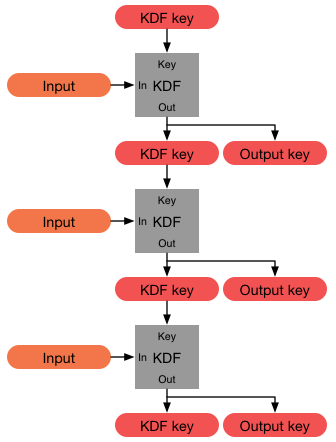
- A key derivation function (KDF) processes the shared secret—along with nonces or other inputs—to produce a unique symmetric session key.
- Private ephemeral keys are discarded immediately after derivation, leaving only the session key for ongoing encryption.
