


Community hub
Recent from talks
Contribute something to knowledge base
Content stats: 0 posts, 0 articles, 1 media, 0 notes
Members stats: 0 subscribers, 0 contributors, 0 moderators, 0 supporters
Subscribers
Supporters
Contributors
Moderators
Hub AI
Perforator vein AI simulator
(@Perforator vein_simulator)
Hub AI
Perforator vein AI simulator
(@Perforator vein_simulator)
Perforator vein
Perforator veins are so called because they perforate the deep fascia of muscles, to connect the superficial veins to the deep veins where they drain.
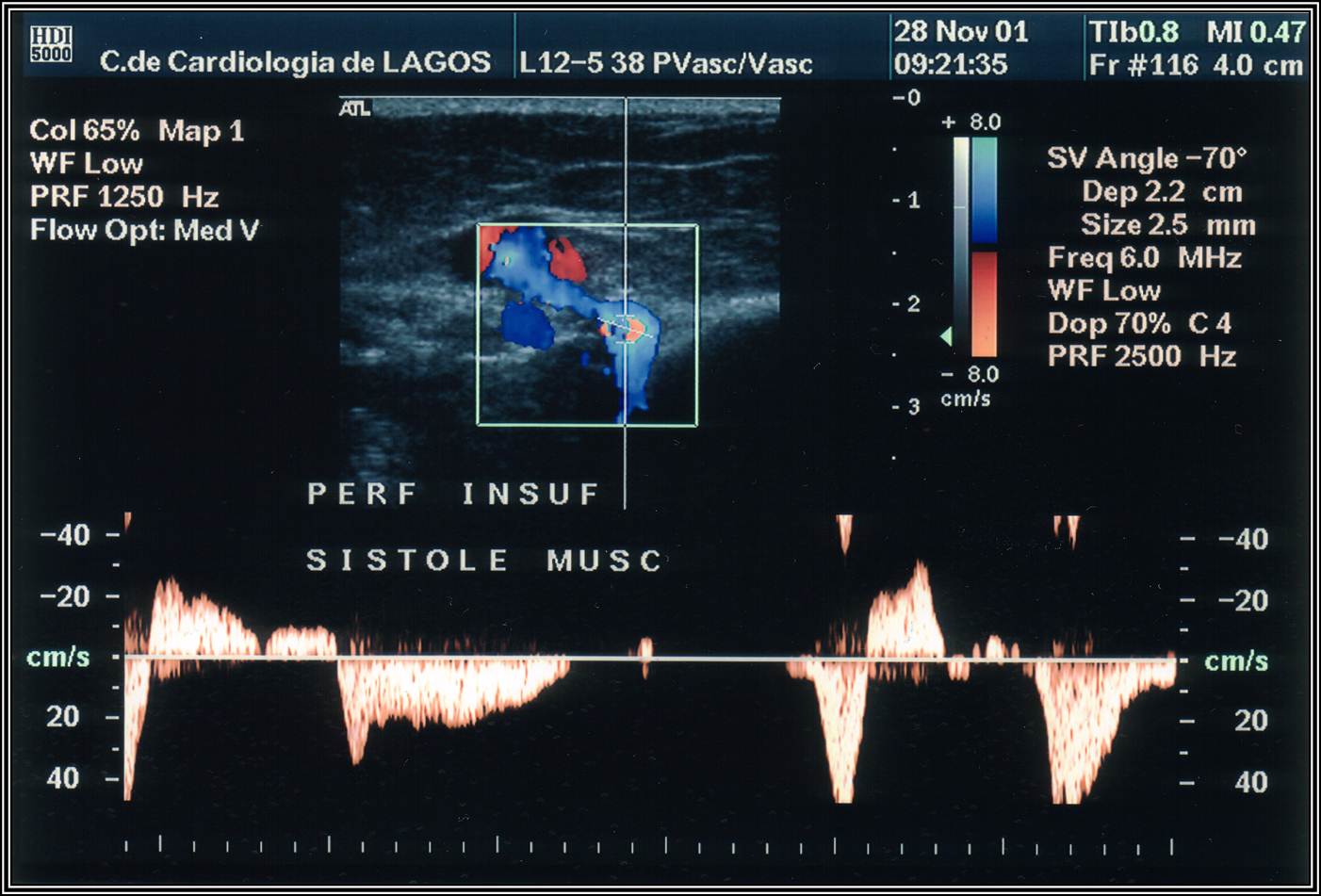
Perforator veins play an essential role in maintaining normal blood draining. They have valves which prevent blood flowing back (regurgitation) from deep to superficial veins in muscular systole or contraction.
Perforator veins exist along the length of the lower limb, in greater number in the leg (anatomical ref to below knee) than in the thigh.
Some veins are named after the physician who first described them:
Others have the name of the deep vein where they drain:
When the valves of perforator veins become incompetent they can cause venous reflux when the muscles contract. This has been explained by Mark Whiteley as "active venous reflux". The resulting reflux can cause a rapid deterioration in an existing varicose disease and be responsible for the development of venous ulcers.
In the past, when varicose vein surgery is undertaken, the surgeon carefully ligated all perforators, but some believe that you can use conservative techniques to treat varicose disease use perforators to drain the superficial venous system. In this case, lower limbs venous ultrasonography plays an important role in evaluating which continent perforators can be used.
However, increasing evidence (see below) is starting to favor the treatment of incompetent perforator veins by minimally invasive techniques such as transluminal occlusion of perforators (TRLOP).
Perforator vein
Perforator veins are so called because they perforate the deep fascia of muscles, to connect the superficial veins to the deep veins where they drain.
Perforator veins play an essential role in maintaining normal blood draining. They have valves which prevent blood flowing back (regurgitation) from deep to superficial veins in muscular systole or contraction.
Perforator veins exist along the length of the lower limb, in greater number in the leg (anatomical ref to below knee) than in the thigh.
Some veins are named after the physician who first described them:
Others have the name of the deep vein where they drain:
When the valves of perforator veins become incompetent they can cause venous reflux when the muscles contract. This has been explained by Mark Whiteley as "active venous reflux". The resulting reflux can cause a rapid deterioration in an existing varicose disease and be responsible for the development of venous ulcers.
In the past, when varicose vein surgery is undertaken, the surgeon carefully ligated all perforators, but some believe that you can use conservative techniques to treat varicose disease use perforators to drain the superficial venous system. In this case, lower limbs venous ultrasonography plays an important role in evaluating which continent perforators can be used.
However, increasing evidence (see below) is starting to favor the treatment of incompetent perforator veins by minimally invasive techniques such as transluminal occlusion of perforators (TRLOP).
Recent media
Recent media