
Recent from talks
Perm (hairstyle)
Knowledge base stats:
Talk channels stats:
Members stats:
Perm (hairstyle)
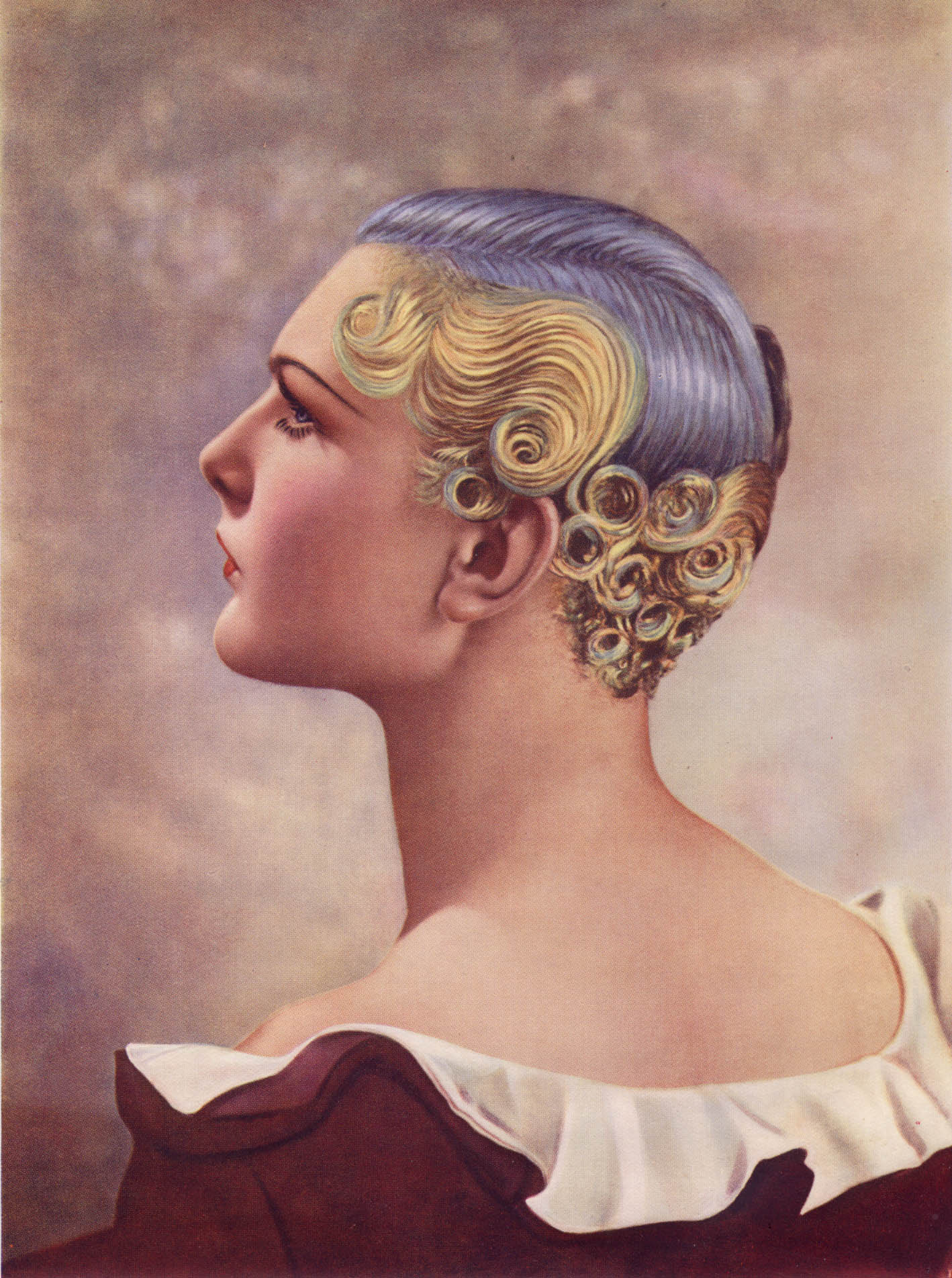
A permanent wave, commonly called a perm or permanent (sometimes called a "curly perm" to distinguish it from a "straight perm"), is a hairstyle consisting of waves or curls set into the hair. The curls may last a number of months, hence the name.
Perms may be applied using thermal or chemical means. In the latter method, chemicals are applied to the hair, which is then wrapped around forms to produce waves and curls. The same process is used for chemical straightening or relaxing, with the hair being flattened instead of curled during the chemical reaction.
The first person to produce a practical thermal method was Marcel Grateau in 1872. He devised a pair of specially manufactured tongs, in which one of the arms had a circular cross-section and the other a concave one, so that one fitted inside the other when the tongs were closed. The tongs were generally heated over a gas or alcohol flame and the correct temperature was achieved by testing the tongs on a newspaper; if the paper browned slightly it was about right. The waving itself was safe if care was taken to keep the tongs away from the scalp. The procedure was to comb a lock of hair towards the operator, moving the comb slowly with one hand to maintain some tension, while applying the tongs to the hair successively down the lock of hair towards the point. Each time the tongs were applied, they were moved slightly in a direction normal to the lock of hair, thus producing a continuous flat or two-dimensional wave. Skill using the wrist could produce slight variations of the wave. Thus, Marcel waving produced a two-dimensional wave, by thermal means only and the change was produced by plastic flow of the hair, rather than by any chemical means. Because of the high temperature used, the process tended to degrade the hair. However, in spite of its drawbacks, forms of Marcel waving have persisted until today, when speedy results and low cost are important.
In the Western world, long hair was standard for women until the 1920s, when flappers cut their hair short (into a "bob") as a form of rebellion against tradition. As the demand for self-determination grew among women, hair was shortened so that it did not pass the lower end of the neck. This was not only a political gesture but a practical one, as women began to take over men's work due to the great shortage of labour during the First World War. At the same time, electricity, which had been introduced mainly for lighting and industrial use, began to be used for heating and the application of the electric motor at the small business and domestic level. Shorter hair was improved in appearance by waving even more than long hair, and soon an improved form of waving would appear.
An early alternative method for curling hair that was suitable for use on people was invented in 1905 by German hairdresser Karl Nessler. He used a mixture of cow urine and water. The first public demonstration took place on 8 October 1905, but Nessler had been working on the idea since 1896. Previously, wigs had been set with caustic chemicals to form curls, but these recipes were too harsh to use next to human skin. His method, called the spiral heat method, was only useful for long hair. The hair was wrapped in a spiral around rods connected to a machine with an electric heating device. Sodium hydroxide (caustic soda) was applied and the hair was heated to 212 °F (100 °C) or more for an extended period of time. The process used about twelve 2-pound (0.9 kg) brass rollers and took six hours to complete. These hot rollers were kept from touching the scalp by a complex system of countering weights which were suspended from an overhead chandelier and mounted on a stand. Nessler conducted his first experiments on his wife, Katharina Laible. The first two attempts resulted in completely burning her hair off and some scalp burns, but the method was improved and his electric permanent wave machine was used in London in 1909 on the long hair of the time.
Nessler had moved to London in 1901, and during World War I, the British jailed Nessler because he was German and forced him to surrender his assets. He escaped to New York City in 1915, buying passage on a steamship under an assumed name. In New York, he found that hundreds of copies of his machine were in use, but most did not work well and were unreliable. Nessler opened a shop on East 49th Street, and soon had salons in Chicago, Detroit, Palm Beach, Florida and Philadelphia. Nessler also developed a machine for home use that was sold for fifteen dollars. However, his machine made little impression in Europe and his first attempts were not even mentioned in the professional press, perhaps because they were too long-winded, cumbersome and dangerous.
Eugene Suter was a Swiss immigrant who set up a fashionable ladies' salon in London's West End. He claimed to have come from Paris, which in those days was the center of fashion and style. He became aware of the possibilities of electrical permanent waving particularly when shorter hair allowed the design of smaller equipment. The system had two parts; one was the electric heater and the other was the system of winding and holding the hair on a form which was inserted into a heater. Suter tried to design a heater, but was unsuccessful.
Isidoro Calvete was a Spanish immigrant who set up a workshop for the repair and manufacture of electrical equipment in the same area of London in 1917. This equipment was just coming into use for the hairdressing and medical professions. Suter consulted him on the heater and Calvete designed a practical model consisting of two windings inserted into an aluminium tube. This ensured that when inserted over a root winding, the thicker hair nearer to the root became hotter than the thinner hair at the end. Suter patented the design in his own name and for the next 12 years ordered all his hairdressing equipment from Calvete but marketed under his commercial name, Eugene Ltd, which became synonymous with permanent waving throughout the world. At the same time, Calvete developed his own products which he manufactured under the name Icall, Ltd. The simultaneous manufacture of two competing lines would inevitably result in conflict.
Hub AI
Perm (hairstyle) AI simulator
(@Perm (hairstyle)_simulator)
Perm (hairstyle)
A permanent wave, commonly called a perm or permanent (sometimes called a "curly perm" to distinguish it from a "straight perm"), is a hairstyle consisting of waves or curls set into the hair. The curls may last a number of months, hence the name.
Perms may be applied using thermal or chemical means. In the latter method, chemicals are applied to the hair, which is then wrapped around forms to produce waves and curls. The same process is used for chemical straightening or relaxing, with the hair being flattened instead of curled during the chemical reaction.
The first person to produce a practical thermal method was Marcel Grateau in 1872. He devised a pair of specially manufactured tongs, in which one of the arms had a circular cross-section and the other a concave one, so that one fitted inside the other when the tongs were closed. The tongs were generally heated over a gas or alcohol flame and the correct temperature was achieved by testing the tongs on a newspaper; if the paper browned slightly it was about right. The waving itself was safe if care was taken to keep the tongs away from the scalp. The procedure was to comb a lock of hair towards the operator, moving the comb slowly with one hand to maintain some tension, while applying the tongs to the hair successively down the lock of hair towards the point. Each time the tongs were applied, they were moved slightly in a direction normal to the lock of hair, thus producing a continuous flat or two-dimensional wave. Skill using the wrist could produce slight variations of the wave. Thus, Marcel waving produced a two-dimensional wave, by thermal means only and the change was produced by plastic flow of the hair, rather than by any chemical means. Because of the high temperature used, the process tended to degrade the hair. However, in spite of its drawbacks, forms of Marcel waving have persisted until today, when speedy results and low cost are important.
In the Western world, long hair was standard for women until the 1920s, when flappers cut their hair short (into a "bob") as a form of rebellion against tradition. As the demand for self-determination grew among women, hair was shortened so that it did not pass the lower end of the neck. This was not only a political gesture but a practical one, as women began to take over men's work due to the great shortage of labour during the First World War. At the same time, electricity, which had been introduced mainly for lighting and industrial use, began to be used for heating and the application of the electric motor at the small business and domestic level. Shorter hair was improved in appearance by waving even more than long hair, and soon an improved form of waving would appear.
An early alternative method for curling hair that was suitable for use on people was invented in 1905 by German hairdresser Karl Nessler. He used a mixture of cow urine and water. The first public demonstration took place on 8 October 1905, but Nessler had been working on the idea since 1896. Previously, wigs had been set with caustic chemicals to form curls, but these recipes were too harsh to use next to human skin. His method, called the spiral heat method, was only useful for long hair. The hair was wrapped in a spiral around rods connected to a machine with an electric heating device. Sodium hydroxide (caustic soda) was applied and the hair was heated to 212 °F (100 °C) or more for an extended period of time. The process used about twelve 2-pound (0.9 kg) brass rollers and took six hours to complete. These hot rollers were kept from touching the scalp by a complex system of countering weights which were suspended from an overhead chandelier and mounted on a stand. Nessler conducted his first experiments on his wife, Katharina Laible. The first two attempts resulted in completely burning her hair off and some scalp burns, but the method was improved and his electric permanent wave machine was used in London in 1909 on the long hair of the time.
Nessler had moved to London in 1901, and during World War I, the British jailed Nessler because he was German and forced him to surrender his assets. He escaped to New York City in 1915, buying passage on a steamship under an assumed name. In New York, he found that hundreds of copies of his machine were in use, but most did not work well and were unreliable. Nessler opened a shop on East 49th Street, and soon had salons in Chicago, Detroit, Palm Beach, Florida and Philadelphia. Nessler also developed a machine for home use that was sold for fifteen dollars. However, his machine made little impression in Europe and his first attempts were not even mentioned in the professional press, perhaps because they were too long-winded, cumbersome and dangerous.
Eugene Suter was a Swiss immigrant who set up a fashionable ladies' salon in London's West End. He claimed to have come from Paris, which in those days was the center of fashion and style. He became aware of the possibilities of electrical permanent waving particularly when shorter hair allowed the design of smaller equipment. The system had two parts; one was the electric heater and the other was the system of winding and holding the hair on a form which was inserted into a heater. Suter tried to design a heater, but was unsuccessful.
Isidoro Calvete was a Spanish immigrant who set up a workshop for the repair and manufacture of electrical equipment in the same area of London in 1917. This equipment was just coming into use for the hairdressing and medical professions. Suter consulted him on the heater and Calvete designed a practical model consisting of two windings inserted into an aluminium tube. This ensured that when inserted over a root winding, the thicker hair nearer to the root became hotter than the thinner hair at the end. Suter patented the design in his own name and for the next 12 years ordered all his hairdressing equipment from Calvete but marketed under his commercial name, Eugene Ltd, which became synonymous with permanent waving throughout the world. At the same time, Calvete developed his own products which he manufactured under the name Icall, Ltd. The simultaneous manufacture of two competing lines would inevitably result in conflict.
Recent media