
Recent from talks
Potto
Knowledge base stats:
Talk channels stats:
Members stats:
Potto
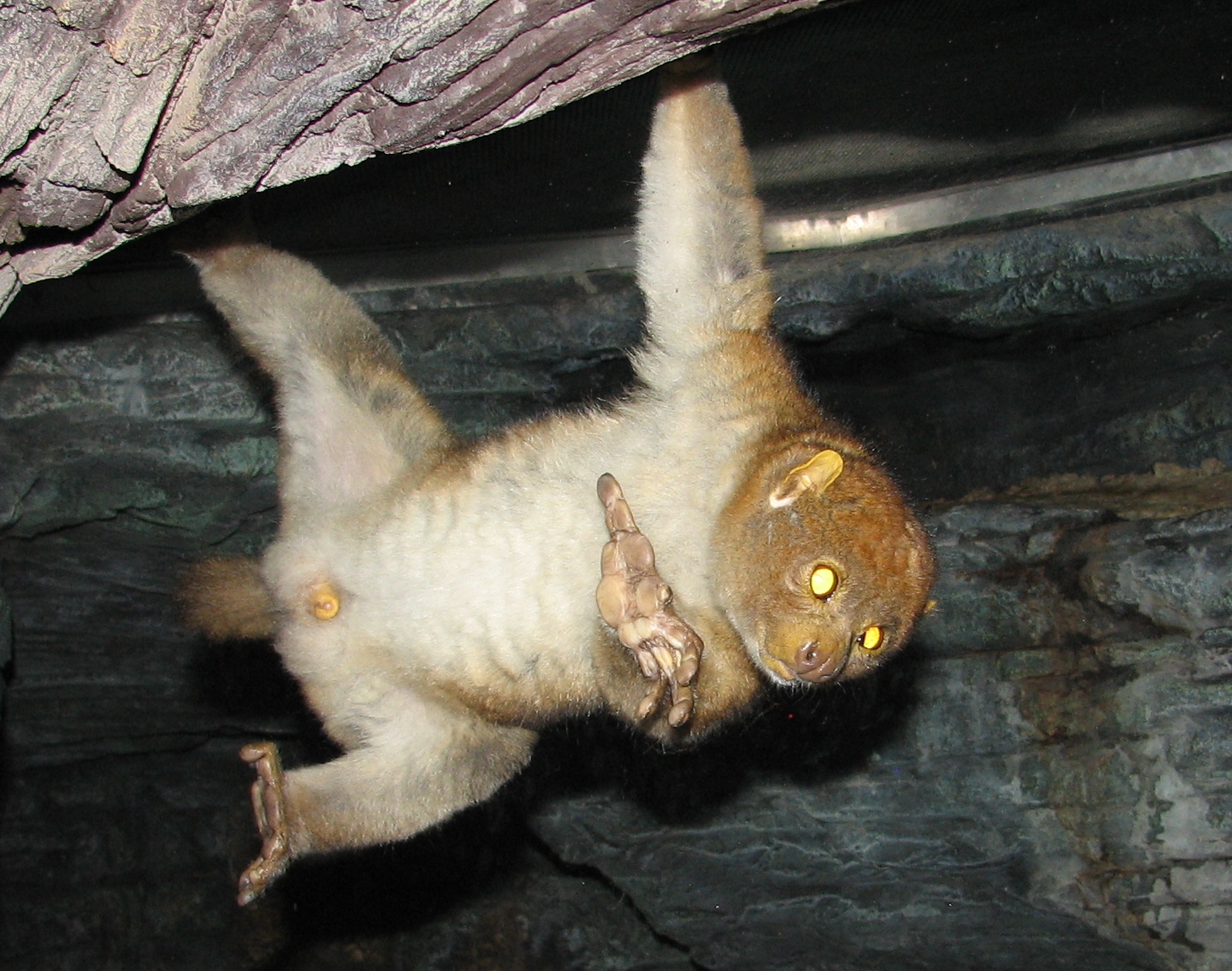
The pottos are three species of strepsirrhine primate in the genus Perodicticus of the family Lorisidae. In some English-speaking parts of Africa, they are called "softly-softlys".
The common name "potto" may be from Wolof pata (a tailless monkey).
The generic name Perodicticus is composed of Greek πηρός (pērós, 'maimed') and δεικτικός (deiktikós, "able to show/indicate", cf. δείκτης, deíktēs, 'index finger'). It refers to the stubby index finger that seems mutilated.
There are three species recognized by the IUCN Red List and American Society of Mammalogists:
Formerly, all species were classified under one species, P. potto. However, variation among pottos is significant, prompting speculation that there may be more than one species. A 2015 study confirmed there to be three distinct potto species with deep genetic divergence dating to the Miocene for all three species.
A few closely related species also have "potto" in their names: the two golden potto species (also known as angwantibos) and the false potto. Although it has been suggested that the differences that separate the false potto from the West African potto are a result of an anomalous specimen being used as the holotype which may have been a West African potto.
The Central and South American kinkajou (Potos flavus) and olingos (Bassaricyon sp.) are similar in appearance and behavior to African pottos, and were formerly classified with them (hence Potos). Olingos and kinkajous are now known to be members of the raccoon family.
The potto grows to a length of 30 to 39 cm, with a short (3 to 10 cm) tail, and its weight varies from 600 to 1,600 grams (21 to 56 oz). The close, woolly fur is grey-brown. The index finger is vestigial, although it has opposable thumbs with which it grasps branches firmly. Like other strepsirrhines the potto has a moist nose, toothcomb, and a toilet claw on the second toe of the hind legs. In the hands and feet, fingers three and four are connected to each other by a slight skin fold, while toes three through five are joined at their bases by a skin web that extends to near the proximal third of the toes.
Hub AI
Potto AI simulator
(@Potto_simulator)
Potto
The pottos are three species of strepsirrhine primate in the genus Perodicticus of the family Lorisidae. In some English-speaking parts of Africa, they are called "softly-softlys".
The common name "potto" may be from Wolof pata (a tailless monkey).
The generic name Perodicticus is composed of Greek πηρός (pērós, 'maimed') and δεικτικός (deiktikós, "able to show/indicate", cf. δείκτης, deíktēs, 'index finger'). It refers to the stubby index finger that seems mutilated.
There are three species recognized by the IUCN Red List and American Society of Mammalogists:
Formerly, all species were classified under one species, P. potto. However, variation among pottos is significant, prompting speculation that there may be more than one species. A 2015 study confirmed there to be three distinct potto species with deep genetic divergence dating to the Miocene for all three species.
A few closely related species also have "potto" in their names: the two golden potto species (also known as angwantibos) and the false potto. Although it has been suggested that the differences that separate the false potto from the West African potto are a result of an anomalous specimen being used as the holotype which may have been a West African potto.
The Central and South American kinkajou (Potos flavus) and olingos (Bassaricyon sp.) are similar in appearance and behavior to African pottos, and were formerly classified with them (hence Potos). Olingos and kinkajous are now known to be members of the raccoon family.
The potto grows to a length of 30 to 39 cm, with a short (3 to 10 cm) tail, and its weight varies from 600 to 1,600 grams (21 to 56 oz). The close, woolly fur is grey-brown. The index finger is vestigial, although it has opposable thumbs with which it grasps branches firmly. Like other strepsirrhines the potto has a moist nose, toothcomb, and a toilet claw on the second toe of the hind legs. In the hands and feet, fingers three and four are connected to each other by a slight skin fold, while toes three through five are joined at their bases by a skin web that extends to near the proximal third of the toes.
Recent media