Hubbry Logo
LorisidaeLorisidaeMain
Open search
Lorisidae
Community hub
Lorisidae
logo
8 pages, 0 posts
0 subscribers
Be the first to start a discussion here.
Lorisidae
Lorisidae
from Wikipedia

Lorisids[1]
Temporal range: Early Miocene–Recent
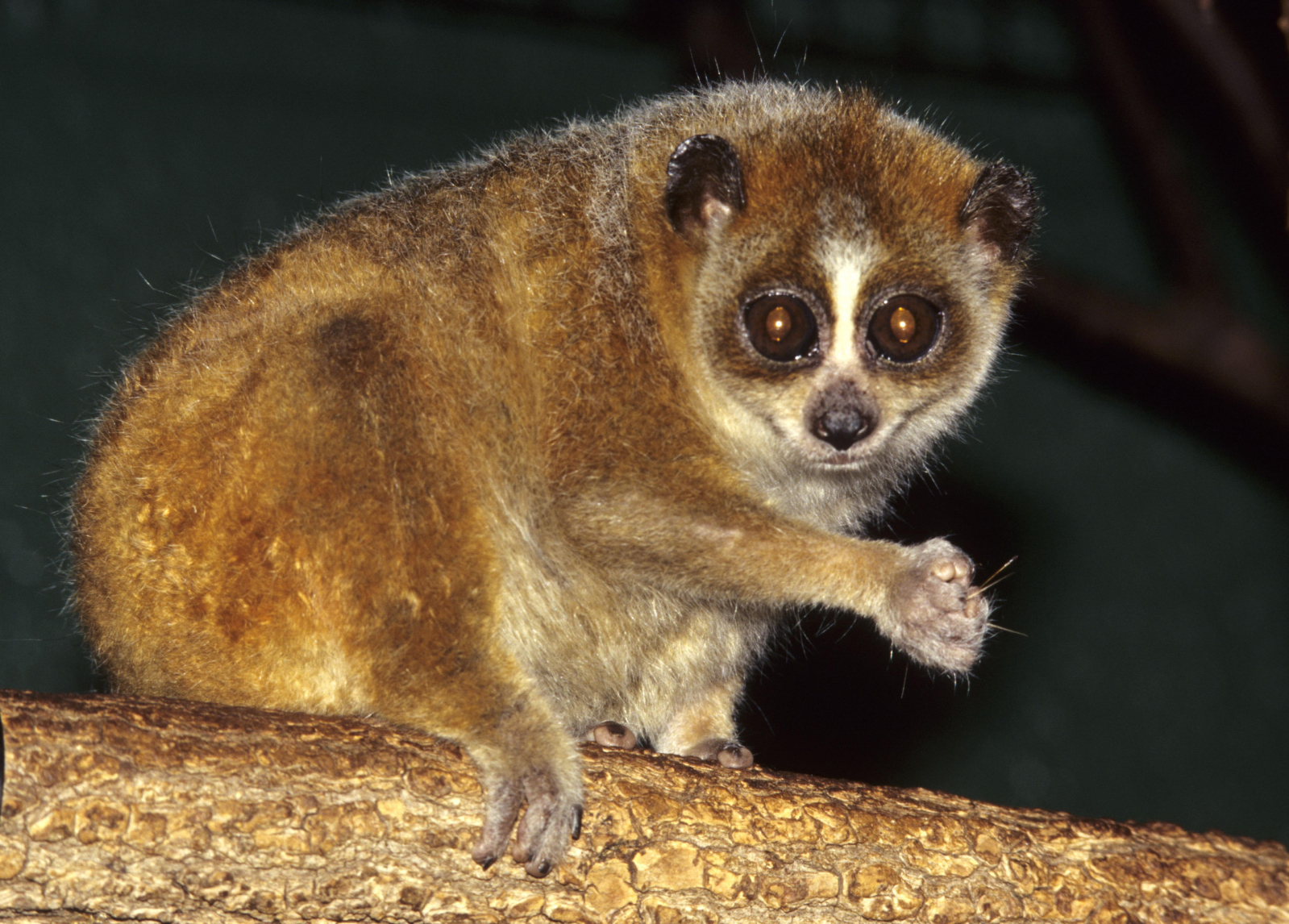
Pygmy slow loris
Scientific classification Edit this classification
Kingdom: Animalia
Phylum: Chordata
Class: Mammalia
Order: Primates
Superfamily: Lorisoidea
Family: Lorisidae
Gray, 1821
Type genus
Loris
Geoffroy, 1796
Genera

Arctocebus
Perodicticus
Loris
Nycticebus
Xanthonycticebus

Synonyms
  • Loridae
    Jenkins, 1987[2]

Lorisidae (or sometimes Loridae) is a family of strepsirrhine primates. The lorisids are all slim arboreal animals and comprise the lorises, pottos, and angwantibos. Lorisids live in tropical, central Africa as well as in south and southeast Asia.

Classification

[edit]

There are five genera and sixteen species of lorisid.[1]

Description

[edit]

Lorisids have a close, woolly fur, which is usually grey or brown, darker on the top side. The eyes are large and face forward. The ears are small and often partially hidden in the fur. The thumbs are opposable and the index finger is short. The second toe of the hind legs has a fine claw for grooming, typical for strepsirrhines. Their tails are short or are missing completely. They grow to a length of 17 to 40 cm and a weight of between 0.3 and 2 kg, depending on the species. Their dental formula is similar to that of lemurs: 2.1.3.32.1.3.3

Behavior and ecology

[edit]

Lorisids are nocturnal and arboreal. Unlike the closely related galagos, lorisids never jump. Some have slow deliberate movements, whilst others can move with some speed across branches. It was previously thought that all lorisids moved slowly, but investigations using red light proved this to be wrong. Nonetheless, even the faster species freeze or move slowly if they hear or see any potential predator. This habit of remaining motionless whilst in danger is successful only because of the leafy environment of their jungle home, which helps to conceal their true position.[4] With their strong hands they clasp at the branches and cannot be removed without significant force. Most lorisids are solitary or live in small family groups.

Slow lorises from southeast Asia produce a secretion from their brachial gland (a scent gland on the upper arm, between the axilla and elbow), that is licked and mixed with their saliva to form a toxin which may be used for defense. The slender lorises from Sri Lanka and South India also possess these brachial glands, but it is uncertain whether they also synthesize the toxin. The potto (Perodicticus potto) is thought to lack brachial glands, though it produces similar toxic excretions with its anal glands.[5]

Lorisids have a gestation period of four to six months and give birth to two young. These often clasp themselves to the belly of the mother or wait in nests, while the mother goes to search for food. After three to nine months - depending on the species - they are weaned and are fully mature within 10 to 18 months. The life expectancy of lorises can be to up to 20 years.

Lorisids consume insects, bird eggs and small vertebrates as well as fruits and gums.[6][7][8][9]

References

[edit]
[edit]
Revisions and contributorsEdit on WikipediaRead on Wikipedia
from Grokipedia
Lorisidae is a family of strepsirrhine in the infraorder Lorisiformes, consisting of the lorises, pottos, and angwantibos, which are small to medium-sized, nocturnal, and primarily arboreal mammals native to and . These primates are distinguished by their slow, deliberate movements, large forward-facing eyes for enhanced , woolly fur, reduced or absent tails, and specialized hands and feet with strong grasping capabilities adapted for navigating dense canopies. The family is divided into two subfamilies: Lorisinae, which includes the Asian lorises (genera Loris, Nycticebus, and Xanthonycticebus), and Perodicticinae, encompassing the African pottos and angwantibos (genera Perodicticus and Arctocebus). Members of Lorisidae exhibit a range of body sizes, from the diminutive pygmy slow loris (Xanthonycticebus pygmaeus) at about 19–25 cm in length and 300–500 g to larger pottos (Perodicticus potto) reaching up to 40 cm and 1.5 kg, with dense, soft fur typically darker on the back and lighter on the underparts. They possess a dental formula of 2/2, 1/1, 3/3, 3/3, featuring a toothcomb formed by the lower incisors and canines for grooming and feeding. Diet varies by species but generally includes insects, gums, sap, fruits, and small vertebrates, supported by a low metabolic rate that allows prolonged activity without frequent foraging. Behaviorally, lorisids are mostly solitary or form loose groups, relying on olfactory and tactile communication through and urine marking, while their locomotion emphasizes stealthy climbing and hanging to avoid predators. They inhabit diverse tropical environments, including primary and secondary rainforests, thickets, and mangroves, from sea level to elevations over 2,000 m in regions spanning , , , , and . Reproduction is seasonal in some , with periods of 4–6 months yielding single , which cling to the mother for extended periods post-birth. Conservation challenges are significant across the family, with many species threatened by from and , as well as illegal for the pet and markets; for instance, several species are classified as Endangered or Critically Endangered on the , including the recently split northern and southern pygmy slow lorises (both Endangered as of March 2025). Efforts to protect Lorisidae focus on habitat preservation and anti-trafficking measures, underscoring their ecological role in ecosystems as seed dispersers and insect controllers.

Taxonomy

Classification

The family Lorisidae was established by British zoologist in 1821, with the . Lorisidae is currently classified as a family within the suborder of the order , encompassing nocturnal, arboreal primates distributed across and . The family includes five genera: Arctocebus (angwantibos), Perodicticus (pottos), Loris (slender lorises), Nycticebus (slow lorises), and Xanthonycticebus (pygmy lorises). These genera reflect recent taxonomic revisions, such as the elevation of the pygmy slow loris to the genus Xanthonycticebus in 2022 based on morphological and genetic distinctions from other Nycticebus species. A 2023 molecular study further split Xanthonycticebus into two species: X. pygmaeus (southern pygmy loris, found in southern Vietnam, Laos, eastern Cambodia) and X. intermedius (northern pygmy loris, in northern Vietnam, Laos, and China), based on 1.9% genetic distance and cranial differences (smaller skull in X. intermedius). In total, Lorisidae comprises 17 recognized species as of 2023. For example, the southern pygmy slow loris is classified as Xanthonycticebus pygmaeus (formerly Nycticebus pygmaeus), and the northern as X. intermedius, highlighting ongoing refinements in lorisid taxonomy driven by molecular and morphological analyses. Other representative species include Arctocebus calabarensis in Arctocebus, Perodicticus potto in Perodicticus, Loris tardigradus in Loris, and Nycticebus coucang in Nycticebus. Phylogenetically, Lorisidae diverged from the family Galagidae (bushbabies) approximately 40-50 million years ago during the , marking a key split within the infraorder Lorisiformes. This divergence is supported by estimates from multi-gene analyses, which place the crown Lorisidae radiation around 42 million years ago. All lorisids share a nocturnal, arboreal lifestyle adapted to forested environments.

Evolutionary history

The family Lorisidae, comprising lorises and pottos, traces its evolutionary origins to , where the earliest definitive fossils appear in the Early . The temporal range of Lorisidae extends from the Early to the present, with the oldest known specimens attributed to the genus Mioeuoticus from sites in , dated to approximately 18–20 million years ago. These early fossils indicate a moderate diversification of the family during the in , potentially preceded by sparse records from the late Oligocene in , though the latter's attribution to Lorisidae remains tentative. Key adaptations defining Lorisidae, such as and slow locomotion, likely emerged in Eocene ancestors shared with other strepsirrhines, predating the family's divergence. Strepsirrhine , the broader including Lorisidae, originated around 55–60 million years ago, with early forms exhibiting large orbits suggestive of nocturnal habits and specialized limb structures for deliberate, energy-efficient movement in arboreal environments. Sensory reconstructions of Mioeuoticus further support that these traits were already present in early lorisids, including enhanced olfactory capabilities and visual adaptations for low-light foraging. From their African cradle, Lorisidae dispersed to during the , facilitated by island hopping across the widening or episodic land bridges associated with tectonic shifts in the Tethys region. The earliest Asian fossils, such as lorisine remains from the Middle Miocene of (around 13–14 million years ago) and , mark this colonization, representing a single immigration event for the Asian lineages. This biogeographic expansion contributed to the phylogenetic split between African (e.g., pottos) and Asian (e.g., slow lorises) clades, with subsequent radiations in both regions. Recent phylogenetic analyses have refined our understanding of lorisid relationships, confirming the distinctiveness of genera like Xanthonycticebus for pygmy lorises based on genetic divergence estimated at approximately 10 million years ago (range 9.8–11.3 mya). The 2022 proposal of Xanthonycticebus as a new genus name from Nycticebus was followed by a 2023 molecular study resurrecting X. intermedius as a separate species, highlighting deep evolutionary splits within Asian lorisids driven by isolation and adaptation. These findings align with modern taxonomy recognizing five genera across Africa and Asia.

Physical characteristics

Morphology

Members of the Lorisidae family are small to medium-sized , with head-body lengths ranging from approximately 17 to 40 cm and weights between 85 g and 1.6 kg across species. For example, the (Loris tardigradus) measures 18–25 cm in length and weighs 85–370 g, while the (Perodicticus potto) reaches 30–39 cm and 600–1,600 g. African species such as the (Arctocebus calabarensis) tend to be smaller on average than larger Asian forms like certain slow lorises (Nycticebus spp.), though variation exists within both groups. Lorisids possess thick, woolly fur typically in to , which is darker dorsally than ventrally and aids in camouflaging them against substrates. Their eyes are notably large and forward-facing to support vision in low-light conditions associated with their nocturnal habits. The ears are small, rounded, and often concealed within the surrounding fur. The limb structure of lorisids is adapted for arboreal life, featuring fore- and hindlimbs of roughly equal length that enable powerful grasping and deliberate quadrupedal locomotion. They have opposable thumbs and a notably short , facilitating secure holds on branches during slow progression. A specialized is present on the second toe of each hind foot, a characteristic shared with other strepsirrhines. The dental formula for Lorisidae is 2.1.3.3 / 2.1.3.3, totaling 36 teeth. The lower incisors are procumbent—angled forward nearly parallel to the —forming a toothcomb structure with the canines that assists in grooming and extracting food items like from crevices.

Adaptations

Lorisidae exhibit specialized sensory adaptations suited to their nocturnal lifestyles. Their large, forward-facing eyes provide enhanced , facilitating depth perception during arboreal navigation in low light. A reflective layer known as the behind the amplifies available light, significantly improving and enabling detection of prey and environmental cues in dim conditions. Complementing this , members of the family possess an acute facilitated by a moist and enlarged olfactory structures in the brain, which support chemical communication and through scent detection. These sensory traits reflect a favoring vision and olfaction over other modalities, with vocalizations playing a minor role in communication, as evidenced by their generally silent behaviors. Locomotor adaptations emphasize energy efficiency and stealth in dense canopies. Lorisids employ a deliberate, slow-climbing characterized by hand-over-hand progression, avoiding saltatory leaps to minimize noise and energy expenditure while maintaining stability on slender branches. This non-jumping strategy is supported by powerful grasping capabilities, with specialized hand and foot musculature allowing prolonged suspension; for instance, the (Perodicticus potto) can maintain grips enabling extended hanging from branches, enabled by a hyper-derived digital flexor system that locks digits in place without continuous muscular effort. Their woolly fur, while primarily morphological, aids in during these cautious movements. Defensive physiological traits further enhance survival. Some Asian species, particularly in the genus Nycticebus (slow lorises), produce potent toxins via specialized brachial glands on the elbows, which mix with oral secretions to create a venomous bite used against predators and in intraspecific conflicts; this unique trait among deters threats through chemical and . In pottos, an elongated facilitates precise probing for hidden in bark crevices, optimizing resource extraction in their . Sexual dimorphism in Lorisidae is generally minimal, with subtle differences in body size rather than pronounced morphological distinctions. Males are often slightly larger than females, particularly in species, where this dimorphism arises through extended male growth periods rather than accelerated rates.

Distribution and habitat

Geographic range

The family Lorisidae is distributed across tropical regions of and South and , with no native populations in or . In , species such as s (genus Perodicticus) and angwantibos (genera Arctocebus and Pseudopotto) are confined to West and Central African rainforests, including lowland and montane forests. For instance, Bosman's (Perodicticus potto) ranges from east to and south to northern , while the eastern (P. ibeanus) extends from through to . In , lorisids occupy diverse island and mainland habitats, with slender lorises (genus Loris) limited to the and , and slow lorises (genus Nycticebus) widespread from through Indochina to . The (Nycticebus bengalensis) inhabits , , southern , , , , , and , often west of the River. Other slow loris species, such as the (N. pygmaeus), are found east of the in , , eastern , and southern Province in , while the (N. javanicus) is endemic to , and slow lorises of the Sunda region, including N. sumatrensis on and N. menagensis, N. bancanus, N. borneanus, and N. kayan on and surrounding islands. The (Loris tardigradus) is strictly endemic to 's southwestern wet zone forests. Many lorisid populations are now fragmented, particularly in , where habitat degradation has isolated subpopulations; for example, the persists in scattered wet zone lowland forests across a restricted area of less than 5,200 km² in southwestern . Fossil evidence indicates that Lorisidae originated in during the early , with subsequent dispersal to occurring in the middle to , possibly facilitated by tectonic connections and climatic shifts during the Miocene-Pliocene transition.

Habitat preferences

Members of the Lorisidae family are primarily arboreal and inhabit dense tropical rainforests, including lowland dipterocarp forests and mangroves, from to elevations exceeding 2,000 meters in some . They show a strong preference for the layers of these forests, where tangled vines, epiphytes, and dense vegetation provide essential cover for their nocturnal lifestyle and slow locomotion. This habitat structure supports their reliance on continuous canopy cover for movement, as lorisids have limited ability to cross gaps larger than a few meters due to their specialized climbing adaptations. Open grasslands and fragmented landscapes are generally avoided, as they lack the vertical continuity required for safe traversal. While most lorisids thrive in humid, closed-canopy environments, some species exhibit flexibility in drier or transitional habitats. For instance, angwantibos (Arctocebus spp.) are often found along savanna-forest edges and in areas with low, dense undergrowth rich in lianas and vines. Pottos (Perodicticus spp.) favor riverine forests and swampy lowlands within broader zones, where moist conditions and abundant foliage align with their arboreal habits. Slow lorises (Nycticebus spp.) frequently utilize thickets interspersed with hardwood trees, particularly in secondary forests, enhancing cover and resource availability. Lorisids' habitat preferences are closely tied to seasonal variations in their environments, such as fruiting cycles in tropical forests, which influence density and food predictability without necessitating migration. Their arboreal morphology, including elongated limbs and grasping hands, further reinforces selection for structurally complex microhabitats that minimize exposure to predators.

Behavior

Activity patterns

Members of the Lorisidae family are strictly nocturnal, with activity cycles aligned to nighttime hours and no evidence of diurnal or cathemeral behaviors across species. Their activity typically peaks around dusk and dawn, showing crepuscular tendencies in some populations, such as the (Nycticebus javanicus), where bridge use and movement intensify near sunset and sunrise. These patterns are influenced by their solitary nature, which emphasizes individual foraging and movement without group synchronization. Circadian rhythms in lorisids are modulated by lunar cycles, with many species exhibiting lunarphobia—reduced activity on full moon nights to minimize predation risk under brighter conditions. For instance, the pygmy loris (Nycticebus pygmaeus) shows decreased locomotion and increased resting during high moonlight intensity. Daily travel distances average 100-500 meters, as observed in the , covering core areas within their home ranges for foraging and exploration. Locomotion in Lorisidae is characterized by slow, deliberate quadrupedal progression at speeds of approximately 1.9 km/h, enabling stealthy navigation through dense vegetation. They employ bridging to cross gaps between branches and suspension by from limbs, avoiding leaps entirely, which suits their arboreal lifestyle and . Males engage in territorial marking using urine trails deposited while dragging their hindquarters along branches, supplemented by secretions from specialized glands like the brachial gland in slow lorises. This behavior reinforces individual ranges, particularly in species like the pygmy loris, where countermarking over rival scents is common.

Social organization

Members of the family Lorisidae display predominantly solitary social structures, typically consisting of individuals or small family units comprising an adult pair and their offspring, rather than forming large troops or cohesive groups. This pattern is evident across genera, including Nycticebus (slow lorises), Loris (slender lorises), Perodicticus (pottos), and Arctocebus (angwantibos), where adults maintain overlapping home ranges but rarely engage in prolonged physical proximity outside of familial bonds. In high-density habitats, loose aggregations may occur, but these lack the coordinated seen in more gregarious . Territoriality plays a key role in their , with adult males defending exclusive ranges that often overlap with those of one or more adult females, facilitating opportunities while minimizing direct . For instance, in the Nycticebus coucang, stable spatial groups form around an adult male and female pair, with home ranges overlapping extensively within the pair (up to 80-90%) but showing little to no overlap between different groups; males exhibit delayed dispersal in some cases, leading to extended family units. Slender lorises (Loris tardigradus) similarly feature male territories that encompass multiple female ranges, promoting a promiscuous , though pair bonds are transient and aggression arises primarily during territorial intrusions by other males. Pottos (Perodicticus spp.) maintain pair-based structures where males and females share ranges and engage in affiliative interactions, such as allogrooming, with minimal between partners. Angwantibos (Arctocebus calabarensis) follow a more strictly solitary pattern, with limited evidence of pair stability beyond scent-marked boundaries. Communication among Lorisidae is subtle and multisensory, relying on scent marking, vocalizations, and visual cues to maintain spatial relationships and reduce encounters. Scent marking via and glandular secretions (e.g., elbow glands in slow lorises) delineates territories and signals reproductive status, with males frequently marking to assert dominance over overlapping female ranges. Vocalizations include ultrasonic clicks and whistles for contact and coordination; for example, slow lorises produce alternate click-calls during friendly interactions within spatial groups, while pottos emit high-pitched whistles. Visual signals, such as eye shine from their large, reflective eyes, aid in nocturnal recognition and deterrence at a . Aggression between adults is minimal, limited mostly to brief chases or threats during territorial disputes, fostering a low-conflict . is rare but has been documented in slow lorises, particularly in contexts involving territory competition or introduction of unfamiliar adults in captive settings. Their nocturnal habits further support this solitary lifestyle by reducing opportunities for group formation during active periods.

Ecology

Diet and foraging

Members of the Lorisidae family exhibit an omnivorous diet, with forming the primary component in many , often comprising up to 96% of feeding events in slender lorises (Loris lydekkerianus). This faunivorous emphasis includes a variety of such as , beetles, caterpillars, moths, and crickets, supplemented by gums, fruits, small vertebrates, bird eggs, and . In slow lorises (Nycticebus spp.), the diet is more balanced, with exudates like gum and sap making up significant portions—such as 30.2% sap and 3.6% gum in some populations—alongside and fruits, reflecting adaptations to exploit tree-derived resources. Pottos (Perodicticus spp.) show opportunistic omnivory, consuming fruits, gums, , and like and millipedes, with occasional small vertebrates, eggs, and fungi; angwantibos (Arctocebus spp.) are predominantly insectivorous, with caterpillars comprising the bulk of their intake. Foraging in Lorisidae is characterized by slow, deliberate movements suited to their nocturnal, arboreal , enabling energy-efficient predation in dim . Slender lorises employ techniques, using vision and olfaction to detect and hand-capture on terminal and middle branches, rarely venturing to trunks or undergrowth. Slow lorises use specialized behaviors like tree gouging to access and , protruding their tongues to lick exudates, and hand-grasping , with seasonal shifts toward fruits during dry periods when insect availability declines. Pottos probe bark crevices for and using elongated fingers, while foraging solitarily over large home ranges, and angwantibos slowly stalk caterpillars in low , rubbing off irritant hairs before consumption or rearing to snatch flying . Nutritional adaptations support this diverse diet, particularly for processing , which are low-quality but abundant. Lorisids possess a low —about 40% of expected for similarly sized mammals—allowing sustained on high-fiber, toxin-laden plant matter without excessive energy expenditure. A specialized, sacculated caecum and elongated colon facilitate microbial of gum , prolonging retention time for ; in pottos, this enables efficient breakdown of complex carbohydrates. Daily remains low, often limited to small quantities relative to body weight, aligning with their energy-conserving strategy and arboreal food sources.

Predation and defense

Members of the Lorisidae family, including slow lorises (Nycticebus spp.), slender lorises (Loris spp.), pottos (Perodicticus potto), and angwantibos (Arctocebus calabarensis), face significant predation pressure in their habitats due to their slow locomotion and nocturnal lifestyle, which limits rapid escape options. Primary predators include snakes such as reticulated pythons (Python reticulatus), like changeable hawk-eagles (Nisaetus cirrhatus), and mammals including small-toothed palm civets (Arctogalidia trivirgata) and clouded leopards ( nebulosa). These species exploit the lorisids' arboreal habits, with documented instances of pythons ambushing slow lorises at rest and hawk-eagles targeting them during foraging. To counter this vulnerability, lorisids primarily rely on as an anti-predator strategy, employing through their mottled fur patterns that blend with bark and foliage, combined with prolonged immobility and silent movement to avoid detection. When fails, individuals may freeze in a defensive posture or release their grip to fall from branches, potentially deterring aerial or climbing predators. Slow lorises possess a unique chemical defense among : they secrete oily exudates from brachial glands on their elbows, which mix with to form a toxic venom delivered via bite, causing swelling, , or anaphylactic reactions in predators. This venomous bite, enabled by specialized lower incisors that groove the into wounds, serves as a last-resort mechanism, though it is less effective against larger predators like clouded leopards. Alarm responses in lorisids are subdued to maintain , with no dedicated alarm calls reported; instead, threatened individuals may emit short defensive vocalizations such as grunts, snarls, or long "kecker" calls during close encounters. Branch-shaking or other conspicuous displays are rare, as these solitary animals lack group vigilance and instead depend on individual stealth. Juveniles experience particularly high predation risk, contributing to elevated mortality rates in wild populations due to their inexperience and smaller size making them easier targets for snakes and raptors. However, precise data on wild juvenile mortality rates remain limited due to challenges in studying these nocturnal . Overall, these defenses enhance survival in predator-rich environments but underscore the lorisids' precarious ecological position.

Reproduction

Mating systems

Lorisidae exhibit that vary across genera, ranging from promiscuous to potentially or polygynous arrangements, influenced by their largely solitary lifestyles that facilitate dispersed opportunities. In the (Loris spp.), the system is promiscuous, with females mating successively with multiple males (typically 3-4) during estrus, promoting . In contrast, the (Nycticebus spp.) shows evidence of social through stable spatial groups consisting of one adult and one adult female, though genetic may involve multiple partners in some populations. For the (Perodicticus spp.), the system remains uncertain but is suggested to be polygynous, with males potentially mating with multiple females. The system of angwantibos (Arctocebus spp.) is largely unknown due to limited observations, but their solitary nature suggests promiscuous or polygynous similar to pottos. in these taxa primarily occurs through scent marking rather than physical aggression, with males using urine and glandular secretions to delineate territories and signal reproductive status, thereby attracting females without direct confrontation. Breeding in Lorisidae is generally seasonal, often synchronized with rainfall patterns that enhance food availability, though the exact timing varies by species and ; angwantibos breed year-round. Estrus cycles last 28-45 days across genera, with females exhibiting heightened receptivity during peak periods; for instance, in slow lorises, cycles average 36.4 days, while slender lorises range from 29-40 days. behaviors emphasize olfactory and tactile cues over aggression, including mutual grooming, licking, and scent-marking exchanges, particularly in pottos where pairs hang upside down from branches during rituals. Vocalizations play a supplementary role, such as whistles or click-calls in slow lorises during friendly interactions leading to , and loud calls in slender lorises during the breeding season. In slender lorises, estrus and births peak twice annually (April-June and October-December), aligning with post-monsoon resource booms in their Indian habitats. Gestation periods span 4-6.5 months, reflecting the family's strepsirrhine traits, with durations of approximately 166-169 days in slender lorises, 185-197 days in slow lorises, 193-205 days in pottos, and 131-136 days in angwantibos. Litters typically consist of 1-2 offspring, with singletons most common, though twins occur frequently in slow lorises. Copulation involves prolonged intromission lasting 2-16 minutes per session, often multiple times during estrus, which supports sperm competition in promiscuous contexts by allowing extended sperm transfer and deposition.

Parental care and development

In Lorisidae, parental care is provided exclusively by females, who typically give birth to a single offspring after a gestation period of 4-6.5 months. Newborns are precocial, born with eyes open and exhibiting some degree of coordinated movement, though they remain highly dependent on maternal transport and nursing. Mothers carry infants ventrally, either clinging to the fur or held in the mouth, for the first few weeks of life, transitioning to parking them on branches during foraging bouts that last 10-20 minutes initially and extend longer as the infant grows. This parking behavior allows females to hunt nocturnally while minimizing predation risk through crypsis, with infants vocalizing to solicit retrieval; angwantibos follow a similar pattern with single infants weaned at 3-5 months. Infants develop rapidly in locomotor skills, achieving independent climbing and deliberate quadrupedal movement by around two months of age, which coincides with increased parking durations up to several hours. occurs between three and nine months, with lasting 5-7 months in species like the (Nycticebus coucang), after which juveniles begin co-feeding on and exudates. Sexual maturity is reached at 10-18 months for females and slightly later for males, reflecting the family's slow life history characterized by low reproductive rates and high in a single offspring to enhance survival in resource-scarce environments. In the wild, lifespans average 10-20 years, such as 12-15 years for gray slender lorises (Loris lydekkerianus) and up to 20 years for slow lorises, while captivity extends this to 20-25 years due to reduced predation and consistent nutrition. Mortality is elevated in early life, with neonatal rates around 15-16% in captive slow lorises, often due to maternal abandonment during threats or insufficient care leading to and weakness. In the wild, survival to maturity is estimated at 30-40%, influenced by predation and abandonment, underscoring the intensive maternal investment required for the species' K-selected strategy.

Conservation

Status and threats

The majority of species within the Lorisidae family are classified as Vulnerable, Endangered, or Critically Endangered on the , reflecting severe population declines driven by anthropogenic pressures. For instance, the (Nycticebus bengalensis) is listed as Endangered, with an inferred decline exceeding 50% over the past three generations (approximately 24 years) due to habitat degradation and exploitation. Similarly, the (Nycticebus javanicus) is Critically Endangered, having experienced an estimated population reduction of over 80% in the last 24 years. Across the family, species have experienced significant declines, with no species extinct but several, including the Bangka slow loris (Nycticebus bancanus; Critically Endangered) and Bornean slow loris (Nycticebus borneanus; Vulnerable), facing ongoing threats. Habitat destruction poses the primary threat to Lorisidae, primarily through , agricultural expansion, and , which have fragmented forests across their ranges in and . These activities reduce available for arboreal species reliant on continuous canopy cover, leading to isolation of subpopulations and increased risks of . exacerbates this by altering fruit availability and phenological patterns, disrupting the gummivorous and frugivorous diets of many lorisids and potentially shifting suitable habitats beyond current ranges. Illegal wildlife trade further imperils Lorisidae, particularly es, which are heavily targeted for the pet trade and traditional Asian medicine. In regions like , , and , parts—such as oil from glands and dried meat—are used in remedies for ailments ranging from issues to , with thousands confiscated annually from markets. Slender lorises ( spp.) and pottos face lesser but growing trade pressures, often as or curios, compounding losses. These combined threats have driven rapid population reductions, with no signs of stabilization in most taxa.

Protection efforts

Several species within the Lorisidae family, particularly all slow lorises (Nycticebus spp.), are listed under Appendix I of the Convention on International Trade in Endangered Species of Wild Fauna and Flora (CITES), which prohibits international commercial trade to prevent further population declines. Other members, such as slender lorises (Loris spp.), pottos (Perodicticus potto), and angwantibos (Arctocebus calabarensis), are protected under Appendix II, regulating trade to avoid utilization incompatible with survival. These listings have driven habitat protection efforts, including the establishment of national parks like Gunung Leuser in Indonesia, a UNESCO World Heritage site that safeguards critical rainforest habitats for Sumatran slow lorises through restricted access and biodiversity monitoring. Reintroduction programs target confiscated individuals, with organizations like International Animal Rescue rehabilitating and releasing slow lorises back into protected forests after health assessments and behavioral training; in 2024, ten critically endangered individuals were successfully returned to the wild in , followed by eight more in Ujung Kulon National Park in September 2025. Anti-poaching patrols, such as those supported by the Kukang Rescue Program in , employ local rangers to monitor trade routes and enforce regulations, reducing illegal captures in high-risk areas. Community education initiatives, exemplified by the Little Fireface Project, operate in trade hotspots across and , teaching villagers about loris and the dangers of pet trade through school programs and awareness campaigns to foster local stewardship. Research efforts emphasize genetic monitoring to assess diversity and guide translocations, with studies on informing breeding programs to maintain viable populations. Habitat restoration projects, including to enhance canopy connectivity, are implemented by groups like the Little Fireface Project to reconnect fragmented forests essential for arboreal loris movement. Successes include population stabilization of grey slender lorises in protected private reserves in , such as Jetwing Vil Uyana, where targeted conservation has led to observed increases in sightings and density. Despite these advances, challenges persist, including enforcement gaps in rural regions of and where remote habitats limit patrol coverage and illegal trade continues undetected. Funding shortages also hinder ex-situ breeding programs, which require sustained resources for specialized care of nocturnal to support future reintroductions. These efforts are largely motivated by assessments classifying most lorisids as Vulnerable or Endangered.

References

Add your contribution
Related Hubs
User Avatar
No comments yet.