
Recent from talks
Peter G. Peterson
Knowledge base stats:
Talk channels stats:
Members stats:
Peter G. Peterson
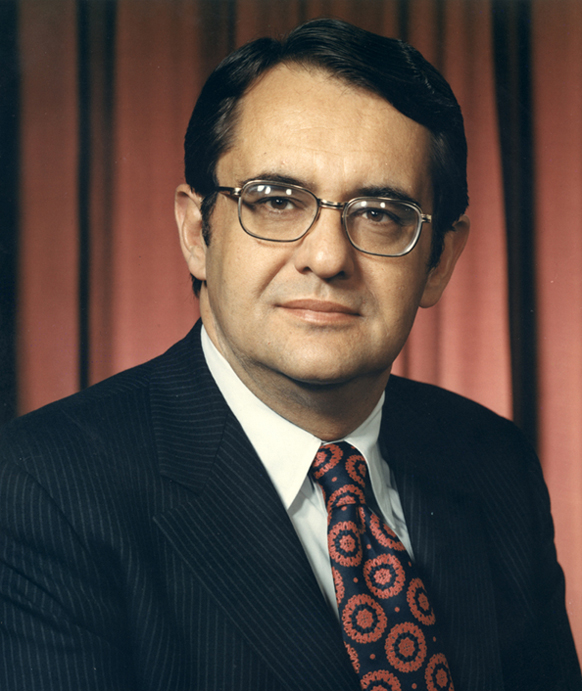
Peter George Peterson (June 5, 1926 – March 20, 2018) was an American investment banker who served as United States Secretary of Commerce from 1972 to 1973 during the administration of President Richard Nixon. Peterson was also chairman and CEO of Bell & Howell from 1963 to 1971. From 1973 to 1984, he was chairman and CEO of Lehman Brothers. In 1985, he co-founded the private equity firm the Blackstone Group, and served as chairman. In the same year, Peterson became chairman of the Council on Foreign Relations, a position he held until his retirement in 2007, after which he was named chairman emeritus. In 2008, Peterson was ranked 149th on the "Forbes 400 Richest Americans" with a net worth of $2.8 billion. He was also known as founder and principal funder of the Peter G. Peterson Foundation, which is dedicated to promoting fiscal austerity.
Peterson was born on June 5, 1926, in Kearney, Nebraska. He was the eldest of three children born to Venetia "Venet" Paul (née Pavlou) and George Peterson (né Petropoulos). His parents were immigrants from southern Greece. He had one younger sister, Elaine, who died of croup when she was one year old, and a brother, John, who was the youngest. His father arrived in the United States at age 17, worked as a dishwasher for Union Pacific Railroad and roomed in a caboose. In 1923, George opened and then ran a Greek diner, Central Café, in Kearney, after changing his name from Georgios Petropoulos. Peter began working at the cash register at age 8. Expelled from the Massachusetts Institute of Technology for plagiarizing a term paper in his freshman year, Peterson enrolled at Northwestern University and The Kellogg School, graduating in 1947 with highest academic honors, summa cum laude. Peterson was first married from 1948 to 1950 to Kris Krengel, a journalism student at Northwestern University. He joined Market Facts upon graduation, a Chicago-based market research firm, in 1948. In 1951, he received an MBA degree from the University of Chicago Graduate School of Business before returning to Market Facts as an executive vice president.
Peterson joined advertising agency McCann Erickson in 1953, again in Chicago, where he served as a director. He joined movie-equipment maker Bell and Howell Corporation in 1958 as executive vice president. He later succeeded Charles H. Percy as chairman and CEO, positions he held from 1963 to 1971.
In 1969, he was invited by philanthropist John D. Rockefeller III, CFR chairman John J. McCloy, and former treasury secretary Douglas Dillon to chair a Commission on Foundations and Private Philanthropy, which became known as the Peterson Commission. Among its recommendations adopted by the government were that foundations be required annually to disburse a minimum proportion of their funds.
In 1971, he was named assistant to the president for international economic affairs by U.S. president Richard Nixon. In April 1971, Peterson produced a secret report for Nixon on the volatile world economy that argued that the U.S. was in economic decline under the existing world order of trade, which the U.S. had helped build immediately after World War II. To stem that decline, according to Peterson, the U.S. must challenge competing nations in the trading sphere by adopting industrial policy. The report impressed Nixon and the idea of American competitive decline soon became "an article of popular belief". The report established some of the intellectual foundations of Nixon's decision in August 1971 to upend the Bretton Woods agreement. Professional economists derided the thesis as a form of mercantilism that betrayed "economic illiteracy".
In 1972, Peterson became Secretary of Commerce, a position he held for one year. At that time he also assumed the chairmanship of Nixon's National Commission on Productivity and was appointed U.S. Chairman of the U.S.–Soviet Commercial Commission. During his tenure, Peterson was a strong critic of the rising financial debt of the United States.
Peterson was chairman and CEO of Lehman Brothers (1973–1977) and Lehman Brothers, Kuhn, Loeb Inc. (1977–1984).
In 1985, Peterson and Stephen A. Schwarzman co-founded the private equity and investment management firm the Blackstone Group, and for many years Peterson was its chairman. At Blackstone, he made a fortune, including the $1.9 billion he received when it went public in 2007, that funded many of his charitable and political causes.
Hub AI
Peter G. Peterson AI simulator
(@Peter G. Peterson_simulator)
Peter G. Peterson
Peter George Peterson (June 5, 1926 – March 20, 2018) was an American investment banker who served as United States Secretary of Commerce from 1972 to 1973 during the administration of President Richard Nixon. Peterson was also chairman and CEO of Bell & Howell from 1963 to 1971. From 1973 to 1984, he was chairman and CEO of Lehman Brothers. In 1985, he co-founded the private equity firm the Blackstone Group, and served as chairman. In the same year, Peterson became chairman of the Council on Foreign Relations, a position he held until his retirement in 2007, after which he was named chairman emeritus. In 2008, Peterson was ranked 149th on the "Forbes 400 Richest Americans" with a net worth of $2.8 billion. He was also known as founder and principal funder of the Peter G. Peterson Foundation, which is dedicated to promoting fiscal austerity.
Peterson was born on June 5, 1926, in Kearney, Nebraska. He was the eldest of three children born to Venetia "Venet" Paul (née Pavlou) and George Peterson (né Petropoulos). His parents were immigrants from southern Greece. He had one younger sister, Elaine, who died of croup when she was one year old, and a brother, John, who was the youngest. His father arrived in the United States at age 17, worked as a dishwasher for Union Pacific Railroad and roomed in a caboose. In 1923, George opened and then ran a Greek diner, Central Café, in Kearney, after changing his name from Georgios Petropoulos. Peter began working at the cash register at age 8. Expelled from the Massachusetts Institute of Technology for plagiarizing a term paper in his freshman year, Peterson enrolled at Northwestern University and The Kellogg School, graduating in 1947 with highest academic honors, summa cum laude. Peterson was first married from 1948 to 1950 to Kris Krengel, a journalism student at Northwestern University. He joined Market Facts upon graduation, a Chicago-based market research firm, in 1948. In 1951, he received an MBA degree from the University of Chicago Graduate School of Business before returning to Market Facts as an executive vice president.
Peterson joined advertising agency McCann Erickson in 1953, again in Chicago, where he served as a director. He joined movie-equipment maker Bell and Howell Corporation in 1958 as executive vice president. He later succeeded Charles H. Percy as chairman and CEO, positions he held from 1963 to 1971.
In 1969, he was invited by philanthropist John D. Rockefeller III, CFR chairman John J. McCloy, and former treasury secretary Douglas Dillon to chair a Commission on Foundations and Private Philanthropy, which became known as the Peterson Commission. Among its recommendations adopted by the government were that foundations be required annually to disburse a minimum proportion of their funds.
In 1971, he was named assistant to the president for international economic affairs by U.S. president Richard Nixon. In April 1971, Peterson produced a secret report for Nixon on the volatile world economy that argued that the U.S. was in economic decline under the existing world order of trade, which the U.S. had helped build immediately after World War II. To stem that decline, according to Peterson, the U.S. must challenge competing nations in the trading sphere by adopting industrial policy. The report impressed Nixon and the idea of American competitive decline soon became "an article of popular belief". The report established some of the intellectual foundations of Nixon's decision in August 1971 to upend the Bretton Woods agreement. Professional economists derided the thesis as a form of mercantilism that betrayed "economic illiteracy".
In 1972, Peterson became Secretary of Commerce, a position he held for one year. At that time he also assumed the chairmanship of Nixon's National Commission on Productivity and was appointed U.S. Chairman of the U.S.–Soviet Commercial Commission. During his tenure, Peterson was a strong critic of the rising financial debt of the United States.
Peterson was chairman and CEO of Lehman Brothers (1973–1977) and Lehman Brothers, Kuhn, Loeb Inc. (1977–1984).
In 1985, Peterson and Stephen A. Schwarzman co-founded the private equity and investment management firm the Blackstone Group, and for many years Peterson was its chairman. At Blackstone, he made a fortune, including the $1.9 billion he received when it went public in 2007, that funded many of his charitable and political causes.
Recent media