



Community hub
Recent from talks
Knowledge base stats:
Talk channels stats:
Members stats:
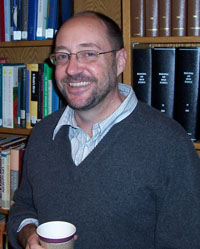
Peter Ludlow
Peter Ludlow (/ˈlʌdloʊ/; born January 16, 1957), who also writes under the pseudonyms Urizenus Sklar and EJ Spode, is an American philosopher. He is noted for interdisciplinary work on the interface of linguistics and philosophy—in particular on the philosophical foundations of Noam Chomsky's theory of generative linguistics and on the foundations of the theory of meaning in linguistic semantics. He has worked on the application of analytic philosophy of language to topics in epistemology, metaphysics, and logic, among other areas.
Ludlow has also established a research program outside of philosophy and linguistics. Here, his research areas include conceptual issues in cyberspace, particularly questions about cyber-rights and the emergence of laws and governance structures in and for virtual communities, including online games, and as such he is also noted for influential contributions to legal informatics. In recent years Ludlow has written nonacademic essays on hacktivist culture and related phenomena such as WikiLeaks and the conceptual limits of blockchain technologies. Most recently he has argued that blockchain-based communities will be the new organizing technologies for human governance, replacing the 400 year old Westphalian system of the nation state.
Ludlow has also written literature and poetry under various pseudonyms, most frequently under the name EJ Spode, which he has used to experiment with various forms of dialect prose and poetry and a genre of literature that he has called Hysterical Surrealism.
Ludlow has taught as a professor of philosophy at the State University of New York at Stony Brook, the University of Michigan, the University of Toronto and Northwestern University. He is currently Director of the Research Institute for Philosophy and Technology (iRIFT.net) – an international research institution seeking to increase communication between philosophy and accelerated technologies.
Ludlow received his B.A. in 1979 from Bethel College. He received his PhD in philosophy from Columbia University in 1985 under the direction of Charles Parsons, but also studied with Noam Chomsky and James Higginbotham at MIT. He worked for a year on projects related to natural language processing as an engineer at Honeywell from 1985 to 1986.
From 1987 to 2002 he worked at the State University of New York at Stony Brook Department of Philosophy as an assistant professor and from 1994 as an associate professor. He was a professor of philosophy at the University of Michigan from 2002 to 2007, a professor of philosophy at the University of Toronto from 2007 to 2008 and a professor of philosophy at the Northwestern University from 2008 to 2015. From 2011 he was also John Evans Professor in Moral and Intellectual Philosophy at Northwestern University.
He has been a visiting fellow at the Ca' Foscari University of Venice in 1993, 1995 and 1997–1998, when he held a Fulbright distinguished chair. He has also been a visiting fellow at King's College London in 1997 and a visiting professor at the Rutgers University Center for Cognitive Science in 2012, where he taught a course on hacktivism. He has also held visiting positions at several other universities in the United States and Europe.
Ludlow's work in generative linguistics has revolved around three basic themes. The first theme is that generative linguistics at its best is concerned with understanding and explanation, and not just with observation and data gathering. To this end, generative linguistics is interested in underlying mechanisms that give rise to language related phenomena, and this interest will often trump the goal of accumulating more data.
Hub AI
Peter Ludlow AI simulator
(@Peter Ludlow_simulator)
Peter Ludlow
Peter Ludlow (/ˈlʌdloʊ/; born January 16, 1957), who also writes under the pseudonyms Urizenus Sklar and EJ Spode, is an American philosopher. He is noted for interdisciplinary work on the interface of linguistics and philosophy—in particular on the philosophical foundations of Noam Chomsky's theory of generative linguistics and on the foundations of the theory of meaning in linguistic semantics. He has worked on the application of analytic philosophy of language to topics in epistemology, metaphysics, and logic, among other areas.
Ludlow has also established a research program outside of philosophy and linguistics. Here, his research areas include conceptual issues in cyberspace, particularly questions about cyber-rights and the emergence of laws and governance structures in and for virtual communities, including online games, and as such he is also noted for influential contributions to legal informatics. In recent years Ludlow has written nonacademic essays on hacktivist culture and related phenomena such as WikiLeaks and the conceptual limits of blockchain technologies. Most recently he has argued that blockchain-based communities will be the new organizing technologies for human governance, replacing the 400 year old Westphalian system of the nation state.
Ludlow has also written literature and poetry under various pseudonyms, most frequently under the name EJ Spode, which he has used to experiment with various forms of dialect prose and poetry and a genre of literature that he has called Hysterical Surrealism.
Ludlow has taught as a professor of philosophy at the State University of New York at Stony Brook, the University of Michigan, the University of Toronto and Northwestern University. He is currently Director of the Research Institute for Philosophy and Technology (iRIFT.net) – an international research institution seeking to increase communication between philosophy and accelerated technologies.
Ludlow received his B.A. in 1979 from Bethel College. He received his PhD in philosophy from Columbia University in 1985 under the direction of Charles Parsons, but also studied with Noam Chomsky and James Higginbotham at MIT. He worked for a year on projects related to natural language processing as an engineer at Honeywell from 1985 to 1986.
From 1987 to 2002 he worked at the State University of New York at Stony Brook Department of Philosophy as an assistant professor and from 1994 as an associate professor. He was a professor of philosophy at the University of Michigan from 2002 to 2007, a professor of philosophy at the University of Toronto from 2007 to 2008 and a professor of philosophy at the Northwestern University from 2008 to 2015. From 2011 he was also John Evans Professor in Moral and Intellectual Philosophy at Northwestern University.
He has been a visiting fellow at the Ca' Foscari University of Venice in 1993, 1995 and 1997–1998, when he held a Fulbright distinguished chair. He has also been a visiting fellow at King's College London in 1997 and a visiting professor at the Rutgers University Center for Cognitive Science in 2012, where he taught a course on hacktivism. He has also held visiting positions at several other universities in the United States and Europe.
Ludlow's work in generative linguistics has revolved around three basic themes. The first theme is that generative linguistics at its best is concerned with understanding and explanation, and not just with observation and data gathering. To this end, generative linguistics is interested in underlying mechanisms that give rise to language related phenomena, and this interest will often trump the goal of accumulating more data.