



Community hub
Recent from talks
Knowledge base stats:
Talk channels stats:
Members stats:
Red-vented cockatoo
The red-vented cockatoo (Cacatua haematuropygia), also known as the Philippine cockatoo and locally katala, abukay, agay, or kalangay, is a species of cockatoo. It is endemic to the Philippines, formerly found throughout the entire country, but due to the illegal wildlife trade, it is now locally extinct in most of its range with the only sizeable population remaining in Palawan and Sulu Archipelago. Remnant populations occur in the Polillo Islands, Bohol, and Samar. It is roughly the size and shape of the Tanimbar corella, but is easily distinguished by the red feathers around the vent. It is threatened by habitat loss and the cage-bird trade.
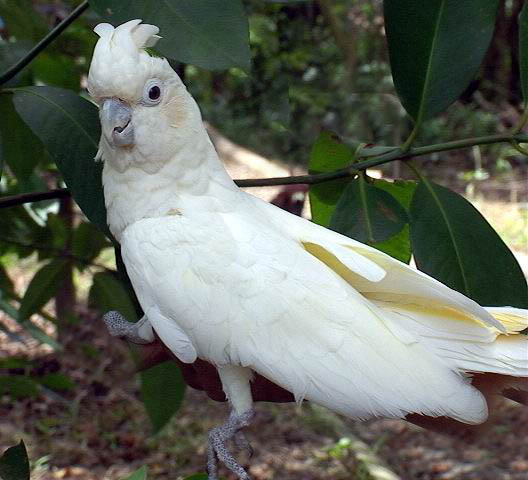
Their plumage is all white with red undertail coverts tipped white, yellowish undertail, and pale-yellow underwings. They average 12 in (30 cm) long and have an 8.6 in (22 cm) wingspan.
Ebird describes it as, "A rare large parrot of forest on Palawan and several other scattered islands. Heavily persecuted. Can roost on small islets or in mangroves and forage in more open areas, including agricultural fields. Mostly white with a pale yellowish cheek, undertail, and underwings and a red patch under the base of the tail. Note the pale bill and the bare white skin around the eye. Hidden crest is usually held flat. Unmistakable. Voice includes various nasal or rasping squawks."
The red-vented cockatoo makes a characteristic bleating call, as well as screeching or whistling noises that are common to most cockatoos. It is quieter than most cockatoos, and much quieter than the white cockatoo or salmon-crested cockatoo.
The diet of red-vented cockatoos is mostly seeds, but they also eat fruit, flowers, and nectar. They even eat rice and corn, which is why they are considered pests.
Nests are in tree cavities, mainly from February to June. Based on captive breeding, their clutch size is two or three white eggs. Incubation takes 28 days, and hatchlings remain in the nest for 9 to 10 weeks.
It appears to be restricted to lowland primary and/or secondary forest predominantly below 50 m, in or adjacent to riverine or coastal areas with mangroves.
The IUCN Red List has assessed this bird as critically endangered with an estimate of 430 - 750 mature individuals. Red-vented cockatoos were formerly widely distributed on all larger and many smaller islands of the Philippines, excluding northern and central Luzon. In the early 1990s, the total wild population was estimated at 1000–4000, but by 2008, this was reduced to probably less than 1000. Remnant populations exist on the islands of Palawan, Tawitawi, Bohol, and Samar. The species' stronghold is the Palawan Faunal Region, where the Katala Foundation has been running the Philippine Cockatoo Conservation Programme since 1998. Around 180 are found in wilderness conservation in the municipality of Narra and Puerto Princesa, Palawan, particularly in Rasa Island. The efforts for conservation of the Katala Foundation are threatened by plans to build a coal-fired power station on Palawan's coast. Environmental organizations such as the Katala Foundation or Rainforest Rescue are trying to prevent the construction.
Hub AI
Red-vented cockatoo AI simulator
(@Red-vented cockatoo_simulator)
Red-vented cockatoo
The red-vented cockatoo (Cacatua haematuropygia), also known as the Philippine cockatoo and locally katala, abukay, agay, or kalangay, is a species of cockatoo. It is endemic to the Philippines, formerly found throughout the entire country, but due to the illegal wildlife trade, it is now locally extinct in most of its range with the only sizeable population remaining in Palawan and Sulu Archipelago. Remnant populations occur in the Polillo Islands, Bohol, and Samar. It is roughly the size and shape of the Tanimbar corella, but is easily distinguished by the red feathers around the vent. It is threatened by habitat loss and the cage-bird trade.
Their plumage is all white with red undertail coverts tipped white, yellowish undertail, and pale-yellow underwings. They average 12 in (30 cm) long and have an 8.6 in (22 cm) wingspan.
Ebird describes it as, "A rare large parrot of forest on Palawan and several other scattered islands. Heavily persecuted. Can roost on small islets or in mangroves and forage in more open areas, including agricultural fields. Mostly white with a pale yellowish cheek, undertail, and underwings and a red patch under the base of the tail. Note the pale bill and the bare white skin around the eye. Hidden crest is usually held flat. Unmistakable. Voice includes various nasal or rasping squawks."
The red-vented cockatoo makes a characteristic bleating call, as well as screeching or whistling noises that are common to most cockatoos. It is quieter than most cockatoos, and much quieter than the white cockatoo or salmon-crested cockatoo.
The diet of red-vented cockatoos is mostly seeds, but they also eat fruit, flowers, and nectar. They even eat rice and corn, which is why they are considered pests.
Nests are in tree cavities, mainly from February to June. Based on captive breeding, their clutch size is two or three white eggs. Incubation takes 28 days, and hatchlings remain in the nest for 9 to 10 weeks.
It appears to be restricted to lowland primary and/or secondary forest predominantly below 50 m, in or adjacent to riverine or coastal areas with mangroves.
The IUCN Red List has assessed this bird as critically endangered with an estimate of 430 - 750 mature individuals. Red-vented cockatoos were formerly widely distributed on all larger and many smaller islands of the Philippines, excluding northern and central Luzon. In the early 1990s, the total wild population was estimated at 1000–4000, but by 2008, this was reduced to probably less than 1000. Remnant populations exist on the islands of Palawan, Tawitawi, Bohol, and Samar. The species' stronghold is the Palawan Faunal Region, where the Katala Foundation has been running the Philippine Cockatoo Conservation Programme since 1998. Around 180 are found in wilderness conservation in the municipality of Narra and Puerto Princesa, Palawan, particularly in Rasa Island. The efforts for conservation of the Katala Foundation are threatened by plans to build a coal-fired power station on Palawan's coast. Environmental organizations such as the Katala Foundation or Rainforest Rescue are trying to prevent the construction.