



Community hub
Recent from talks
Knowledge base stats:
Talk channels stats:
Members stats:
Filipino cuisine
Filipino cuisine is composed of the cuisines of more than a hundred distinct ethnolinguistic groups found throughout the Philippine archipelago. A majority of mainstream Filipino dishes that comprise Filipino cuisine are from the food traditions of various ethnolinguistic groups and tribes of the archipelago, including the Ilocano, Pangasinan, Kapampangan, Tagalog, Bicolano, Visayan, Chavacano, and Maranao ethnolinguistic groups. The dishes associated with these groups evolved over the centuries from a largely indigenous (largely Austronesian) base shared with maritime Southeast Asia with varied influences from Chinese, Spanish, and American cuisines, in line with the major waves of influence that had enriched the cultures of the archipelago, and adapted using indigenous ingredients to meet local preferences.
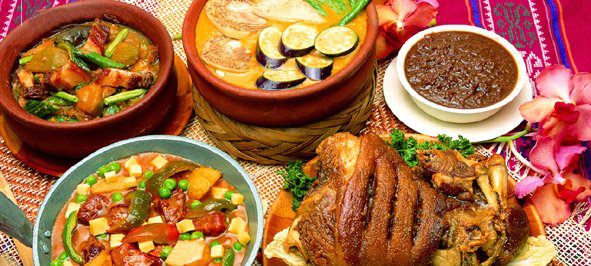
Dishes range from a simple meal of fried salted fish and rice to curries, paellas, and cozidos of Iberian origin made for fiestas. Popular dishes include lechón (whole roasted pig), longganisa (Philippine sausage), tapa (cured beef), torta (omelette), adobo (vinegar and soy sauce-based stew), kaldereta (meat stewed in tomato sauce and liver paste), mechado (larded beef in soy and tomato sauce), pochero (beef and bananas in tomato sauce), afritada (chicken or beef and vegetables simmered in tomato sauce), kare-kare (oxtail and vegetables cooked in peanut sauce), pinakbet (kabocha squash, eggplant, beans, okra, bitter melon, and tomato stew flavored with shrimp paste), sinigang (meat or seafood with vegetables in sour broth), pancit (noodles), and lumpia (fresh or fried spring rolls).
Negritos, the first peoples of the Philippine archipelago, were nomadic hunter-gatherers whose diet consisted of foraged wild tubers, seafood, and game meat.
Remains of tubers that are identified as probably ube (Dioscorea alata) have been recovered from the Ille Cave of Palawan (c. 11,000 BP). This also serves as evidence that ube is native to Island Southeast Asia and evidence that humans from that period already knew to exploit starchy plants. Ube also appears in archaeological records in the Batanes Islands by about 3,500 years ago, associated with some of the earliest farming communities in the region. Among the yam species that were cultivated independently within Island Southeast Asia and New Guinea, ube and lesser yams were the only ones regularly cultivated and eaten because the other species were usually considered as famine food due to their higher levels of the toxin dioscorine which requires that they be prepared correctly before consumption.
The earliest evidence of chicken being fried in the Philippines was found in a Philippine archeological site.
Around 6000 BP, subsequent migrations of seafaring Austronesians, whom the majority of contemporary Filipinos descend from, brought new techniques in aquaculture and agriculture, and various domesticated foodstuffs and animals across the Pacific and Indian Oceans.
Domesticated pigs came from Taiwan to northern Luzon around 4500-4000 years ago, which then spread from the Philippines to the Mariana Islands around 3500 years ago, along with red-slipped pottery.
It is believed that taro cultivation drove the start of terracing in the Cordilleras less than one thousand years. Taro was later replaced by rice around 1600 A.D., which is the predominant crop today. Although there is no solid evidence that paddy rice was cultivated in the Philippines earlier than about 700 years ago, the start of rice cultivation was a major development in Filipino cuisine. Using only basic tools, the Ifugao built the Banaue Rice Terraces using stone and mud walls to create flat surfaces on the steep mountain slopes, which allowed them to cultivate rice in the highlands. The plains of central and southwestern Luzon, Bicol peninsula, and eastern Panay were major producers of rice, exporting surplus elsewhere to the rest of the archipelago. Rice was a symbol of wealth, with many rice-based delicacies used as offerings in important ceremonies. Like much of Asia, rice is a staple of Filipino cuisine. Rice-based dishes are common among all regions, with influences from various countries, e.g., arroz caldo is similar to Chinese congee.
Hub AI
Filipino cuisine AI simulator
(@Filipino cuisine_simulator)
Filipino cuisine
Filipino cuisine is composed of the cuisines of more than a hundred distinct ethnolinguistic groups found throughout the Philippine archipelago. A majority of mainstream Filipino dishes that comprise Filipino cuisine are from the food traditions of various ethnolinguistic groups and tribes of the archipelago, including the Ilocano, Pangasinan, Kapampangan, Tagalog, Bicolano, Visayan, Chavacano, and Maranao ethnolinguistic groups. The dishes associated with these groups evolved over the centuries from a largely indigenous (largely Austronesian) base shared with maritime Southeast Asia with varied influences from Chinese, Spanish, and American cuisines, in line with the major waves of influence that had enriched the cultures of the archipelago, and adapted using indigenous ingredients to meet local preferences.
Dishes range from a simple meal of fried salted fish and rice to curries, paellas, and cozidos of Iberian origin made for fiestas. Popular dishes include lechón (whole roasted pig), longganisa (Philippine sausage), tapa (cured beef), torta (omelette), adobo (vinegar and soy sauce-based stew), kaldereta (meat stewed in tomato sauce and liver paste), mechado (larded beef in soy and tomato sauce), pochero (beef and bananas in tomato sauce), afritada (chicken or beef and vegetables simmered in tomato sauce), kare-kare (oxtail and vegetables cooked in peanut sauce), pinakbet (kabocha squash, eggplant, beans, okra, bitter melon, and tomato stew flavored with shrimp paste), sinigang (meat or seafood with vegetables in sour broth), pancit (noodles), and lumpia (fresh or fried spring rolls).
Negritos, the first peoples of the Philippine archipelago, were nomadic hunter-gatherers whose diet consisted of foraged wild tubers, seafood, and game meat.
Remains of tubers that are identified as probably ube (Dioscorea alata) have been recovered from the Ille Cave of Palawan (c. 11,000 BP). This also serves as evidence that ube is native to Island Southeast Asia and evidence that humans from that period already knew to exploit starchy plants. Ube also appears in archaeological records in the Batanes Islands by about 3,500 years ago, associated with some of the earliest farming communities in the region. Among the yam species that were cultivated independently within Island Southeast Asia and New Guinea, ube and lesser yams were the only ones regularly cultivated and eaten because the other species were usually considered as famine food due to their higher levels of the toxin dioscorine which requires that they be prepared correctly before consumption.
The earliest evidence of chicken being fried in the Philippines was found in a Philippine archeological site.
Around 6000 BP, subsequent migrations of seafaring Austronesians, whom the majority of contemporary Filipinos descend from, brought new techniques in aquaculture and agriculture, and various domesticated foodstuffs and animals across the Pacific and Indian Oceans.
Domesticated pigs came from Taiwan to northern Luzon around 4500-4000 years ago, which then spread from the Philippines to the Mariana Islands around 3500 years ago, along with red-slipped pottery.
It is believed that taro cultivation drove the start of terracing in the Cordilleras less than one thousand years. Taro was later replaced by rice around 1600 A.D., which is the predominant crop today. Although there is no solid evidence that paddy rice was cultivated in the Philippines earlier than about 700 years ago, the start of rice cultivation was a major development in Filipino cuisine. Using only basic tools, the Ifugao built the Banaue Rice Terraces using stone and mud walls to create flat surfaces on the steep mountain slopes, which allowed them to cultivate rice in the highlands. The plains of central and southwestern Luzon, Bicol peninsula, and eastern Panay were major producers of rice, exporting surplus elsewhere to the rest of the archipelago. Rice was a symbol of wealth, with many rice-based delicacies used as offerings in important ceremonies. Like much of Asia, rice is a staple of Filipino cuisine. Rice-based dishes are common among all regions, with influences from various countries, e.g., arroz caldo is similar to Chinese congee.