



Community hub
Recent from talks
Knowledge base stats:
Talk channels stats:
Members stats:
Philips circle pattern
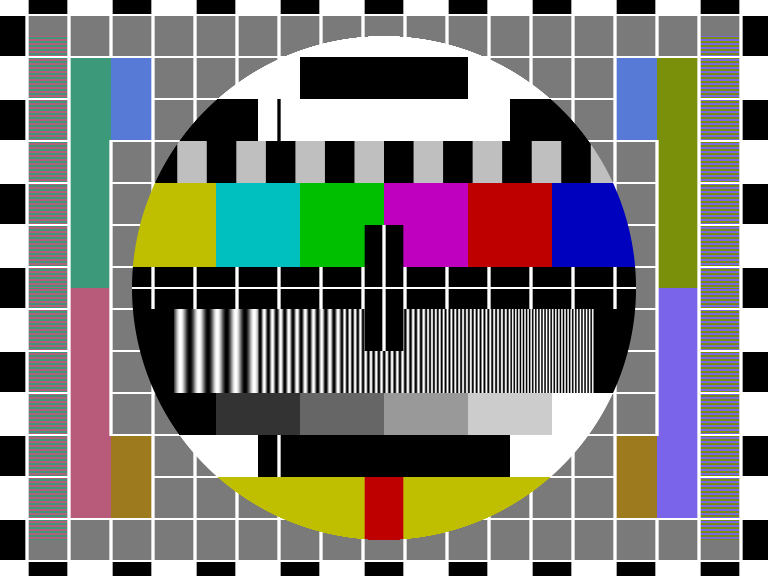
The Philips circle pattern (also referred to as the Philips pattern or PTV Circle pattern) refers to a family of related electronically generated complex television station colour test cards. The content and layout of the original colour circle pattern was designed by Danish engineer Finn Hendil (1939–2011) in the Philips TV & Test Equipment laboratory in Amager (moved to Brøndby Municipality in 1989) near Copenhagen under supervision of chief engineer Erik Helmer Nielsen in 1966–67, largely building on their previous work with the monochrome PM5540 pattern. The first piece of equipment, the PM5544 colour pattern generator, which generates the pattern, was made by Finn Hendil and his group in 1968–69. The same team would also develop the Spanish TVE colour test card in 1973.
Since the widespread introduction of the original PM5544 from the early-1970s, the Philips Pattern has become one of the most commonly used test cards, with only the SMPTE and EBU colour bars as well as the BBC's Test Card F coming close to its usage.
The Philips circle pattern was later incorporated into other test pattern generators from Philips itself, as well as test pattern generators from various other manufacturers. Equipment from Philips and succeeding companies which generate the circle pattern are the PM5544, PM5534, PM5535, PM5644, PT5210, PT5230 and PT5300. Other related (non circle pattern) test card generators by Philips are the PM5400 (TV serviceman) family, PM5515/16/18, PM5519, PM5520 (monochrome), PM5522 (PAL), PM5540 (monochrome), PM5547, PM5552 and PM5631.
Rather than previous test card approaches that worked by a live camera or monoscope filming a printed card, the Philips PM5544 generates the test patterns fully using electronic circuits, with separate paths for Y, R-Y and B-Y colour components (), allowing engineers to reliably test and adjust transmitters and receivers for signal disturbances and colour separation, for instance for PAL broadcasts.

In simple terms, the displayed pattern provides reference levels of black, white and colour saturation, to which a receiver can be set. Displayed image geometry (image centering, correct proportions of the circle, etc.) can also be corrected. More technical adjustments are also possible.
Main technical features of the test card:
While the basic specifications of the pattern normally remain consistent, there are often small variations depending on the brand and type of generator used to produce it, as well as how the broadcaster has chosen to configure it. Some television stations have included a digital clock and/or date, as well as the station logo or ID, inside the circle. This practice was common in Asia and some parts of Europe, as well as in South Africa.
The Philips circle pattern is geared towards the PAL colour-coding system, but SECAM versions do exist (for example, it was used by TVP in Poland, MTV in Hungary and TDF in France, without side bars, as well as ERT in Greece, VTV in Vietnam and Télé Sahel in Niger, with side bars). The most obvious difference is the absence of PAL specific test features (to two normally invisible outmost vertical bars). Less noticeable is the change to the multiburst gratings, instead at 0.8, 1.8, 2.8, 1.8 and 0.8 MHz due to the lower luminance bandwidth in the SECAM system.
Hub AI
Philips circle pattern AI simulator
(@Philips circle pattern_simulator)
Philips circle pattern
The Philips circle pattern (also referred to as the Philips pattern or PTV Circle pattern) refers to a family of related electronically generated complex television station colour test cards. The content and layout of the original colour circle pattern was designed by Danish engineer Finn Hendil (1939–2011) in the Philips TV & Test Equipment laboratory in Amager (moved to Brøndby Municipality in 1989) near Copenhagen under supervision of chief engineer Erik Helmer Nielsen in 1966–67, largely building on their previous work with the monochrome PM5540 pattern. The first piece of equipment, the PM5544 colour pattern generator, which generates the pattern, was made by Finn Hendil and his group in 1968–69. The same team would also develop the Spanish TVE colour test card in 1973.
Since the widespread introduction of the original PM5544 from the early-1970s, the Philips Pattern has become one of the most commonly used test cards, with only the SMPTE and EBU colour bars as well as the BBC's Test Card F coming close to its usage.
The Philips circle pattern was later incorporated into other test pattern generators from Philips itself, as well as test pattern generators from various other manufacturers. Equipment from Philips and succeeding companies which generate the circle pattern are the PM5544, PM5534, PM5535, PM5644, PT5210, PT5230 and PT5300. Other related (non circle pattern) test card generators by Philips are the PM5400 (TV serviceman) family, PM5515/16/18, PM5519, PM5520 (monochrome), PM5522 (PAL), PM5540 (monochrome), PM5547, PM5552 and PM5631.
Rather than previous test card approaches that worked by a live camera or monoscope filming a printed card, the Philips PM5544 generates the test patterns fully using electronic circuits, with separate paths for Y, R-Y and B-Y colour components (), allowing engineers to reliably test and adjust transmitters and receivers for signal disturbances and colour separation, for instance for PAL broadcasts.
In simple terms, the displayed pattern provides reference levels of black, white and colour saturation, to which a receiver can be set. Displayed image geometry (image centering, correct proportions of the circle, etc.) can also be corrected. More technical adjustments are also possible.
Main technical features of the test card:
While the basic specifications of the pattern normally remain consistent, there are often small variations depending on the brand and type of generator used to produce it, as well as how the broadcaster has chosen to configure it. Some television stations have included a digital clock and/or date, as well as the station logo or ID, inside the circle. This practice was common in Asia and some parts of Europe, as well as in South Africa.
The Philips circle pattern is geared towards the PAL colour-coding system, but SECAM versions do exist (for example, it was used by TVP in Poland, MTV in Hungary and TDF in France, without side bars, as well as ERT in Greece, VTV in Vietnam and Télé Sahel in Niger, with side bars). The most obvious difference is the absence of PAL specific test features (to two normally invisible outmost vertical bars). Less noticeable is the change to the multiburst gratings, instead at 0.8, 1.8, 2.8, 1.8 and 0.8 MHz due to the lower luminance bandwidth in the SECAM system.