Hubbry Logo
Phillip GriffithsPhillip GriffithsMain
Open search
Phillip Griffiths
Community hub
Phillip Griffiths
logo
8 pages, 0 posts
0 subscribers
Be the first to start a discussion here.
Phillip Griffiths
Phillip Griffiths
from Wikipedia

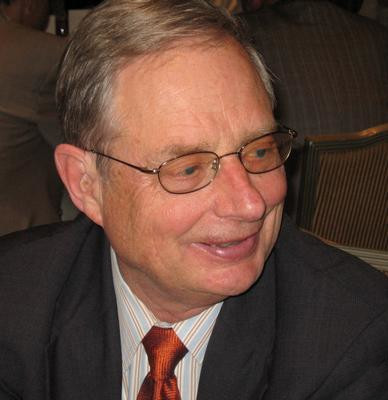
Phillip Augustus Griffiths IV (born October 18, 1938) is an American mathematician, known for his work in the field of geometry, and in particular for the complex manifold approach to algebraic geometry. He is a major developer in particular of the theory of variation of Hodge structure in Hodge theory and moduli theory, which forms part of transcendental algebraic geometry and which also touches upon major and distant areas of differential geometry. He also worked on partial differential equations, coauthored with Shiing-Shen Chern, Robert Bryant and Robert Gardner on Exterior Differential Systems.

Key Information

Professional career

[edit]

He received his BS from Wake Forest College in 1959 and his PhD from Princeton University in 1962 after completing a doctoral dissertation, titled "On certain homogeneous complex manifolds", under the supervision of Donald Spencer.[1] Afterwards, he held positions at University of California, Berkeley (1962–1967) and Princeton University (1967–1972).[citation needed] Griffiths was a professor of mathematics at Harvard University from 1972 to 1983.[2] He was then a Provost and James B. Duke Professor of Mathematics at Duke University from 1983 to 1991.[2] From 1991 to 2003, he was the Director of the Institute for Advanced Study (IAS) in Princeton, New Jersey.[2] He remained as part of the Faculty of Mathematics at the IAS until June 2009, after which he has been emeritus at the IAS.[2] He has published on algebraic geometry, differential geometry, geometric function theory, and the geometry of partial differential equations.

Griffiths serves as the Chair of the Science Initiative Group.[2] He is co-author, with Joe Harris, of Principles of Algebraic Geometry, a well-regarded textbook on complex algebraic geometry.[3]

Awards and honors

[edit]

Griffiths was elected to the National Academy of Sciences in 1979 and the American Philosophical Society in 1992.[4][5] In 2008 he was awarded the Wolf Prize (jointly with Deligne and Mumford)[6] and the Brouwer Medal.[7] In 2012 he became a fellow of the American Mathematical Society.[8] Moreover, in 2014 Griffiths was awarded the Leroy P. Steele Prize for Lifetime Achievement by the American Mathematical Society.[9] Also in 2014, Griffiths was awarded the Chern Medal for lifetime devotion to mathematics and outstanding achievements.

Selected publications

[edit]

Articles

[edit]

Books

[edit]

References

[edit]
[edit]
Revisions and contributorsEdit on WikipediaRead on Wikipedia
from Grokipedia
Phillip A. Griffiths (born 1938) is an American mathematician renowned for his pioneering work in algebraic geometry, complex manifolds, and Hodge theory, particularly for initiating the theory of variations of Hodge structure that has profoundly influenced modern mathematics. Born in Raleigh, North Carolina, Griffiths developed an early interest in mathematics while attending a military academy, where he studied calculus informally with a dedicated teacher. He earned a B.S. from Wake Forest University in 1959 and a Ph.D. from Princeton University in 1962 under the supervision of Donald C. Spencer. Following his doctorate, Griffiths held positions as a postdoctoral researcher and assistant professor at the University of California, Berkeley from 1962 to 1967, before joining the faculty at Princeton University and later Harvard University, where he served as Professor from 1972 to 1983, becoming the Dwight Parker Robinson Professor in 1983. In 1983, he became Provost and James B. Duke Professor at Duke University, a role he held until 1991, after which he served as Director of the Institute for Advanced Study from 1991 to 2003; he now holds the position of Professor Emeritus in the School of Mathematics there. Griffiths' research has spanned differential and integral geometry, geometric function theory, and the geometry of partial differential equations, with seminal contributions including the development of transcendental methods in algebraic geometry and collaborations that advanced the understanding of period mappings and moduli spaces. He co-authored influential texts, such as Principles of Algebraic Geometry with Joseph Harris, which remains a standard reference in the field. Beyond research, Griffiths has shaped mathematics through leadership roles, including as former Secretary of the from 1999 to 2006 and chair of the Science Initiative Group, which promotes scientific in developing regions like . His profound impact is recognized by numerous honors, including the in 2008, the Leroy P. Steele Prize for Lifetime Achievement from the in 2014, and the from the in 2014. Earlier accolades include the Dannie Heineman Prize from the Academy of Sciences in 1979 and election to the in 1979.

Early life and education

Early years and family

Phillip Augustus Griffiths IV was born on October 18, 1938, in , to parents Philip Griffiths, who worked in , and Jeanette Field Griffiths, a and teacher. Growing up in in a modest socioeconomic environment shaped by his father's occupation in and the region's rural influences, Griffiths experienced a challenging early life. Griffiths' interest in developed during high school at a , where his teacher Lottie Wilson's infectious passion for the subject proved pivotal. Wilson tutored him in at her kitchen table on weekends, sparking a deep engagement that contrasted with his earlier pursuits like on lakes and set the foundation for his academic trajectory. This , amid the disciplined structure of the academy, proved influential. In 1958, while still an undergraduate, Griffiths married Ann Lane Crittenden; the couple had two children, Jan Kirsten and David, before divorcing in 1967. He remarried in 1968 to Marian Folsom Jones, a neurologist, with whom he had two more children, Sarah and Rebecca, forming a family that supported his emerging career as he transitioned to studies at Wake Forest College.

Academic training

Phillip Griffiths earned his degree in from Wake Forest in , in 1959. As one of the first students at the institution's new campus following its relocation in 1956, Griffiths benefited from a mathematics that primarily focused on introductory courses, but he was granted permission to pursue in advanced topics to prepare for graduate-level work. Griffiths then entered Princeton University in 1959, where he completed his Ph.D. in mathematics in 1962 under the supervision of Donald C. Spencer. His doctoral thesis, titled "On Certain Homogeneous Complex Manifolds," explored geometric aspects of complex analysis. During his graduate studies, Spencer profoundly influenced Griffiths by introducing him to key concepts in Lie groups, sheaf cohomology, complex manifolds, and differential geometry, while recommending seminal texts such as Hermann Weyl's Die Idee der Riemannschen Fläche and Élie Cartan's papers on differential forms. This guidance provided Griffiths with deep exposure to complex manifolds, shaping his foundational expertise in several complex variables and laying the groundwork for his later research.

Academic career

Early academic positions

Following the completion of his Ph.D. at in 1962, Phillip Griffiths took up a prestigious Miller Research Fellowship at the , where he served from 1962 to 1964. This postdoctoral position allowed him to build on his doctoral training in complex manifolds under Donald Spencer, focusing on advanced topics in geometry while immersing himself in Berkeley's vibrant mathematical community. During this period, Griffiths began forming key connections, notably meeting , whose influence would shape his future work in . In 1964, Griffiths transitioned to a faculty role at Berkeley, starting as an and continuing until 1967. He contributed to the department by teaching graduate-level courses in several complex variables and , helping to strengthen the institution's emphasis on these areas amid a growing interest in analytic approaches to . His instructional efforts included developing materials that bridged classical with emerging geometric techniques, fostering collaborations among students and faculty on problems in complex manifolds. Seeking new opportunities, Griffiths spent the 1967–1968 academic year as a visiting professor at Princeton University, leveraging his alma mater's resources to deepen his research trajectory. This led to his appointment as a full professor at Princeton in 1968, a position he held until 1972. At Princeton, he played a significant role in the mathematics department by organizing seminars on Hodge theory and algebraic cycles, which encouraged interdisciplinary dialogue and supported the training of several doctoral students in geometry-related fields. These early positions marked Griffiths' rapid ascent in academia, establishing him as a rising figure in geometric studies.

Leadership and later roles

In 1972, Griffiths joined Harvard University as a professor of mathematics, serving in that role until 1983. In 1983, he was appointed the Dwight Parker Robinson Professor of Mathematics at Harvard, a position that marked his rising prominence in academic administration. That same year, Griffiths moved to Duke University, where he served as provost and James B. Duke Professor of Mathematics from 1983 to 1991. During his tenure as provost, he played a key role in shaping the university's academic and research priorities, leveraging his expertise to foster interdisciplinary initiatives. From 1991 to 2003, Griffiths directed the Institute for Advanced Study (IAS) in , overseeing its operations and expanding its influence in fundamental research. A significant initiative under his leadership was the launch of the Millennium Science Initiative in 1998, which aimed to bolster science and technology capacity in developing nations through targeted grants and institutional partnerships. Following his directorship, Griffiths remained on the IAS faculty as a professor of mathematics from 2003 until June 2009, when he became professor emeritus. Currently, Griffiths serves as chair of the Science Initiative Group (SIG), an organization he helped found in to advance global science policy and education by supporting capacity-building programs in the developing world. In this role, he continues to guide efforts that promote equitable access to scientific resources and training internationally. Additionally, Griffiths has contributed to U.S. and policy through advisory positions, including chairing the Carnegie Corporation-IAS Commission on Mathematics and Science Education and serving on the National Research Council Board on and Their Applications, as well as the President's Council of Advisors on Science and Technology.

Mathematical contributions

Work in algebraic geometry and Hodge theory

Phillip Griffiths made foundational contributions to through his development of the theory of variations of Hodge structures and period domains during the 1960s and 1970s. In his seminal work, Griffiths introduced variations of Hodge structures as a framework to study families of algebraic varieties, formalizing how Hodge structures evolve over parameter spaces while preserving key analytic properties. This concept arose from analyzing period integrals on algebraic manifolds, where he established that the Gauss-Manin connection on the cohomology bundles satisfies specific integrability conditions, enabling the global study of period mappings from moduli spaces to classifying spaces. These period domains serve as universal parameter spaces for polarized Hodge structures of a given weight, providing a geometric arena where algebraic varieties can be classified up to biholomorphic equivalence via their periods. A central result in this framework is the Griffiths transversality theorem, which asserts that for a variation of Hodge structure, the image of the horizontal tangent space under the Gauss-Manin connection lies within the horizontal subbundle defined by the Hodge filtration. Specifically, if FF^\bullet denotes the decreasing filtration on the flat vector bundle underlying the variation, the theorem states that the connection \nabla satisfies (Fp)Fp1Ω1\nabla(F^p) \subseteq F^{p-1} \otimes \Omega^1, ensuring that infinitesimal deformations respect the Hodge decomposition. This transversality condition has profound implications for mappings between manifolds, as it imposes rigidity on period maps, preventing arbitrary deformations and linking the differential geometry of the base manifold to the algebraic structure of the fibers. By restricting the possible directions of variation, it facilitates the proof of infinitesimal rigidity for certain period mappings, such as those arising from families of curves or abelian varieties. Griffiths' work extended to moduli theory for algebraic varieties, where period mappings provide a transcendental tool to understand the of . These mappings, from the of polarized varieties to the period domain, are holomorphic and horizontal with respect to the natural connections, and their rigidity—often proven via transversality—implies that the image lies on Noether-Lefschetz loci, where Hodge classes coincide with algebraic classes. This approach revolutionized the study of moduli by bridging algebraic invariants with analytic ones, particularly in cases like Calabi-Yau threefolds, where period integrals encode mirror symmetry phenomena. Griffiths demonstrated that such mappings are immersive near generic points, allowing the reconstruction of the variety from its period data under suitable conditions. The influence of Griffiths' ideas permeates transcendental methods in , fostering a deep interplay between and algebra. By emphasizing period domains and variations, his theory enables the use of differential equations to probe algebraic questions, such as the distribution of Hodge classes in families. variations of Hodge structures, as developed by Griffiths, capture the local behavior of these families, where the Hodge filtration FF^\bullet parameterizes the possible deformations of the complex structure. This filtration plays a crucial role in classifying complex structures on manifolds, as its variations distinguish between algebraic and transcendental extensions, providing invariants that detect the algebraicity of cycles via the invariant of normal functions. Overall, these contributions established as an indispensable tool for modern , influencing subsequent developments in mirror symmetry and arithmetic .

Contributions to differential geometry and other areas

Griffiths made significant contributions to the theory of exterior differential systems (EDS), collaborating with , Robert Bryant, and others to develop a geometric framework for analyzing systems of partial differential equations (PDEs). In their seminal 1991 volume, Exterior Differential Systems, the authors presented a comprehensive treatment of EDS, emphasizing its role in solving overdetermined systems arising in and physics, with applications to problems like the and integral manifolds. This work built on Élie Cartan's foundational ideas, providing tools for classifying PDEs through involutivity conditions and equivalence methods, which facilitated practical computations in . In the 1980s, Griffiths advanced the study of isometric embeddings and Euler-Lagrange equations using EDS techniques. His 1987 book with Gary R. Jensen, Differential Systems and Isometric Embeddings, explored the geometric constraints on embedding Riemannian manifolds into Euclidean spaces, deriving necessary and sufficient conditions via the method of equivalence. This approach connected variational principles to local , particularly for hypersurfaces with prescribed metrics. Extending these ideas, Griffiths co-authored Exterior Differential Systems and Euler-Lagrange Partial Differential Equations in 2003 with Bryant and Daniel Grossman, focusing on first-order Lagrangians and their associated PDEs, including symmetries and conservation laws via . Griffiths co-developed key aspects of rational homotopy theory through the lens of differential forms in collaboration with John Morgan. Their 1981 book, Rational Homotopy Theory and Differential Forms (revised 2013), introduced algebraic models for simply connected spaces using Sullivan's minimal models and de Rham's theorem, enabling computations of rational homotopy groups via commutative differential graded algebras. This framework bridged algebraic topology and complex geometry, providing tools for Postnikov towers and rational types of manifolds. Griffiths explored entire holomorphic mappings as part of geometric function theory, emphasizing value distribution and growth properties. In his 1976 monograph Entire Holomorphic Mappings in One and Several Complex Variables, based on lectures at the Institute for Advanced Study, he generalized Nevanlinna theory to higher dimensions, deriving defect relations and order functions for mappings from Cn\mathbb{C}^n to compact complex manifolds. This work highlighted the role of curvature in constraining holomorphic images, with applications to algebraic degeneracy and Borel's theorem. Throughout these efforts, Griffiths emphasized intersections between and PDEs, applying EDS to practical geometric problems such as realizations and variational . His methods uncovered hidden symmetries in nonlinear PDEs, influencing fields like and through geometric integrability conditions. These contributions provided a unified analytic toolkit for studying geometric structures via differential forms and systems.

Awards and honors

Major mathematical prizes

Phillip A. Griffiths received the Leroy P. Steele Prize from the in 1971 for his seminal paper "Periods of integrals on algebraic manifolds," published in the Bulletin of the , which advanced the understanding of periods in through innovative transcendental methods. This early recognition highlighted his foundational contributions to geometry, emphasizing the paper's broad impact and expository clarity in bridging algebraic and analytic approaches. In 1979, Griffiths was awarded the Dannie Heineman Prize by the Academy of Sciences at , recognizing his outstanding work in transcendental , particularly the method of intermediate Jacobians, and its connections to Henri Poincaré's foundational ideas. The prize, valued at 30,000 Deutsche Marks and conferred biennially, underscored his applications of these geometric techniques to broader mathematical problems, including those with implications for . Griffiths shared the 2008 Wolf Prize in Mathematics with Pierre Deligne and David Mumford, awarded by the Wolf Foundation for his pioneering work on variations of Hodge structures, the theory of periods of abelian integrals, and contributions to complex differential geometry. The $100,000 prize, presented at the Knesset in Jerusalem, celebrated how these innovations generalized classical period concepts and influenced moduli theory and Hodge filtration applications. In 2014, the bestowed upon Griffiths the Leroy P. Steele Prize for Lifetime Achievement, honoring his profound influence across , , and differential equations through works such as collaborations with on and local differential geometry. Presented at the AMS's 120th Annual Meeting in , this award acknowledged his role in inspiring generations of mathematicians via research, teaching, and leadership. That same year, Griffiths received the from the at the in , for his transformative development of transcendental methods in , especially in and periods of algebraic varieties, which advanced algebraic cycles, period mappings, and topology. The medal, carrying a $500,000 prize and awarded quadrennially, highlighted his 50-year career's impact on differential systems and global mathematics support. Additionally, in 2002, Griffiths was granted the Grand Cross of the Brazilian Order of Scientific Merit by Brazil's Ministry of Science and Technology, recognizing his international contributions to mathematics and science promotion in developing regions. This honor reflected his leadership in initiatives fostering mathematical research worldwide.

Elected memberships and other recognitions

Griffiths was elected to the National Academy of Sciences in 1979, recognizing his significant contributions to mathematics. He joined the American Philosophical Society as a member in 1992, further affirming his stature among leading scholars across disciplines. In 2012, he was named a Fellow of the American Mathematical Society as part of its inaugural class, honoring his lifelong impact on the field. In 2019, he was elected a foreign member of the Russian Academy of Sciences. In 2008, Griffiths received the Brouwer Medal from the Royal Dutch Mathematical Society for his pioneering work in and . He delivered a plenary lecture titled "A Transcendental Method in " at the in in 1970, a prestigious invitation that highlighted his early influence. Additionally, he served as the American Mathematical Society's Colloquium Lecturer in 1979, presenting on and during the society's winter meeting in . Beyond these academic honors, Griffiths has been recognized for his leadership in science policy. He served on the National Science Board, the policymaking body of the , from 1991 to 1996. Griffiths played a central role in establishing the Millennium Science Initiative in 1998, a program aimed at strengthening science and technology capacity in developing countries through international . This effort extended to the African Mathematics Millennium Science Initiative (AMMSI), which honors his contributions with the annual Phillip Griffiths Prize, awarded starting in 2016 to outstanding African mathematicians working on the continent. In 2025, he was awarded the Medal with Ribbon by the Institute of Mathematics and Informatics at the for his outstanding contributions to the development of modern and his exceptional role in fostering international mathematical . These recognitions complement the major mathematical prizes he has received, underscoring his broader influence in fostering global mathematical development.

Selected publications

Books

Principles of Algebraic Geometry, co-authored with Joseph Harris and published in 1978 by John Wiley & Sons, offers a self-contained treatment of the fundamentals of , including schemes, coherent sheaves, , and moduli spaces of curves and abelian varieties. This book establishes geometric intuition through specific computations while presenting general theorems, making it accessible yet rigorous for graduate students and researchers. It remains a reference in the field, influencing the teaching and research in for decades. In Exterior Differential Systems, co-authored with Robert Bryant, , Robert Gardner, and Hubert Goldschmidt and published in 1991 as part of the MSRI Publications by Springer, Griffiths and collaborators develop the general theory of exterior differential systems (EDS), a framework for studying systems of partial differential equations geometrically. The volume covers integral manifolds, the Cartan-Kähler theory, and applications to and physics, providing tools for analyzing overdetermined PDEs. This work has been instrumental in advancing geometric approaches to differential equations, with lasting applications in and related areas. Differential Systems and Isometric Embeddings, written with Gary R. Jensen and published in 1987 by in the Studies series, applies EDS techniques to the problem of isometric embeddings of Riemannian manifolds into Euclidean spaces. The book details the local and global solvability of associated PDEs, including and rigidity results, through moving frames and involutivity conditions. It synthesizes and PDE theory, serving as a key resource for understanding embedding problems in . Co-authored with John W. Morgan, Rational Homotopy Theory and Differential Forms, published in 1981 by Birkhäuser in the Progress in Mathematics series, explores the rational homotopy type of simply connected spaces using Sullivan's minimal models and . The text bridges and by constructing quasitopological invariants via differential forms and proving duality theorems. This influential monograph has shaped the development of , providing foundational tools for studying homotopy invariants rationally. In Mumford–Tate Groups and Domains: Their Geometry and Arithmetic, co-authored with Mark Green and Matt Kerr and published in 2012 by in the Annals of Mathematics Studies series, Griffiths and colleagues provide a comprehensive account of Mumford-Tate groups associated to s. The book covers the geometry of period domains, arithmetic aspects via Shimura varieties, and classifications of , integrating , , and . It offers new perspectives on variations of and has advanced research in transcendental methods in arithmetic geometry. Entire Holomorphic Mappings in One and Several Complex Variables, edited by Griffiths and published in 1976 by in the Annals of Mathematics Studies series, compiles seminar notes on value distribution theory and for holomorphic functions and maps. Drawing from works by Ahlfors, Hayman, and others, it addresses hyperbolicity, defect relations, and applications to , such as the Green-Griffiths conjecture. This volume has been pivotal in , fostering connections between function theory and geometry.

Notable articles

Griffiths' seminal contributions to the study of periods and Hodge structures are exemplified in his three-part series "Periods of integrals on algebraic manifolds," published between 1968 and 1970. In Part I, he constructed the period domain as a for polarized Hodge structures and explored its properties as a , laying the groundwork for understanding how Hodge structures vary in families of algebraic varieties. This work established the framework for infinitesimal and global properties of period mappings, influencing subsequent developments in moduli theory. Part II focused on the local behavior of the period mapping near a marked point, demonstrating transversality conditions under which the mapping is immersive and analyzing its relation to the tangent spaces of moduli spaces. These results provided tools for studying deformations of complex structures and their compatibility with algebraic conditions, with applications to the Schottky problem. Part III extended the analysis globally, proving that the period domain is a and deriving differential-geometric properties of the period mapping, such as its plurisubharmonicity, which facilitated connections between and transcendental methods in . A companion expository article, "Periods of integrals on algebraic manifolds: Summary of main results and discussion of open problems," synthesized these findings and posed key questions about the image of period mappings, stimulating research on the Hodge and Griffiths conjectures. This piece highlighted the role of period mappings in bridging differential geometry and algebraic geometry, earning widespread citation for its clarity and foresight. In collaboration with C. Herbert Clemens, Griffiths' 1972 paper "The intermediate Jacobian of the cubic threefold" applied Hodge theory to explicitly compute the intermediate Jacobian of a smooth cubic threefold, showing it to be a principally polarized abelian variety of dimension five. The work demonstrated how algebraic cycles generate the Jacobian, providing evidence for the Hodge conjecture in this case and influencing studies of rationality and unirationality of threefolds. Griffiths' 1969 article "Hermitian differential geometry, Chern classes, and positive vector bundles" developed the notion of positivity for holomorphic vector bundles using Chern connections and forms, proving that ample bundles admit Hermitian metrics with positive definite . This established a differential-geometric criterion for ampleness, with lasting impact on the study of stability and moduli of bundles in . The 1978 collaboration with S.S. Chern, "Abel's theorem and webs," integrated exterior differential systems with web geometry to prove an analogue of for multidimensional webs, showing that certain webs arise from algebraic integrals. By employing systems and Frobenius integrability, the paper advanced the geometric theory of partial differential equations, with applications to overdetermined systems in . In the 1980s, Griffiths contributed influential surveys on Hodge theory applications. His 2004 article "Hodge theory and ," reviewed variations of in the context of moduli spaces and discussed connections to mirror symmetry precursors and arithmetic . This expository work clarified the geometric implications of Hodge decompositions, serving as a key reference for integrating with contemporary . The series "Infinitesimal variations of Hodge structure" (1983), coauthored with J. Carlson, M. Green, and J. Harris, extended earlier ideas to mixed s. Part I analyzed the on and its infinitesimal deformations, resolving aspects of the generic Torelli theorem for curves. Subsequent parts introduced invariants for normal functions and determinantal varieties, impacting the study of limiting mixed s and the period index problem.

References

Add your contribution
Related Hubs
User Avatar
No comments yet.