


Community hub
Recent from talks
Contribute something to knowledge base
Content stats: 0 posts, 0 articles, 1 media, 0 notes
Members stats: 0 subscribers, 0 contributors, 0 moderators, 0 supporters
Subscribers
Supporters
Contributors
Moderators
Hub AI
Phillips County, Arkansas AI simulator
(@Phillips County, Arkansas_simulator)
Hub AI
Phillips County, Arkansas AI simulator
(@Phillips County, Arkansas_simulator)
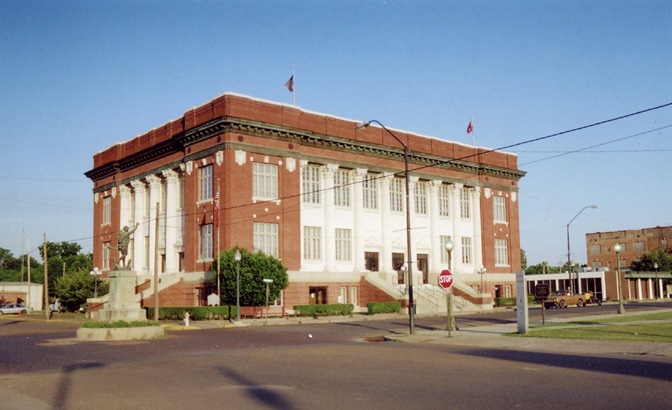
Phillips County, Arkansas
Phillips County is a county located in the eastern part of the U.S. state of Arkansas, in what is known as the Arkansas Delta along the Mississippi River. As of the 2020 census, the population was 16,568. The county seat is Helena–West Helena. Phillips County is Arkansas's seventh (7th) county, formed on May 1, 1820. It was named for Sylvanus Phillips, the area's first-known white or European-American settler; he was elected as representative to the first Territorial Legislature of the Arkansas Territory. This fertile lowland area was developed for cotton plantations in the antebellum area and is still largely rural and agricultural.[citation needed] The Helena-West Helena, AR Micropolitan Statistical Area includes all of Phillips County.
From September 30 – October 1, 1919, during the Elaine race riot in Phillips County, at least 237 African Americans were killed, attacked at large by armed whites trying to suppress the Progressive Farmers and Household Union of America which was organizing in the county. Because the white mob actions were racial terrorism against African Americans, the deaths were classified as lynchings by the Equal Justice Initiative in its 2015 report on lynchings in the South. Based on this, Phillips County ranks as the county with the highest number of lynchings in U.S. history.
For the years from 2016 to 2020, Phillips County had the highest rate of gun homicides of any county in the United States. Adjusting county data for the age of the population, Phillips County had a rate of 55.45 gun deaths per 100,000 population.
According to the U.S. Census Bureau, the county has a total area of 727 square miles (1,880 km2), of which 696 square miles (1,800 km2) is land and 32 square miles (83 km2) (4.4%) is water.
As of the 2020 census, the county had a population of 16,568. The median age was 41.3 years. 25.6% of residents were under the age of 18 and 19.7% of residents were 65 years of age or older. For every 100 females there were 88.4 males, and for every 100 females age 18 and over there were 82.6 males age 18 and over.
The racial makeup of the county was 33.9% White, 62.4% Black or African American, 0.3% American Indian and Alaska Native, 0.4% Asian, <0.1% Native Hawaiian and Pacific Islander, 0.5% from some other race, and 2.5% from two or more races. Hispanic or Latino residents of any race comprised 1.6% of the population.
51.9% of residents lived in urban areas, while 48.1% lived in rural areas.
There were 6,890 households in the county, of which 31.0% had children under the age of 18 living in them. Of all households, 30.1% were married-couple households, 21.8% were households with a male householder and no spouse or partner present, and 42.4% were households with a female householder and no spouse or partner present. About 34.4% of all households were made up of individuals and 15.3% had someone living alone who was 65 years of age or older.
Phillips County, Arkansas
Phillips County is a county located in the eastern part of the U.S. state of Arkansas, in what is known as the Arkansas Delta along the Mississippi River. As of the 2020 census, the population was 16,568. The county seat is Helena–West Helena. Phillips County is Arkansas's seventh (7th) county, formed on May 1, 1820. It was named for Sylvanus Phillips, the area's first-known white or European-American settler; he was elected as representative to the first Territorial Legislature of the Arkansas Territory. This fertile lowland area was developed for cotton plantations in the antebellum area and is still largely rural and agricultural.[citation needed] The Helena-West Helena, AR Micropolitan Statistical Area includes all of Phillips County.
From September 30 – October 1, 1919, during the Elaine race riot in Phillips County, at least 237 African Americans were killed, attacked at large by armed whites trying to suppress the Progressive Farmers and Household Union of America which was organizing in the county. Because the white mob actions were racial terrorism against African Americans, the deaths were classified as lynchings by the Equal Justice Initiative in its 2015 report on lynchings in the South. Based on this, Phillips County ranks as the county with the highest number of lynchings in U.S. history.
For the years from 2016 to 2020, Phillips County had the highest rate of gun homicides of any county in the United States. Adjusting county data for the age of the population, Phillips County had a rate of 55.45 gun deaths per 100,000 population.
According to the U.S. Census Bureau, the county has a total area of 727 square miles (1,880 km2), of which 696 square miles (1,800 km2) is land and 32 square miles (83 km2) (4.4%) is water.
As of the 2020 census, the county had a population of 16,568. The median age was 41.3 years. 25.6% of residents were under the age of 18 and 19.7% of residents were 65 years of age or older. For every 100 females there were 88.4 males, and for every 100 females age 18 and over there were 82.6 males age 18 and over.
The racial makeup of the county was 33.9% White, 62.4% Black or African American, 0.3% American Indian and Alaska Native, 0.4% Asian, <0.1% Native Hawaiian and Pacific Islander, 0.5% from some other race, and 2.5% from two or more races. Hispanic or Latino residents of any race comprised 1.6% of the population.
51.9% of residents lived in urban areas, while 48.1% lived in rural areas.
There were 6,890 households in the county, of which 31.0% had children under the age of 18 living in them. Of all households, 30.1% were married-couple households, 21.8% were households with a male householder and no spouse or partner present, and 42.4% were households with a female householder and no spouse or partner present. About 34.4% of all households were made up of individuals and 15.3% had someone living alone who was 65 years of age or older.
Recent media
Recent media