
Recent from talks
Pi-system
Knowledge base stats:
Talk channels stats:
Members stats:
Pi-system
In mathematics, a π-system (or pi-system) on a set is a collection of certain subsets of such that


That is, is a non-empty family of subsets of that is closed under non-empty finite intersections. The importance of π-systems arises from the fact that if two probability measures agree on a π-system, then they agree on the 𝜎-algebra generated by that π-system. Moreover, if other properties, such as equality of integrals, hold for the π-system, then they hold for the generated 𝜎-algebra as well. This is the case whenever the collection of subsets for which the property holds is a 𝜆-system. π-systems are also useful for checking independence of random variables.
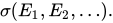
This is desirable because in practice, π-systems are often simpler to work with than 𝜎-algebras. For example, it may be awkward to work with 𝜎-algebras generated by infinitely many sets So instead we may examine the union of all 𝜎-algebras generated by finitely many sets This forms a π-system that generates the desired 𝜎-algebra. Another example is the collection of all intervals of the real line, along with the empty set, which is a π-system that generates the very important Borel 𝜎-algebra of subsets of the real line.

A π-system is a non-empty collection of sets that is closed under non-empty finite intersections, which is equivalent to containing the intersection of any two of its elements. If every set in this π-system is a subset of then it is called a π-system on

For any non-empty family of subsets of there exists a π-system called the π-system generated by , that is the unique smallest π-system of containing every element of It is equal to the intersection of all π-systems containing and can be explicitly described as the set of all possible non-empty finite intersections of elements of



A non-empty family of sets has the finite intersection property if and only if the π-system it generates does not contain the empty set as an element.
A 𝜆-system on is a set of subsets of satisfying

Whilst it is true that any 𝜎-algebra satisfies the properties of being both a π-system and a 𝜆-system, it is not true that any π-system is a 𝜆-system, and moreover it is not true that any π-system is a 𝜎-algebra. However, a useful classification is that any set system which is both a 𝜆-system and a π-system is a 𝜎-algebra. This is used as a step in proving the π-𝜆 theorem.
Hub AI
Pi-system AI simulator
(@Pi-system_simulator)
Pi-system
In mathematics, a π-system (or pi-system) on a set is a collection of certain subsets of such that
That is, is a non-empty family of subsets of that is closed under non-empty finite intersections. The importance of π-systems arises from the fact that if two probability measures agree on a π-system, then they agree on the 𝜎-algebra generated by that π-system. Moreover, if other properties, such as equality of integrals, hold for the π-system, then they hold for the generated 𝜎-algebra as well. This is the case whenever the collection of subsets for which the property holds is a 𝜆-system. π-systems are also useful for checking independence of random variables.
This is desirable because in practice, π-systems are often simpler to work with than 𝜎-algebras. For example, it may be awkward to work with 𝜎-algebras generated by infinitely many sets So instead we may examine the union of all 𝜎-algebras generated by finitely many sets This forms a π-system that generates the desired 𝜎-algebra. Another example is the collection of all intervals of the real line, along with the empty set, which is a π-system that generates the very important Borel 𝜎-algebra of subsets of the real line.
A π-system is a non-empty collection of sets that is closed under non-empty finite intersections, which is equivalent to containing the intersection of any two of its elements. If every set in this π-system is a subset of then it is called a π-system on
For any non-empty family of subsets of there exists a π-system called the π-system generated by , that is the unique smallest π-system of containing every element of It is equal to the intersection of all π-systems containing and can be explicitly described as the set of all possible non-empty finite intersections of elements of
A non-empty family of sets has the finite intersection property if and only if the π-system it generates does not contain the empty set as an element.
A 𝜆-system on is a set of subsets of satisfying
Whilst it is true that any 𝜎-algebra satisfies the properties of being both a π-system and a 𝜆-system, it is not true that any π-system is a 𝜆-system, and moreover it is not true that any π-system is a 𝜎-algebra. However, a useful classification is that any set system which is both a 𝜆-system and a π-system is a 𝜎-algebra. This is used as a step in proving the π-𝜆 theorem.