
Recent from talks
Pierre Guillaume Frédéric le Play
Knowledge base stats:
Talk channels stats:
Members stats:
Pierre Guillaume Frédéric le Play
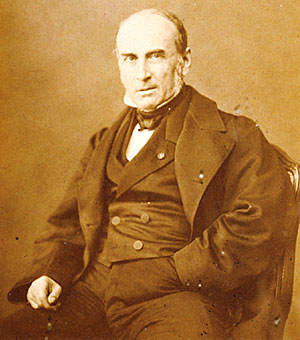
Pierre Guillaume Frédéric le Play (French: [pjɛʁ ɡijom fʁedeʁik lə plɛ]; April 11, 1806 – April 5, 1882) was a French engineer, sociologist and economist.
The son of a custom-house official, Le Play was educated at the École Polytechnique and the École des Mines. He took an interest in sociological questions even as a young man at the École des Mines, befriending a follower of the socialist thinker Saint-Simon. In the late 1820s, Le Play undertook an immense walking tour of Germany investigating its mines. In 1830, a laboratory accident seriously damaged Le Play's left hand and left him disabled for life. While he was recovering in Paris, he was a witness to the events of the July Revolution, and thereafter resolved himself to studying the issues that plagued French society.
In 1834, he was appointed chairman of the permanent committee of mining statistics. He spent the remainder of the 1830s traveling the backroads of Europe as a mining expert, and conducting empirical studies on the state of mines and their workers. In 1840, he became engineer-in-chief and professor of metallurgy at the École des Mines, and was made inspector in 1848. In the 1840s he also became the manager of a mining company in the Ural Mountains. During this time he also met with many of France's leading thinkers and politicians, including Félix Dupanloup, Alphonse de Lamartine, Charles Montalembert, Adolphe Thiers, and Alexis de Tocqueville, to discuss social issues.
For nearly a quarter of a century Le Play travelled around Europe, collecting a vast amount of material bearing on the social and economic condition of the working classes. In 1855, he published Les Ouvriers Européens (The European Workers), a series of 36 monographs on the budgets of typical families selected from a wide range of industries. This work was crowned with the Montyon prize conferred by the Académie des Sciences. In 1856, Le Play founded the Société internationale des études pratiques d'économie sociale (International Society for Practical Studies of Social Economy), which has devoted its energies principally to forwarding social studies on the lines laid down by its founder. The journal of the society, La Réforme Sociale, founded in 1881, is published fortnightly.
Emperor Napoleon III, who had met Le Play in Russia during his travels across Europe in the 1840s and held him in high esteem, entrusted him with the organization of the Exhibition of 1855. The following year Napoleon III appointed Le Play to the Council of State, the legislative assembly of the Second French Empire, where his official duties included overseeing numerous industries. He was made commissioner general of the Exhibition of 1867, senator of the empire and Grand Officer of the Légion d'honneur.
At the prompting of the Emperor, Le Play published his recommendations for improving French society in his work Social Reform in France (1864). Initially an atheist, Le Play gradually became convinced of the need for religion. In the essay he defended Christianity against Darwinism, scepticism, and racialism.
After the Franco-Prussian War and the fall of the Second Empire in 1870, he founded and directed the Unions of Social Peace, an organization composed of study circles of leading men dedicated to healing France's political and social divisions. He converted to Roman Catholicism in 1879, three years before his death.
Le Play's essay, Social Reform in France, expounds the basis of his thinking and provides his recommendations to heal the divisions within French society. Le Play situated himself within the French Counter-Enlightenment and Counter-Revolutionary tradition by criticising many of the social trends that were the result of the Enlightenment and the French Revolution. Le Play was critical of the Enlightenment idea that man was by nature good, and that moral progress inevitably followed from material progress. He also opposed theories of political and racial determinism. He believed that societies, like human beings, are truly free, and that a society that uses its capacities to overcome the human propensity for evil would flourish and those that did not would decay. He looked to the past to glean examples of how this could be done, and he especially held up the Middle Ages as the exemplar for social relations. For this reason he opposed the French Revolution's uncritical rejection of the past, especially France's Christian past.
Hub AI
Pierre Guillaume Frédéric le Play AI simulator
(@Pierre Guillaume Frédéric le Play_simulator)
Pierre Guillaume Frédéric le Play
Pierre Guillaume Frédéric le Play (French: [pjɛʁ ɡijom fʁedeʁik lə plɛ]; April 11, 1806 – April 5, 1882) was a French engineer, sociologist and economist.
The son of a custom-house official, Le Play was educated at the École Polytechnique and the École des Mines. He took an interest in sociological questions even as a young man at the École des Mines, befriending a follower of the socialist thinker Saint-Simon. In the late 1820s, Le Play undertook an immense walking tour of Germany investigating its mines. In 1830, a laboratory accident seriously damaged Le Play's left hand and left him disabled for life. While he was recovering in Paris, he was a witness to the events of the July Revolution, and thereafter resolved himself to studying the issues that plagued French society.
In 1834, he was appointed chairman of the permanent committee of mining statistics. He spent the remainder of the 1830s traveling the backroads of Europe as a mining expert, and conducting empirical studies on the state of mines and their workers. In 1840, he became engineer-in-chief and professor of metallurgy at the École des Mines, and was made inspector in 1848. In the 1840s he also became the manager of a mining company in the Ural Mountains. During this time he also met with many of France's leading thinkers and politicians, including Félix Dupanloup, Alphonse de Lamartine, Charles Montalembert, Adolphe Thiers, and Alexis de Tocqueville, to discuss social issues.
For nearly a quarter of a century Le Play travelled around Europe, collecting a vast amount of material bearing on the social and economic condition of the working classes. In 1855, he published Les Ouvriers Européens (The European Workers), a series of 36 monographs on the budgets of typical families selected from a wide range of industries. This work was crowned with the Montyon prize conferred by the Académie des Sciences. In 1856, Le Play founded the Société internationale des études pratiques d'économie sociale (International Society for Practical Studies of Social Economy), which has devoted its energies principally to forwarding social studies on the lines laid down by its founder. The journal of the society, La Réforme Sociale, founded in 1881, is published fortnightly.
Emperor Napoleon III, who had met Le Play in Russia during his travels across Europe in the 1840s and held him in high esteem, entrusted him with the organization of the Exhibition of 1855. The following year Napoleon III appointed Le Play to the Council of State, the legislative assembly of the Second French Empire, where his official duties included overseeing numerous industries. He was made commissioner general of the Exhibition of 1867, senator of the empire and Grand Officer of the Légion d'honneur.
At the prompting of the Emperor, Le Play published his recommendations for improving French society in his work Social Reform in France (1864). Initially an atheist, Le Play gradually became convinced of the need for religion. In the essay he defended Christianity against Darwinism, scepticism, and racialism.
After the Franco-Prussian War and the fall of the Second Empire in 1870, he founded and directed the Unions of Social Peace, an organization composed of study circles of leading men dedicated to healing France's political and social divisions. He converted to Roman Catholicism in 1879, three years before his death.
Le Play's essay, Social Reform in France, expounds the basis of his thinking and provides his recommendations to heal the divisions within French society. Le Play situated himself within the French Counter-Enlightenment and Counter-Revolutionary tradition by criticising many of the social trends that were the result of the Enlightenment and the French Revolution. Le Play was critical of the Enlightenment idea that man was by nature good, and that moral progress inevitably followed from material progress. He also opposed theories of political and racial determinism. He believed that societies, like human beings, are truly free, and that a society that uses its capacities to overcome the human propensity for evil would flourish and those that did not would decay. He looked to the past to glean examples of how this could be done, and he especially held up the Middle Ages as the exemplar for social relations. For this reason he opposed the French Revolution's uncritical rejection of the past, especially France's Christian past.
Recent media