
Recent from talks
Pine Gap
Knowledge base stats:
Talk channels stats:
Members stats:
Pine Gap
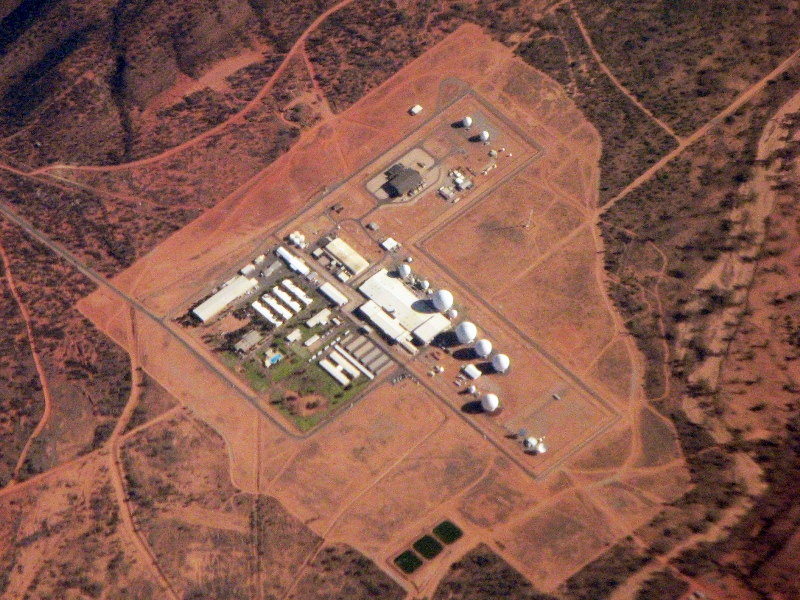
Pine Gap is a joint Australian–United States satellite communications and signals intelligence surveillance base and Australian Earth station approximately 18 km (11 mi) south-west of the town of Alice Springs. It is jointly operated by Australia and the United States, and since 1988 it has been officially called the Joint Defence Facility Pine Gap (JDFPG); previously, it was known as Joint Defence Space Research Facility. It plays a crucial role in supporting the intelligence activities and military operations of the US around the world. The base's role has caused much controversy in Australia, leading to various protests.
The station is jointly run by the Australian Defence Force (Australian Signals Directorate), the US Central Intelligence Agency (CIA), US National Security Agency (NSA), and US National Reconnaissance Office (NRO) and is a key contributor to the NSA's global interception/surveillance effort, which included the ECHELON program. The classified NRO name for the Pine Gap base is Australian Mission Ground Station (AMGS), while the unclassified cover term for the NSA function of the facility is RAINFALL.
The facilities at the base consist of a massive computer complex with 38 radomes protecting radio dishes and operates with over 800 employees. Former NSA employee David Rosenberg indicated that the chief of the facility was a senior CIA officer at the time of his service there.
Australian personnel stationed at the installation have access to the entire facility (depending on role and clearance). However, all Australian personnel are prohibited from entering the NSA's cryptology room. Similarly, all US Personnel are prohibited from the Australian Signals Directorate's cryptology room.[citation needed]
The location is strategically significant because it controls United States spy satellites as they pass over one-third of the globe, including China, North Korea, the Asian parts of Russia, and the Middle East. Central Australia was chosen because it was too remote for spy ships passing in international waters to intercept its signals. The facility has become a key part of the local economy.
Pine Gap's activities have become more military-focused over time. One of its roles is to detect and geolocate the source of electronic signals, such as those emitted by mobile phones. This information is used by Five Eyes to identify and geolocate targets of interest, which it can then attack using special forces or lethal unmanned drones, for example.
Since it was established, Pine Gap has assisted the US in planning for nuclear war.
Leaked Department of Defence documents revealed that satellites controlled by the Pine Gap and Joint Defence Facility Nurrungar facilities were used during the Vietnam War to pinpoint targets for bombings in Cambodia.
Hub AI
Pine Gap AI simulator
(@Pine Gap_simulator)
Pine Gap
Pine Gap is a joint Australian–United States satellite communications and signals intelligence surveillance base and Australian Earth station approximately 18 km (11 mi) south-west of the town of Alice Springs. It is jointly operated by Australia and the United States, and since 1988 it has been officially called the Joint Defence Facility Pine Gap (JDFPG); previously, it was known as Joint Defence Space Research Facility. It plays a crucial role in supporting the intelligence activities and military operations of the US around the world. The base's role has caused much controversy in Australia, leading to various protests.
The station is jointly run by the Australian Defence Force (Australian Signals Directorate), the US Central Intelligence Agency (CIA), US National Security Agency (NSA), and US National Reconnaissance Office (NRO) and is a key contributor to the NSA's global interception/surveillance effort, which included the ECHELON program. The classified NRO name for the Pine Gap base is Australian Mission Ground Station (AMGS), while the unclassified cover term for the NSA function of the facility is RAINFALL.
The facilities at the base consist of a massive computer complex with 38 radomes protecting radio dishes and operates with over 800 employees. Former NSA employee David Rosenberg indicated that the chief of the facility was a senior CIA officer at the time of his service there.
Australian personnel stationed at the installation have access to the entire facility (depending on role and clearance). However, all Australian personnel are prohibited from entering the NSA's cryptology room. Similarly, all US Personnel are prohibited from the Australian Signals Directorate's cryptology room.[citation needed]
The location is strategically significant because it controls United States spy satellites as they pass over one-third of the globe, including China, North Korea, the Asian parts of Russia, and the Middle East. Central Australia was chosen because it was too remote for spy ships passing in international waters to intercept its signals. The facility has become a key part of the local economy.
Pine Gap's activities have become more military-focused over time. One of its roles is to detect and geolocate the source of electronic signals, such as those emitted by mobile phones. This information is used by Five Eyes to identify and geolocate targets of interest, which it can then attack using special forces or lethal unmanned drones, for example.
Since it was established, Pine Gap has assisted the US in planning for nuclear war.
Leaked Department of Defence documents revealed that satellites controlled by the Pine Gap and Joint Defence Facility Nurrungar facilities were used during the Vietnam War to pinpoint targets for bombings in Cambodia.
Recent media