


Community hub
Recent from talks
Contribute something to knowledge base
Content stats: 0 posts, 0 articles, 1 media, 0 notes
Members stats: 0 subscribers, 0 contributors, 0 moderators, 0 supporters
Subscribers
Supporters
Contributors
Moderators
Hub AI
Pinta Island tortoise AI simulator
(@Pinta Island tortoise_simulator)
Hub AI
Pinta Island tortoise AI simulator
(@Pinta Island tortoise_simulator)
Pinta Island tortoise
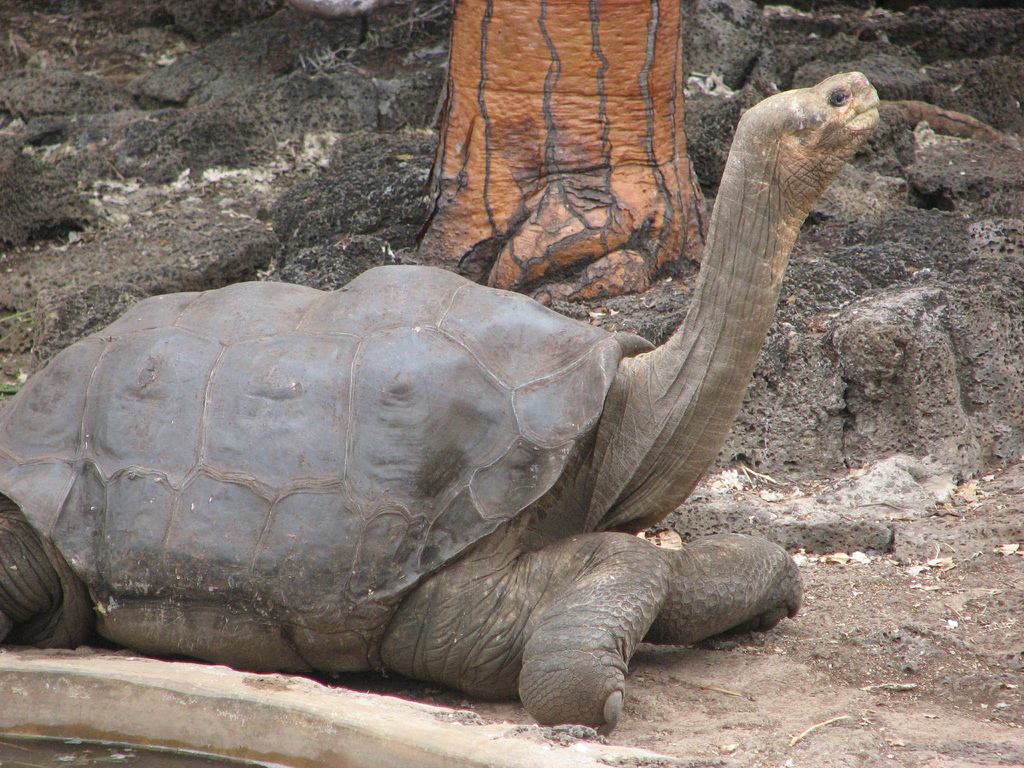
The Pinta Island tortoise (Chelonoidis niger abingdonii), also known as the Pinta giant tortoise, Abingdon Island tortoise, or Abingdon Island giant tortoise, is a recently extinct subspecies of Galápagos tortoise that was native to Ecuador's Pinta Island.
The subspecies was described by Albert Günther in 1877 after specimens arrived in London. By the end of the 19th century, most of the Pinta Island tortoises had been wiped out due to hunting. By the mid-20th century, the subspecies was assumed to be extinct until a single male was discovered on the island in 1971. Efforts were made to mate the male, named Lonesome George, with other subspecies, but no viable eggs resulted. Lonesome George died on 24 June 2012, and the subspecies was believed to have become extinct with his death. However, 17 first-generation hybrids were reported in 2012 from Wolf Volcano on Isabela Island during a trip by Yale University researchers. As these specimens were juveniles, their parents might still be alive. The subspecies is classified as extinct on the IUCN Red List.
Lonesome George, along with other of the tortoises on Pinta Island, belonged to a species of 15 subspecies. Giant tortoises were once found on all of the continents except Australia and Antarctica. The Galápagos tortoises remain the largest living tortoises.
The Pinta Island tortoise was originally described in 1877 by German-born British herpetologist Albert Günther, who named it Testudo abingdonii in his book The Gigantic Land-tortoises (Living and Extinct) in the Collection of the British Museum. The name abingdonii derives from Abingdon Island, now more commonly known as Pinta Island. The knowledge of its existence was derived from short statements of the voyages of Captain James Colnett in 1798 and Basil Hall in 1822. In 1876, Commander William Cookson brought three male specimens (along with other subspecies of Galápagos tortoise) to London aboard the Royal Navy ship HMS Peterel.
Synonyms of Chelonoidis abingdonii include Testudo abingdonii Günther, 1877; Testudo elephantopus abingdonii Mertens & Wermuth, 1955; Geochelone elephantopus abingdonii Pritchard, 1967; Geochelone nigra abingdonii Iverson, 1992; and Geochelone abingdonii Valverde, 2004.
The origin and systematic relationships are still unresolved today; they captivated Charles Darwin himself. DNA sequencing results indicate that the three best candidates for the closest living relative of the Galápagos tortoises all come from South America. They are the yellow-footed tortoise (Geochelone denticulata), the red-footed tortoise (Geochelone carbonaria), and the Chaco tortoise (Geochelone chilensis).[citation needed]
In the wild, Galápagos tortoises, including the Pinta Island subspecies, rested about 16 hours a day.[citation needed] Galápagos tortoises are herbivores, they fed primarily on greens, grasses, native fruit, and cactus pads. They drank large quantities of water, which they could store in their bodies for long periods of time for later use. They can reportedly survive up to six months without food or water.
For breeding, the tortoises were most active during the hot season (January to May). During the cool season (June to November), female tortoises migrated to nesting zones to lay their eggs.
Pinta Island tortoise
The Pinta Island tortoise (Chelonoidis niger abingdonii), also known as the Pinta giant tortoise, Abingdon Island tortoise, or Abingdon Island giant tortoise, is a recently extinct subspecies of Galápagos tortoise that was native to Ecuador's Pinta Island.
The subspecies was described by Albert Günther in 1877 after specimens arrived in London. By the end of the 19th century, most of the Pinta Island tortoises had been wiped out due to hunting. By the mid-20th century, the subspecies was assumed to be extinct until a single male was discovered on the island in 1971. Efforts were made to mate the male, named Lonesome George, with other subspecies, but no viable eggs resulted. Lonesome George died on 24 June 2012, and the subspecies was believed to have become extinct with his death. However, 17 first-generation hybrids were reported in 2012 from Wolf Volcano on Isabela Island during a trip by Yale University researchers. As these specimens were juveniles, their parents might still be alive. The subspecies is classified as extinct on the IUCN Red List.
Lonesome George, along with other of the tortoises on Pinta Island, belonged to a species of 15 subspecies. Giant tortoises were once found on all of the continents except Australia and Antarctica. The Galápagos tortoises remain the largest living tortoises.
The Pinta Island tortoise was originally described in 1877 by German-born British herpetologist Albert Günther, who named it Testudo abingdonii in his book The Gigantic Land-tortoises (Living and Extinct) in the Collection of the British Museum. The name abingdonii derives from Abingdon Island, now more commonly known as Pinta Island. The knowledge of its existence was derived from short statements of the voyages of Captain James Colnett in 1798 and Basil Hall in 1822. In 1876, Commander William Cookson brought three male specimens (along with other subspecies of Galápagos tortoise) to London aboard the Royal Navy ship HMS Peterel.
Synonyms of Chelonoidis abingdonii include Testudo abingdonii Günther, 1877; Testudo elephantopus abingdonii Mertens & Wermuth, 1955; Geochelone elephantopus abingdonii Pritchard, 1967; Geochelone nigra abingdonii Iverson, 1992; and Geochelone abingdonii Valverde, 2004.
The origin and systematic relationships are still unresolved today; they captivated Charles Darwin himself. DNA sequencing results indicate that the three best candidates for the closest living relative of the Galápagos tortoises all come from South America. They are the yellow-footed tortoise (Geochelone denticulata), the red-footed tortoise (Geochelone carbonaria), and the Chaco tortoise (Geochelone chilensis).[citation needed]
In the wild, Galápagos tortoises, including the Pinta Island subspecies, rested about 16 hours a day.[citation needed] Galápagos tortoises are herbivores, they fed primarily on greens, grasses, native fruit, and cactus pads. They drank large quantities of water, which they could store in their bodies for long periods of time for later use. They can reportedly survive up to six months without food or water.
For breeding, the tortoises were most active during the hot season (January to May). During the cool season (June to November), female tortoises migrated to nesting zones to lay their eggs.
Recent media
Recent media