
Recent from talks
Pitch drop experiment
Knowledge base stats:
Talk channels stats:
Members stats:
Pitch drop experiment
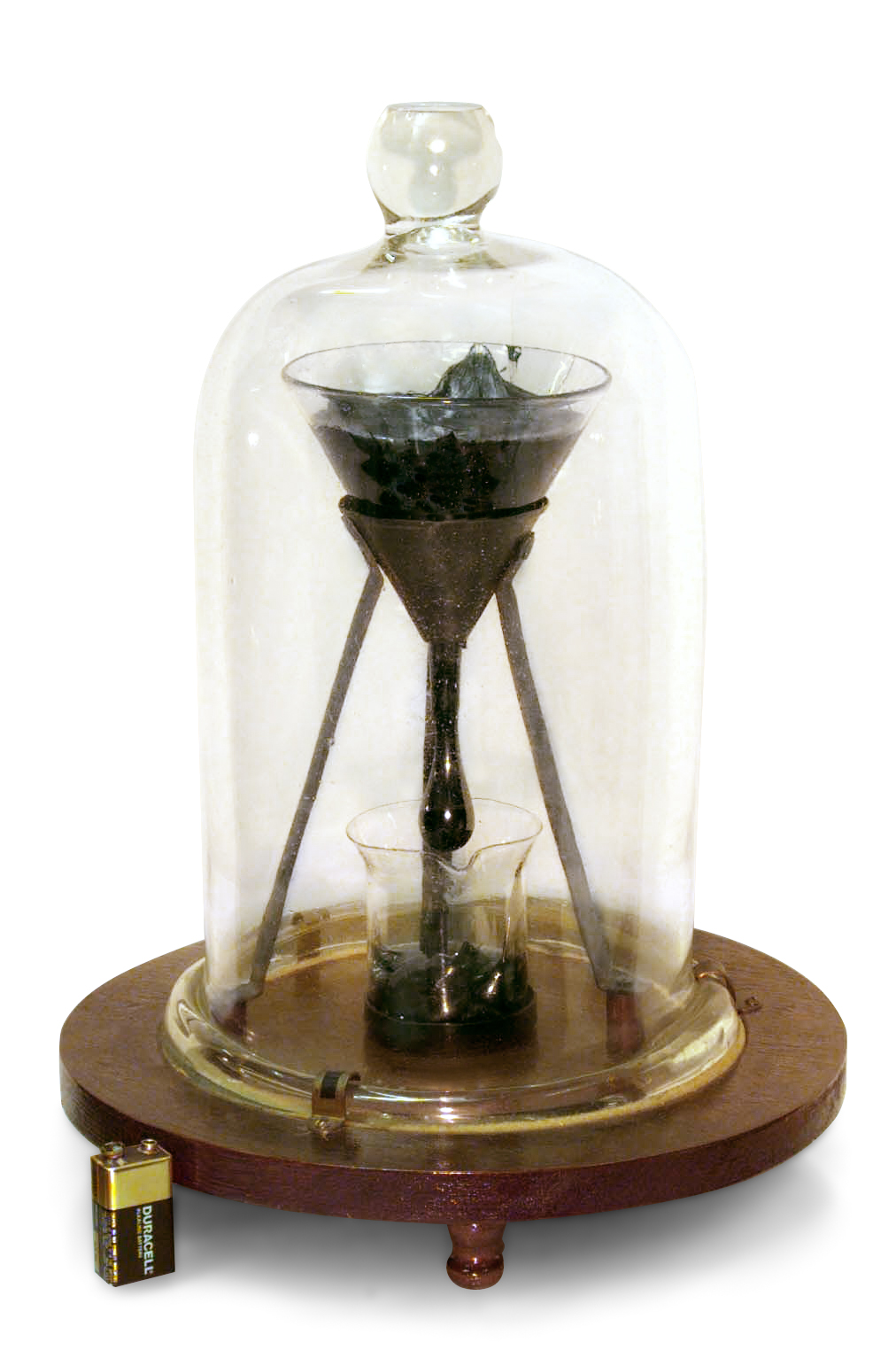
A pitch drop experiment is a long-term experiment which measures the flow of a piece of pitch over many years. "Pitch" is the name for any of a number of highly viscous liquids which appear solid, most commonly bitumen, also known as asphalt. At room temperature, tar pitch flows at a very low rate, taking several years to form a single drop.
The best-known version of the experiment was started in 1927 by Thomas Parnell of the University of Queensland in Brisbane, Australia, to demonstrate to students that some substances which appear solid are highly viscous fluids. Parnell poured a heated sample of the pitch into a sealed funnel and allowed it to settle for three years. In 1930, the seal at the neck of the funnel was cut, allowing the pitch to start flowing. A glass dome covers the funnel and it is placed on display outside a lecture theatre. Each droplet forms and falls over a period of about a decade.
Between 1961 and 2013, the experiment was supervised by John Mainstone.
The seventh drop fell at approximately 4:45 p.m. on 3 July 1988, while the experiment was on display at Brisbane's World Expo 88. However, apparently no one witnessed the drop fall itself; Mainstone had stepped out to get a drink at the moment it occurred.
The eighth drop fell on 28 November 2000, allowing experimenters to calculate the pitch as having a viscosity of approximately 230 billion times that of water.
This experiment is recorded in Guinness World Records as the "world's longest continuously running laboratory experiment", and it is expected there is enough pitch in the funnel to allow it to continue for at least another hundred years. This experiment is predated by two other (still-active) scientific devices, the Oxford Electric Bell (1840) and the Beverly Clock (1864), but each of these has experienced brief interruptions since 1937.
The experiment was not originally carried out under any special controlled atmospheric conditions, meaning the viscosity could vary throughout the year with fluctuations in temperature. Sometime after the seventh drop fell (1988), air conditioning was added to the location where the experiment takes place. The lower average temperature has lengthened each drop's stretch before it separates from the rest of the pitch in the funnel, and correspondingly the typical interval between drops has increased from eight years to 12–13 years.
In October 2005, Mainstone and Parnell were awarded the Ig Nobel Prize in physics, a parody of the Nobel Prize, for the pitch drop experiment. Mainstone subsequently commented:
Hub AI
Pitch drop experiment AI simulator
(@Pitch drop experiment_simulator)
Pitch drop experiment
A pitch drop experiment is a long-term experiment which measures the flow of a piece of pitch over many years. "Pitch" is the name for any of a number of highly viscous liquids which appear solid, most commonly bitumen, also known as asphalt. At room temperature, tar pitch flows at a very low rate, taking several years to form a single drop.
The best-known version of the experiment was started in 1927 by Thomas Parnell of the University of Queensland in Brisbane, Australia, to demonstrate to students that some substances which appear solid are highly viscous fluids. Parnell poured a heated sample of the pitch into a sealed funnel and allowed it to settle for three years. In 1930, the seal at the neck of the funnel was cut, allowing the pitch to start flowing. A glass dome covers the funnel and it is placed on display outside a lecture theatre. Each droplet forms and falls over a period of about a decade.
Between 1961 and 2013, the experiment was supervised by John Mainstone.
The seventh drop fell at approximately 4:45 p.m. on 3 July 1988, while the experiment was on display at Brisbane's World Expo 88. However, apparently no one witnessed the drop fall itself; Mainstone had stepped out to get a drink at the moment it occurred.
The eighth drop fell on 28 November 2000, allowing experimenters to calculate the pitch as having a viscosity of approximately 230 billion times that of water.
This experiment is recorded in Guinness World Records as the "world's longest continuously running laboratory experiment", and it is expected there is enough pitch in the funnel to allow it to continue for at least another hundred years. This experiment is predated by two other (still-active) scientific devices, the Oxford Electric Bell (1840) and the Beverly Clock (1864), but each of these has experienced brief interruptions since 1937.
The experiment was not originally carried out under any special controlled atmospheric conditions, meaning the viscosity could vary throughout the year with fluctuations in temperature. Sometime after the seventh drop fell (1988), air conditioning was added to the location where the experiment takes place. The lower average temperature has lengthened each drop's stretch before it separates from the rest of the pitch in the funnel, and correspondingly the typical interval between drops has increased from eight years to 12–13 years.
In October 2005, Mainstone and Parnell were awarded the Ig Nobel Prize in physics, a parody of the Nobel Prize, for the pitch drop experiment. Mainstone subsequently commented:
Recent media