


Community hub
Recent from talks
Contribute something to knowledge base
Content stats: 0 posts, 0 articles, 1 media, 0 notes
Members stats: 0 subscribers, 0 contributors, 0 moderators, 0 supporters
Subscribers
Supporters
Contributors
Moderators
Hub AI
Pitchford Hall AI simulator
(@Pitchford Hall_simulator)
Hub AI
Pitchford Hall AI simulator
(@Pitchford Hall_simulator)
Pitchford Hall
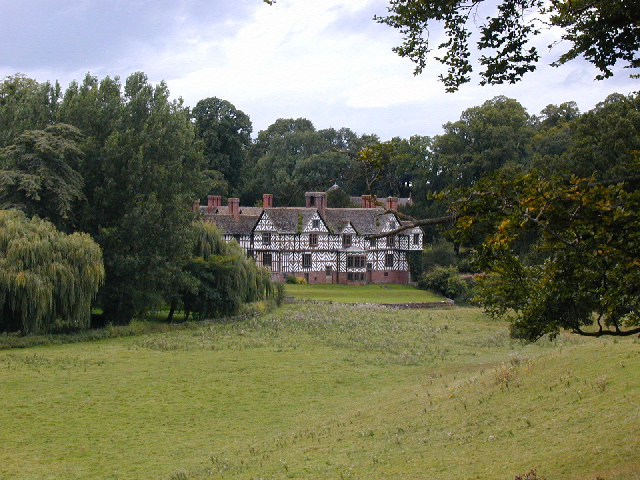
Pitchford Hall is a Grade I listed Tudor country house in the village of Pitchford, Shropshire, 6 miles south east of Shrewsbury.
It was built c.1560 on the site of a medieval building and has been modified several times since, particularly in the 1870s and 1880s when it was substantially restored, remodelled and extended. It is a timber-framed two-storey building with rendered red sandstone panels, a stone roof and brick chimneys. The floor plan is E-shaped round a courtyard to the south with a Victorian service wing to the west. There is also an orangery and walled garden on the grounds.
A deer park established in 1638 was disparked in 1790. 100 metres north of the hall is a bitumen well, near a ford across the Row Brook, from which the village gets its name. The bitumen or pitch was once used for waterproofing the timbers of the house. A 17th-century tree house in a large lime tree is one of the oldest in the world. A stretch of the Roman Watling Street runs through the estate.
The hall and its contents were sold at auction in 1992. The hall was repurchased in 2016 by the Colthurst family, who had retained the estate, and is under restoration after falling derelict.
The house has 42 rooms and is a Tudor timber-framed building on a plinth of sandstone rubble, with rendered infill panels. It is on an E plan, with a main courtyard in the south and a service wing in the west. It was Grade I listed in January 1952. There is a priest hole.
Several outbuildings, walls, and garden features at Pitchford are also on the listed buildings register. The 17th-century tree house, one of the oldest in the world, was remodelled in Gothic style in the 18th century and was Grade II listed in April 1977.
St. Michael's Church, the parish church of Pitchford, is opposite the hall and also Grade I listed. It is open to the public and holds services once or twice a month.
There has been a manor house on the site since around 1284, the estate at the time being in the possession of the de Pykeford family. Geoffrey de Pykeford, a crusader, was lord of the manor from 1272 and built the local church of St Michael, which contains an oak effigy of him. Eventually, however, the family had to sell the estate to the church in the 1330s in order to repay debts.
Pitchford Hall
Pitchford Hall is a Grade I listed Tudor country house in the village of Pitchford, Shropshire, 6 miles south east of Shrewsbury.
It was built c.1560 on the site of a medieval building and has been modified several times since, particularly in the 1870s and 1880s when it was substantially restored, remodelled and extended. It is a timber-framed two-storey building with rendered red sandstone panels, a stone roof and brick chimneys. The floor plan is E-shaped round a courtyard to the south with a Victorian service wing to the west. There is also an orangery and walled garden on the grounds.
A deer park established in 1638 was disparked in 1790. 100 metres north of the hall is a bitumen well, near a ford across the Row Brook, from which the village gets its name. The bitumen or pitch was once used for waterproofing the timbers of the house. A 17th-century tree house in a large lime tree is one of the oldest in the world. A stretch of the Roman Watling Street runs through the estate.
The hall and its contents were sold at auction in 1992. The hall was repurchased in 2016 by the Colthurst family, who had retained the estate, and is under restoration after falling derelict.
The house has 42 rooms and is a Tudor timber-framed building on a plinth of sandstone rubble, with rendered infill panels. It is on an E plan, with a main courtyard in the south and a service wing in the west. It was Grade I listed in January 1952. There is a priest hole.
Several outbuildings, walls, and garden features at Pitchford are also on the listed buildings register. The 17th-century tree house, one of the oldest in the world, was remodelled in Gothic style in the 18th century and was Grade II listed in April 1977.
St. Michael's Church, the parish church of Pitchford, is opposite the hall and also Grade I listed. It is open to the public and holds services once or twice a month.
There has been a manor house on the site since around 1284, the estate at the time being in the possession of the de Pykeford family. Geoffrey de Pykeford, a crusader, was lord of the manor from 1272 and built the local church of St Michael, which contains an oak effigy of him. Eventually, however, the family had to sell the estate to the church in the 1330s in order to repay debts.
Recent media
Recent media