



Community hub
Recent from talks
Knowledge base stats:
Talk channels stats:
Members stats:
Ischia
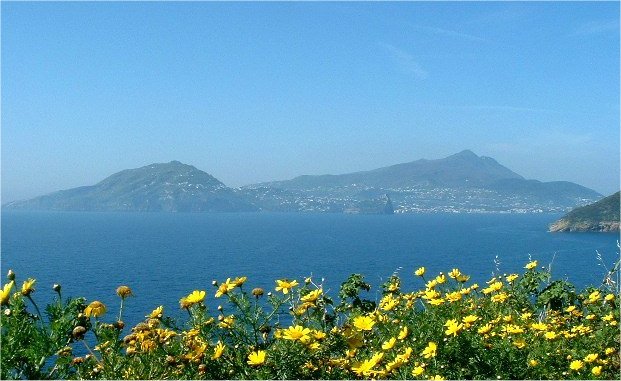
Ischia (/ˈɪskiə/ ISK-ee-ə, Italian: [ˈiskja], Neapolitan: [ˈiʃkjə]) is a volcanic island in the Tyrrhenian Sea. It lies at the northern end of the Gulf of Naples, about 30 kilometres (19 miles) from the city of Naples. It is the largest of the Phlegrean Islands. Although inhabited since the Bronze Age, as a Greek emporium it was founded in the 8th or 9th century BCE, and known as Πιθηκοῦσαι, Pithekoūsai.
Roughly trapezoidal in shape, it measures approximately 10 km (6 miles) east to west and 7 km (4 miles) north to south and has about 34 km (21 miles) of coastline and a surface area of 47 square kilometres (18.1 sq mi). It is almost entirely mountainous; the highest peak is Mount Epomeo, at 788 metres (2,585 feet). The island is not very densely populated, with 20,000 residents. Ischia is the name of the main comune of the island. The other comuni of the island are Barano d'Ischia, Casamicciola Terme, Forio, Lacco Ameno and Serrara Fontana.
The roughly trapezoidal island is formed by a complex volcano immediately southwest of the Campi Flegrei area at the western side of the Bay of Naples. The eruption of the trachytic Green Tuff Ignimbrite about 56,000 years ago was followed by the formation of a caldera comprising almost the entire island and some of the surrounding seabed. The highest point of the island, Monte Epomeo (788 m (2,585 ft)), is a volcanic horst consisting of green tuff that was submerged after its eruption and then uplifted. Volcanism on the island has been significantly affected by tectonism that formed a series of horsts and grabens; resurgent doming produced at least 800 m (2,600 ft) of uplift during the past 33,000 years. Many small monogenetic volcanoes formed around the uplifted block. Volcanism during the Holocene produced a series of pumiceous tephras, tuff rings, lava domes, and lava flows. The last eruption of Ischia, in 1302, produced a spatter cone and the Arso lava flow, which reached the NE coast.
The surrounding waters including gulfs of Gaeta, Naples and Pozzuoli are both rich and healthy, providing a habitat for around 7 species of whales and dolphins including gigantic fin and sperm whales. Special research programmes on local cetaceans have been conducted to monitor and protect this bio-diversity.
From its roughly trapezoidal shape, the island is approximately 18 nautical miles from Naples, 10 km wide from east to west, 7 km from north to south, with a coastline of 43 km and an area of approximately 46.3 km2. The highest elevation is Monte Epomeo, standing at 788 meters and located in the center of the island. This is an horst, a tectonic volcano, meaning a block of the Earth's crust that has been uplifted compared to the surrounding crust due to magmatic pressure (horst is a German term meaning "rock"). Monte Epomeo is mistakenly thought of as a volcano, although it lacks any volcanic characteristics. Island volcanism, in fact, is particularly prevalent along the fractures that border the horst, namely Monte Epomeo.
Strabo reports what the Greek historian Timeo said about a tsunami that occurred in Ischia shortly before his time. Following the volcanic activity of Epomeo, "...the sea receded for three stages; afterwards (...) it turned back again and its ebb tide submerged the island (...) those who lived on the mainland fled from the coast into the interior of Campania" (Geography V, 4, 9). Cumae, not far from that coast, in Greek means "wave". Volcanic activity on Ischia has generally been characterized by eruptions that were not very significant and occurred at great intervals. After eruptions in Greek and Roman times, the last one occurred in 1302 in the eastern sector of the island with a brief flow (known as Arso) reaching the sea.
The Greeks called their colony on the island Pithekoussai (Πιθηκοῦσσαι), from which the Latin name Pithecusa was derived. The name has an uncertain etymology. According to Ovid (Metamorphoses 14.92) and the Alexandrian historian Senagora, the name would derive from pithekos, monkey, and refer to the myth of the Cercopes, inhabitants of the Phlegraean islands transformed by Zeus into monkeys. More plausible is the interpretation of Pliny the Elder (Nat. Hist. 111, 6.82), who instead derives the name from pythos, amphora, a theory supported by archaeological finds that testify to the Greek-Italic production of ceramics (and in particular of wine amphorae) on the island and in the Gulf of Naples.
It has also been proposed that the name describes a characteristic of the island, rich in pine forests. "Pitueois" (rich in pines), "pituis" (pine cone), "pissa, pitta" (resin) appear as descriptive terms from which Pithekoussai could derive, meaning "island of resin," an important substance used, among other things, to waterproof wine vessels. The name Aenaria, also used by the Latins, is linked to metallurgical workshops (from aenus, metal) located on the eastern coast, under the castle.
Hub AI
Ischia AI simulator
(@Ischia_simulator)
Ischia
Ischia (/ˈɪskiə/ ISK-ee-ə, Italian: [ˈiskja], Neapolitan: [ˈiʃkjə]) is a volcanic island in the Tyrrhenian Sea. It lies at the northern end of the Gulf of Naples, about 30 kilometres (19 miles) from the city of Naples. It is the largest of the Phlegrean Islands. Although inhabited since the Bronze Age, as a Greek emporium it was founded in the 8th or 9th century BCE, and known as Πιθηκοῦσαι, Pithekoūsai.
Roughly trapezoidal in shape, it measures approximately 10 km (6 miles) east to west and 7 km (4 miles) north to south and has about 34 km (21 miles) of coastline and a surface area of 47 square kilometres (18.1 sq mi). It is almost entirely mountainous; the highest peak is Mount Epomeo, at 788 metres (2,585 feet). The island is not very densely populated, with 20,000 residents. Ischia is the name of the main comune of the island. The other comuni of the island are Barano d'Ischia, Casamicciola Terme, Forio, Lacco Ameno and Serrara Fontana.
The roughly trapezoidal island is formed by a complex volcano immediately southwest of the Campi Flegrei area at the western side of the Bay of Naples. The eruption of the trachytic Green Tuff Ignimbrite about 56,000 years ago was followed by the formation of a caldera comprising almost the entire island and some of the surrounding seabed. The highest point of the island, Monte Epomeo (788 m (2,585 ft)), is a volcanic horst consisting of green tuff that was submerged after its eruption and then uplifted. Volcanism on the island has been significantly affected by tectonism that formed a series of horsts and grabens; resurgent doming produced at least 800 m (2,600 ft) of uplift during the past 33,000 years. Many small monogenetic volcanoes formed around the uplifted block. Volcanism during the Holocene produced a series of pumiceous tephras, tuff rings, lava domes, and lava flows. The last eruption of Ischia, in 1302, produced a spatter cone and the Arso lava flow, which reached the NE coast.
The surrounding waters including gulfs of Gaeta, Naples and Pozzuoli are both rich and healthy, providing a habitat for around 7 species of whales and dolphins including gigantic fin and sperm whales. Special research programmes on local cetaceans have been conducted to monitor and protect this bio-diversity.
From its roughly trapezoidal shape, the island is approximately 18 nautical miles from Naples, 10 km wide from east to west, 7 km from north to south, with a coastline of 43 km and an area of approximately 46.3 km2. The highest elevation is Monte Epomeo, standing at 788 meters and located in the center of the island. This is an horst, a tectonic volcano, meaning a block of the Earth's crust that has been uplifted compared to the surrounding crust due to magmatic pressure (horst is a German term meaning "rock"). Monte Epomeo is mistakenly thought of as a volcano, although it lacks any volcanic characteristics. Island volcanism, in fact, is particularly prevalent along the fractures that border the horst, namely Monte Epomeo.
Strabo reports what the Greek historian Timeo said about a tsunami that occurred in Ischia shortly before his time. Following the volcanic activity of Epomeo, "...the sea receded for three stages; afterwards (...) it turned back again and its ebb tide submerged the island (...) those who lived on the mainland fled from the coast into the interior of Campania" (Geography V, 4, 9). Cumae, not far from that coast, in Greek means "wave". Volcanic activity on Ischia has generally been characterized by eruptions that were not very significant and occurred at great intervals. After eruptions in Greek and Roman times, the last one occurred in 1302 in the eastern sector of the island with a brief flow (known as Arso) reaching the sea.
The Greeks called their colony on the island Pithekoussai (Πιθηκοῦσσαι), from which the Latin name Pithecusa was derived. The name has an uncertain etymology. According to Ovid (Metamorphoses 14.92) and the Alexandrian historian Senagora, the name would derive from pithekos, monkey, and refer to the myth of the Cercopes, inhabitants of the Phlegraean islands transformed by Zeus into monkeys. More plausible is the interpretation of Pliny the Elder (Nat. Hist. 111, 6.82), who instead derives the name from pythos, amphora, a theory supported by archaeological finds that testify to the Greek-Italic production of ceramics (and in particular of wine amphorae) on the island and in the Gulf of Naples.
It has also been proposed that the name describes a characteristic of the island, rich in pine forests. "Pitueois" (rich in pines), "pituis" (pine cone), "pissa, pitta" (resin) appear as descriptive terms from which Pithekoussai could derive, meaning "island of resin," an important substance used, among other things, to waterproof wine vessels. The name Aenaria, also used by the Latins, is linked to metallurgical workshops (from aenus, metal) located on the eastern coast, under the castle.