



Community hub
Recent from talks
Knowledge base stats:
Talk channels stats:
Members stats:
Pitot tube
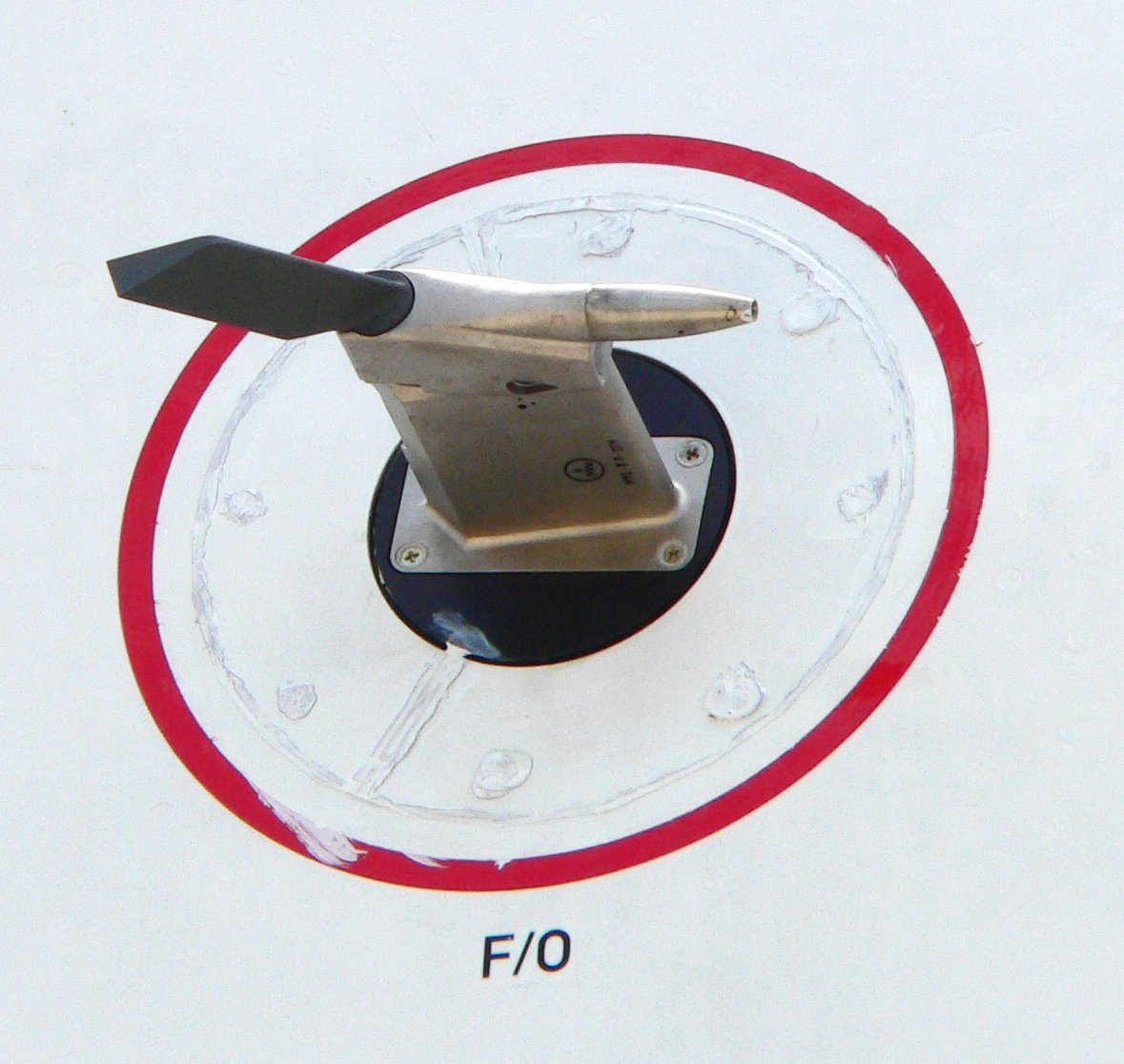
A pitot tube (/ˈpiːtoʊ/ PEE-toh; also pitot probe) measures fluid flow velocity. It was invented by French engineer Henri Pitot during his work with aqueducts and published in 1732, and modified to its modern form in 1858 by Henry Darcy. It is widely used to determine the airspeed of aircraft; the water speed of boats; and the flow velocity of liquids, air, and gases in industry.
The basic pitot tube consists of a tube pointing directly into the oncoming fluid flow. Pressure in the tube can be measured as the moving fluid cannot escape and stagnates. This pressure is the stagnation pressure of the fluid, also known as the total pressure or (particularly in aviation) the pitot pressure.
The measured stagnation pressure cannot just by itself be used to determine the fluid flow velocity (airspeed in aviation) directly. However, with a measured static pressure as well it can be determined by the use of Bernoulli's equation which states:
Which can also be written
Solving that for flow velocity gives
where
This equation applies only to fluids that can be treated as incompressible. Liquids are treated as incompressible under almost all conditions. Gases under certain conditions can be approximated as incompressible. See Compressibility.
The dynamic pressure is the difference between the stagnation pressure and the static pressure. The dynamic pressure is then determined using a diaphragm inside an enclosed container. If the air on one side of the diaphragm is at the static pressure, and the other at the stagnation pressure, then the deflection of the diaphragm is proportional to the dynamic pressure.
Hub AI
Pitot tube AI simulator
(@Pitot tube_simulator)
Pitot tube
A pitot tube (/ˈpiːtoʊ/ PEE-toh; also pitot probe) measures fluid flow velocity. It was invented by French engineer Henri Pitot during his work with aqueducts and published in 1732, and modified to its modern form in 1858 by Henry Darcy. It is widely used to determine the airspeed of aircraft; the water speed of boats; and the flow velocity of liquids, air, and gases in industry.
The basic pitot tube consists of a tube pointing directly into the oncoming fluid flow. Pressure in the tube can be measured as the moving fluid cannot escape and stagnates. This pressure is the stagnation pressure of the fluid, also known as the total pressure or (particularly in aviation) the pitot pressure.
The measured stagnation pressure cannot just by itself be used to determine the fluid flow velocity (airspeed in aviation) directly. However, with a measured static pressure as well it can be determined by the use of Bernoulli's equation which states:
Which can also be written
Solving that for flow velocity gives
where
This equation applies only to fluids that can be treated as incompressible. Liquids are treated as incompressible under almost all conditions. Gases under certain conditions can be approximated as incompressible. See Compressibility.
The dynamic pressure is the difference between the stagnation pressure and the static pressure. The dynamic pressure is then determined using a diaphragm inside an enclosed container. If the air on one side of the diaphragm is at the static pressure, and the other at the stagnation pressure, then the deflection of the diaphragm is proportional to the dynamic pressure.