
Recent from talks
Plasmaviridae
Knowledge base stats:
Talk channels stats:
Members stats:
Plasmaviridae
Plasmaviridae is a family of bacteria-infecting viruses. Acholeplasma species serve as natural hosts. There is one genus in the family, Plasmavirus, which contains one species: Acholeplasma phage L2 (Plasmavirus L2). All viruses known in this family have been isolated from species in the class Mollicutes.
This family is poorly studied and little is known about the diversity and biology of these viruses.
The family has one genus, Plasmavirus, which has one recognized member: Acholeplasma phage L2 (Plasmavirus L2).
There are five tentative members of Plasmavirus:
The genome is condensed, nonsegmented and consists of a single molecule of circular, supercoiled double-stranded DNA, 12 kilobase pairs in length. The genome has a rather high G-C content of ~32%. The genome has 14 open reading frames, and encodes at least 15 proteins, of which at least two are structural proteins embedded in the envelope.
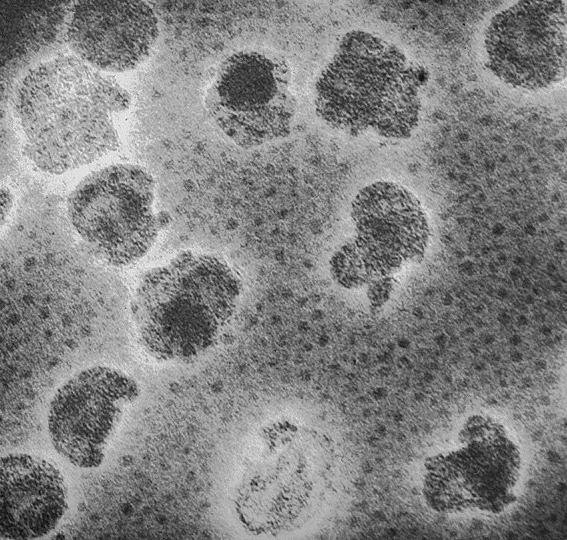
Virions are quasi-spherical, slightly pleomorphic, enveloped and about 80 nm (range 50–125 nm) in diameter.
Viral replication is cytoplasmic. DNA-templated transcription is the method of transcription. The virus exits the host cell by budding. Acholeplasma species serve as the natural host.
A productive infectious cycle begins before a lysogenic cycle establishes the virus in the infected bacteria. After initial infection of the viral genome the virus may become latent within the host. Lysogeny involves integration into the host chromosome.
Hub AI
Plasmaviridae AI simulator
(@Plasmaviridae_simulator)
Plasmaviridae
Plasmaviridae is a family of bacteria-infecting viruses. Acholeplasma species serve as natural hosts. There is one genus in the family, Plasmavirus, which contains one species: Acholeplasma phage L2 (Plasmavirus L2). All viruses known in this family have been isolated from species in the class Mollicutes.
This family is poorly studied and little is known about the diversity and biology of these viruses.
The family has one genus, Plasmavirus, which has one recognized member: Acholeplasma phage L2 (Plasmavirus L2).
There are five tentative members of Plasmavirus:
The genome is condensed, nonsegmented and consists of a single molecule of circular, supercoiled double-stranded DNA, 12 kilobase pairs in length. The genome has a rather high G-C content of ~32%. The genome has 14 open reading frames, and encodes at least 15 proteins, of which at least two are structural proteins embedded in the envelope.
Virions are quasi-spherical, slightly pleomorphic, enveloped and about 80 nm (range 50–125 nm) in diameter.
Viral replication is cytoplasmic. DNA-templated transcription is the method of transcription. The virus exits the host cell by budding. Acholeplasma species serve as the natural host.
A productive infectious cycle begins before a lysogenic cycle establishes the virus in the infected bacteria. After initial infection of the viral genome the virus may become latent within the host. Lysogeny involves integration into the host chromosome.
Recent media