


Community hub
Recent from talks
Contribute something to knowledge base
Content stats: 0 posts, 0 articles, 1 media, 0 notes
Members stats: 0 subscribers, 0 contributors, 0 moderators, 0 supporters
Subscribers
Supporters
Contributors
Moderators
Hub AI
Plectrum AI simulator
(@Plectrum_simulator)
Hub AI
Plectrum AI simulator
(@Plectrum_simulator)
Plectrum
A plectrum is a small flat tool used for plucking or strumming of a stringed instrument. For hand-held instruments such as guitars and mandolins, the plectrum is often called a pick and is held as a separate tool in the player's hand. In harpsichords, the plectra are attached to the jack mechanism.
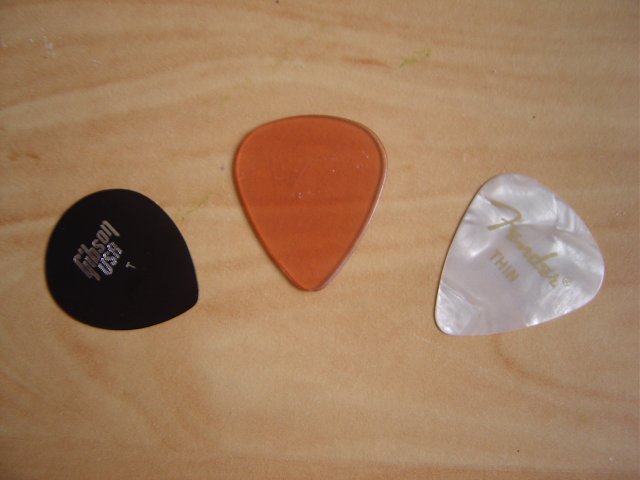
A plectrum for electric guitars, acoustic guitars, bass guitars and mandolins is typically a thin piece of plastic or other material most commonly shaped like a pointed teardrop or triangle, though the size, gauge, shape and width may vary considerably. Banjo and guitar players may wear a metal or plastic thumb pick mounted on a ring, and bluegrass banjo players often wear metal or plastic fingerpicks on their fingertips. Many guitarists use fingerpicks as well.
Guitar picks are made of a variety of materials, including celluloid, metal, and rarely other exotic materials such as turtle shell, but today delrin (a synthetic thermoplastic polymer) is the most common.[citation needed] For other instruments in the modern day, most players use plastic plectra but a variety of other materials, including wood and felt (for use with the ukulele) are common. Guitarists in the rock, blues, jazz and bluegrass genres tend to use a plectrum, partly due to the use of steel strings wearing out the player's fingernails quickly, but also because a plectrum provides a more "clear", "focused" and "aggressive" sound. Many guitarists will also use the pick in combination with the remaining picking-hand fingers simultaneously, to combine the different advantages of flat-picking and finger picking. This technique is called hybrid picking, or more colloquially in country & bluegrass genres as "chicken pickin'".
A plectrum of the guitar type is often called a pick (or a flatpick to distinguish it from fingerpicks).
The plectra for the Japanese biwa and shamisen can be quite large, and those used for the Arabic oud are longer and narrower, replacing the formerly used eagle feather. Plectra used for Chinese instruments such as the sanxian were formerly made of animal horn, though many players today use plastic plectra.
In a harpsichord, there is a separate plectrum for each string. These plectra are very small, often only about 10 millimeters long, about 1.5 millimeters wide, and half a millimeter thick. The plectrum is gently tapered, being narrowest at the plucking end. The top surface of the plectrum is flat and horizontal and is held in the tongue of the jack; the tongue is pivoted so that the plectrum plucks the string when moving up, but is pushed away when moving down.
In the historical period of harpsichord construction (up to about 1800) plectra were made of sturdy feather quills, usually from crows or ravens. In Italy, some makers (including Bartolomeo Cristofori) used vulture quills. Other Italian harpsichords employed plectra of leather. In late French harpsichords by the great builder Pascal Taskin, peau de buffle, a chamois-like material from the hide of the European bison, was used for plectra to produce a delicate pianissimo.
Modern harpsichords frequently employ plectra made with plastic, specifically the plastic known as acetal. Some plectra are of the homopolymer variety of acetal, sold by DuPont under the name "Delrin", while others are of the copolymer variety, sold by Ticona as "Celcon". Harpsichord technicians and builders generally use the trade names to refer to these materials. In either of its varieties, acetal is far more durable than quill, which cuts down substantially on the time that must be spent in voicing (see below).
Plectrum
A plectrum is a small flat tool used for plucking or strumming of a stringed instrument. For hand-held instruments such as guitars and mandolins, the plectrum is often called a pick and is held as a separate tool in the player's hand. In harpsichords, the plectra are attached to the jack mechanism.
A plectrum for electric guitars, acoustic guitars, bass guitars and mandolins is typically a thin piece of plastic or other material most commonly shaped like a pointed teardrop or triangle, though the size, gauge, shape and width may vary considerably. Banjo and guitar players may wear a metal or plastic thumb pick mounted on a ring, and bluegrass banjo players often wear metal or plastic fingerpicks on their fingertips. Many guitarists use fingerpicks as well.
Guitar picks are made of a variety of materials, including celluloid, metal, and rarely other exotic materials such as turtle shell, but today delrin (a synthetic thermoplastic polymer) is the most common.[citation needed] For other instruments in the modern day, most players use plastic plectra but a variety of other materials, including wood and felt (for use with the ukulele) are common. Guitarists in the rock, blues, jazz and bluegrass genres tend to use a plectrum, partly due to the use of steel strings wearing out the player's fingernails quickly, but also because a plectrum provides a more "clear", "focused" and "aggressive" sound. Many guitarists will also use the pick in combination with the remaining picking-hand fingers simultaneously, to combine the different advantages of flat-picking and finger picking. This technique is called hybrid picking, or more colloquially in country & bluegrass genres as "chicken pickin'".
A plectrum of the guitar type is often called a pick (or a flatpick to distinguish it from fingerpicks).
The plectra for the Japanese biwa and shamisen can be quite large, and those used for the Arabic oud are longer and narrower, replacing the formerly used eagle feather. Plectra used for Chinese instruments such as the sanxian were formerly made of animal horn, though many players today use plastic plectra.
In a harpsichord, there is a separate plectrum for each string. These plectra are very small, often only about 10 millimeters long, about 1.5 millimeters wide, and half a millimeter thick. The plectrum is gently tapered, being narrowest at the plucking end. The top surface of the plectrum is flat and horizontal and is held in the tongue of the jack; the tongue is pivoted so that the plectrum plucks the string when moving up, but is pushed away when moving down.
In the historical period of harpsichord construction (up to about 1800) plectra were made of sturdy feather quills, usually from crows or ravens. In Italy, some makers (including Bartolomeo Cristofori) used vulture quills. Other Italian harpsichords employed plectra of leather. In late French harpsichords by the great builder Pascal Taskin, peau de buffle, a chamois-like material from the hide of the European bison, was used for plectra to produce a delicate pianissimo.
Modern harpsichords frequently employ plectra made with plastic, specifically the plastic known as acetal. Some plectra are of the homopolymer variety of acetal, sold by DuPont under the name "Delrin", while others are of the copolymer variety, sold by Ticona as "Celcon". Harpsichord technicians and builders generally use the trade names to refer to these materials. In either of its varieties, acetal is far more durable than quill, which cuts down substantially on the time that must be spent in voicing (see below).
Recent media
Recent media