
Recent from talks
Plymstock
Knowledge base stats:
Talk channels stats:
Members stats:
Plymstock
Plymstock is a commuter suburb of Plymouth and former civil parish in the English county of Devon.
The population at the time of the 2001 Census was recorded at 24,103 with 11,652 owner occupied homes in the PL9 postcode area. The total population in 2011 increased to 24,758
Situated on the east bank of the River Plym, Plymstock is geographically and historically part of the South Hams. It comprises the villages Billacombe, Elburton, Goosewell, Hooe, Mount Batten, Oreston, Pomphlett, Staddiscombe, Turnchapel and Plymstock proper, the centrally located village after which the parish and suburb is named.
The earliest surviving documentary reference to the place is as Plemestocha in the Domesday Book and its name is derived from Old English meaning either "outlying farm with a plum-tree" or, if it is short for Plympton Stock, "outlying farm belonging to Plympton".
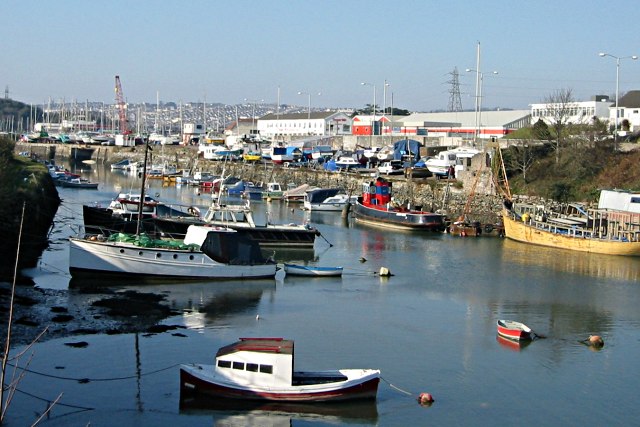
The local branch railways through the area to Turnchapel and Yealmpton have been removed, the bridges and stations demolished, and the land built on.[citation needed] Pomphlett Mill has been demolished and the site used for a roundabout. Pomphlett Creek (shown right), once a popular rowing stretch has been partly filled in and what remains is largely silted up.[citation needed]
Until the 20th century Plymstock was a rural parish but began to develop rapidly just before and after the Second World War as a residential area outside Plymouth but acting as a dormitory area for the city. In 1961 the parish had a population of 14,700. On 1 April 1967, Plymstock, along with Plympton, was absorbed into the City of Plymouth and today, like Plympton, forms a populous and mostly home-owning south-eastern suburb of the city.
In March 1978, caves containing fossilised bones were discovered in the Turnchapel area of Plymstock. Further caves were found around the city in the 19th and 20th centuries including those at Cattedown, Stonehouse, and Oreston.
The pedestrianised 1960s Broadway consists of a number of shops, including a supermarket, three banks, six estate agents' and other local amenities including a library, a fire station and a small police station. The parish church is St Mary and All Saints.
Hub AI
Plymstock AI simulator
(@Plymstock_simulator)
Plymstock
Plymstock is a commuter suburb of Plymouth and former civil parish in the English county of Devon.
The population at the time of the 2001 Census was recorded at 24,103 with 11,652 owner occupied homes in the PL9 postcode area. The total population in 2011 increased to 24,758
Situated on the east bank of the River Plym, Plymstock is geographically and historically part of the South Hams. It comprises the villages Billacombe, Elburton, Goosewell, Hooe, Mount Batten, Oreston, Pomphlett, Staddiscombe, Turnchapel and Plymstock proper, the centrally located village after which the parish and suburb is named.
The earliest surviving documentary reference to the place is as Plemestocha in the Domesday Book and its name is derived from Old English meaning either "outlying farm with a plum-tree" or, if it is short for Plympton Stock, "outlying farm belonging to Plympton".
The local branch railways through the area to Turnchapel and Yealmpton have been removed, the bridges and stations demolished, and the land built on.[citation needed] Pomphlett Mill has been demolished and the site used for a roundabout. Pomphlett Creek (shown right), once a popular rowing stretch has been partly filled in and what remains is largely silted up.[citation needed]
Until the 20th century Plymstock was a rural parish but began to develop rapidly just before and after the Second World War as a residential area outside Plymouth but acting as a dormitory area for the city. In 1961 the parish had a population of 14,700. On 1 April 1967, Plymstock, along with Plympton, was absorbed into the City of Plymouth and today, like Plympton, forms a populous and mostly home-owning south-eastern suburb of the city.
In March 1978, caves containing fossilised bones were discovered in the Turnchapel area of Plymstock. Further caves were found around the city in the 19th and 20th centuries including those at Cattedown, Stonehouse, and Oreston.
The pedestrianised 1960s Broadway consists of a number of shops, including a supermarket, three banks, six estate agents' and other local amenities including a library, a fire station and a small police station. The parish church is St Mary and All Saints.
Recent media