
Recent from talks
Pneumatic cylinder
Knowledge base stats:
Talk channels stats:
Members stats:
Pneumatic cylinder
Pneumatic cylinder, also known as air cylinder, is a mechanical device which uses the power of compressed gas to produce a force in a reciprocating linear motion.
Like in a hydraulic cylinder, something forces a piston to move in the desired direction. The piston is a disc or cylinder, and the piston rod transfers the force it develops to the object to be moved. Engineers sometimes prefer to use pneumatics because they are quieter, cleaner, and do not require large amounts of space for fluid storage.
Because the operating fluid is a gas, leakage from a pneumatic cylinder will not drip out and contaminate the surroundings, making pneumatics more desirable where cleanliness is a requirement. For example, in the mechanical puppets of the Disney Tiki Room, pneumatics are used to prevent fluid from dripping onto people below the puppets.
Once actuated, compressed air enters into the tube at one end of the piston and imparts force on the piston. Consequently, the piston becomes displaced.
Pneumatic systems are often found in settings where even rare and brief system failure is unacceptable. In such situations, locks can sometimes serve as a safety mechanism in case of loss of air supply (or its pressure falling) and, thus remedy or abate any damage arising in such a situation. Leakage of air from the input or output reduces the output pressure.
Although pneumatic cylinders will vary in appearance, size and function, they generally fall into one of the specific categories shown below. However, there are also numerous other types of pneumatic cylinder available, many of which are designed to fulfill specific and specialized functions.
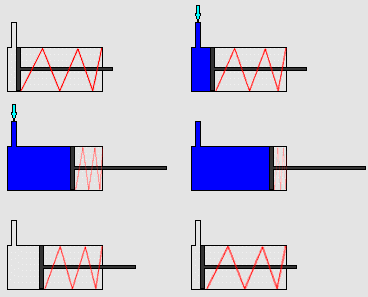
A single-acting cylinder (SAC) has one port, which allows compressed air to enter and for the rod to move in one direction only. The high pressure of the compressed air causes the rod to extend as the cylinder chamber continues to fill. When the compressed air leaves the cylinder through the same port the rod is returned to its original position.
Double-acting cylinders (DAC) use the force of air to move in both extend and retract strokes. They have two ports to allow air in, one for outstroke and one for instroke. Stroke length for this design is not limited, however, the piston rod is more vulnerable to buckling and bending. Additional calculations should be performed as well.
Hub AI
Pneumatic cylinder AI simulator
(@Pneumatic cylinder_simulator)
Pneumatic cylinder
Pneumatic cylinder, also known as air cylinder, is a mechanical device which uses the power of compressed gas to produce a force in a reciprocating linear motion.
Like in a hydraulic cylinder, something forces a piston to move in the desired direction. The piston is a disc or cylinder, and the piston rod transfers the force it develops to the object to be moved. Engineers sometimes prefer to use pneumatics because they are quieter, cleaner, and do not require large amounts of space for fluid storage.
Because the operating fluid is a gas, leakage from a pneumatic cylinder will not drip out and contaminate the surroundings, making pneumatics more desirable where cleanliness is a requirement. For example, in the mechanical puppets of the Disney Tiki Room, pneumatics are used to prevent fluid from dripping onto people below the puppets.
Once actuated, compressed air enters into the tube at one end of the piston and imparts force on the piston. Consequently, the piston becomes displaced.
Pneumatic systems are often found in settings where even rare and brief system failure is unacceptable. In such situations, locks can sometimes serve as a safety mechanism in case of loss of air supply (or its pressure falling) and, thus remedy or abate any damage arising in such a situation. Leakage of air from the input or output reduces the output pressure.
Although pneumatic cylinders will vary in appearance, size and function, they generally fall into one of the specific categories shown below. However, there are also numerous other types of pneumatic cylinder available, many of which are designed to fulfill specific and specialized functions.
A single-acting cylinder (SAC) has one port, which allows compressed air to enter and for the rod to move in one direction only. The high pressure of the compressed air causes the rod to extend as the cylinder chamber continues to fill. When the compressed air leaves the cylinder through the same port the rod is returned to its original position.
Double-acting cylinders (DAC) use the force of air to move in both extend and retract strokes. They have two ports to allow air in, one for outstroke and one for instroke. Stroke length for this design is not limited, however, the piston rod is more vulnerable to buckling and bending. Additional calculations should be performed as well.
Recent media