


Community hub
Recent from talks
Contribute something to knowledge base
Content stats: 0 posts, 0 articles, 1 media, 0 notes
Members stats: 0 subscribers, 0 contributors, 0 moderators, 0 supporters
Subscribers
Supporters
Contributors
Moderators
Hub AI
Pocketknife AI simulator
(@Pocketknife_simulator)
Hub AI
Pocketknife AI simulator
(@Pocketknife_simulator)
Pocketknife
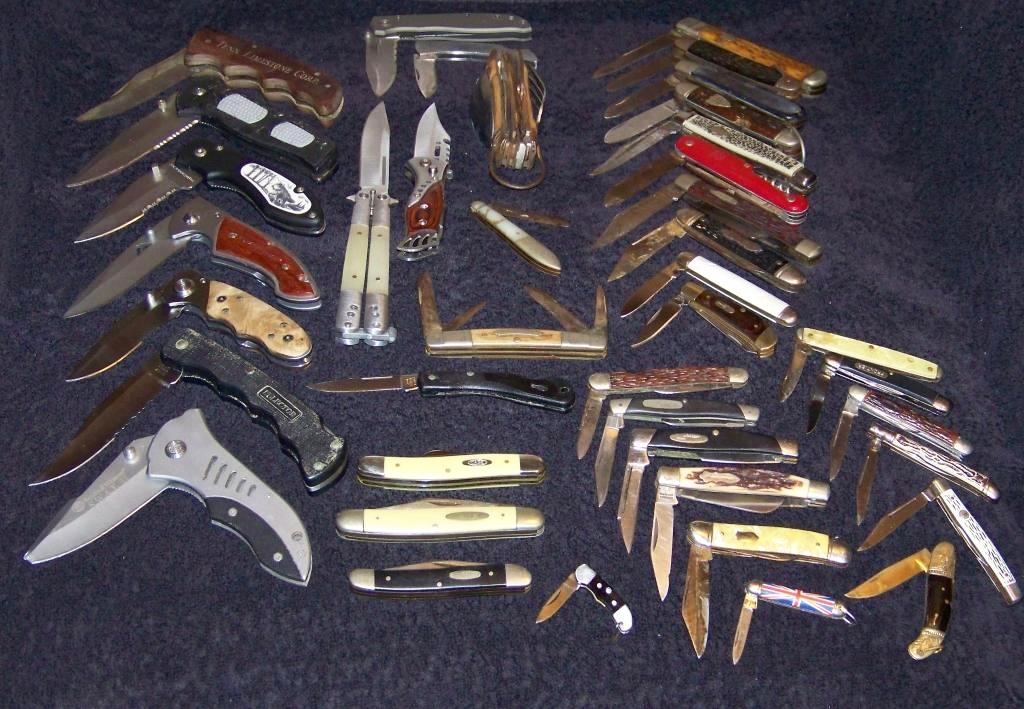
A pocketknife (also spelled as pocket knife) is a knife with one or more blades that fold into the handle. It is also known as a jackknife, or a folding knife. It may be referred to as a penknife, though a penknife may also be a specific kind of pocketknife. A typical blade length is 5 to 15 centimetres (2 to 6 in).
Pocketknives are versatile tools, and may be used for anything from whittling and woodcarving, to butchering small game, gutting and filleting small fish, aiding in the preparation of tinder and kindling for fires, boring holes in soft material, to opening an envelope, cutting twine, slicing fruits and vegetables or as a means of self-defense.
Pocketknives may also be used in conjunction with other tools and equipment for woodcraft and bushcraft.
Specialised designs are also used for mushroom hunting and gardening. Pocketknives designed for gardening include pruning knives, which are folding knives with long curved blades used for pruning, trimming cuttings, taking buds and preparing material for grafting.
The earliest known pocketknives date to at least the early Iron Age. A pocketknife with a bone handle was found at the Hallstatt Culture type site in Austria, dating to around 600–500 BCE. Iberian folding-blade knives made by indigenous artisans and craftsmen and dating to the pre-Roman era have been found in Spain. Many folding knives from the Viking Age have been found. They carried some friction binders, but more often they seem to have used folding knives that used a closure to keep the blade open.
The peasant knife, farmer knife, or penny knife is the original and most basic design of a folding pocketknife, using a simple pivoted blade that folds in and out of the handle freely, without a backspring, slipjoint, or blade locking mechanism. The first peasant knives date to the pre-Roman era, but were not widely distributed nor affordable by most people until the advent of limited production of such knives in cutlery centers such as Sheffield, England commencing around 1650, with large-scale production starting around the year 1700 with models such as Fuller's Penny Knife and the Wharncliffe Knife. Some peasant knives used a bolster or tensioning screw at the blade to apply friction to the blade tang in order to keep the blade in the open position. The smallest (Nos. 2–5) Opinel knives are an example of the peasant knife. The knife's low cost made it a favorite of small farmers, herdsmen, and gardeners in Europe and the Americas during the late 19th and early 20th century.
Most pocketknives for light duty are slipjoints. This means that the blade does not lock but, once opened, is held in place by tension from a flat bar or leaf-type backspring that allows the blade to fold if a certain amount of pressure is applied. The first spring-back knives were developed around 1660 in England, but were not widely available until the Industrial Revolution and development of machinery capable of mass production. Many locking knives have only one blade that is as large as can be fitted into the handle, because the locking mechanism relies on a spring-loaded latch built into the spine or frame of the handle to lock it and it is difficult to build in multiple levers, one for each blade. Slipjoints tend to be smaller than other typical pocketknives.
Some popular patterns of slipjoint knives include:
Pocketknife
A pocketknife (also spelled as pocket knife) is a knife with one or more blades that fold into the handle. It is also known as a jackknife, or a folding knife. It may be referred to as a penknife, though a penknife may also be a specific kind of pocketknife. A typical blade length is 5 to 15 centimetres (2 to 6 in).
Pocketknives are versatile tools, and may be used for anything from whittling and woodcarving, to butchering small game, gutting and filleting small fish, aiding in the preparation of tinder and kindling for fires, boring holes in soft material, to opening an envelope, cutting twine, slicing fruits and vegetables or as a means of self-defense.
Pocketknives may also be used in conjunction with other tools and equipment for woodcraft and bushcraft.
Specialised designs are also used for mushroom hunting and gardening. Pocketknives designed for gardening include pruning knives, which are folding knives with long curved blades used for pruning, trimming cuttings, taking buds and preparing material for grafting.
The earliest known pocketknives date to at least the early Iron Age. A pocketknife with a bone handle was found at the Hallstatt Culture type site in Austria, dating to around 600–500 BCE. Iberian folding-blade knives made by indigenous artisans and craftsmen and dating to the pre-Roman era have been found in Spain. Many folding knives from the Viking Age have been found. They carried some friction binders, but more often they seem to have used folding knives that used a closure to keep the blade open.
The peasant knife, farmer knife, or penny knife is the original and most basic design of a folding pocketknife, using a simple pivoted blade that folds in and out of the handle freely, without a backspring, slipjoint, or blade locking mechanism. The first peasant knives date to the pre-Roman era, but were not widely distributed nor affordable by most people until the advent of limited production of such knives in cutlery centers such as Sheffield, England commencing around 1650, with large-scale production starting around the year 1700 with models such as Fuller's Penny Knife and the Wharncliffe Knife. Some peasant knives used a bolster or tensioning screw at the blade to apply friction to the blade tang in order to keep the blade in the open position. The smallest (Nos. 2–5) Opinel knives are an example of the peasant knife. The knife's low cost made it a favorite of small farmers, herdsmen, and gardeners in Europe and the Americas during the late 19th and early 20th century.
Most pocketknives for light duty are slipjoints. This means that the blade does not lock but, once opened, is held in place by tension from a flat bar or leaf-type backspring that allows the blade to fold if a certain amount of pressure is applied. The first spring-back knives were developed around 1660 in England, but were not widely available until the Industrial Revolution and development of machinery capable of mass production. Many locking knives have only one blade that is as large as can be fitted into the handle, because the locking mechanism relies on a spring-loaded latch built into the spine or frame of the handle to lock it and it is difficult to build in multiple levers, one for each blade. Slipjoints tend to be smaller than other typical pocketknives.
Some popular patterns of slipjoint knives include:
Recent media
Recent media