
Recent from talks
Podgorica City Stadium
Knowledge base stats:
Talk channels stats:
Members stats:
Podgorica City Stadium
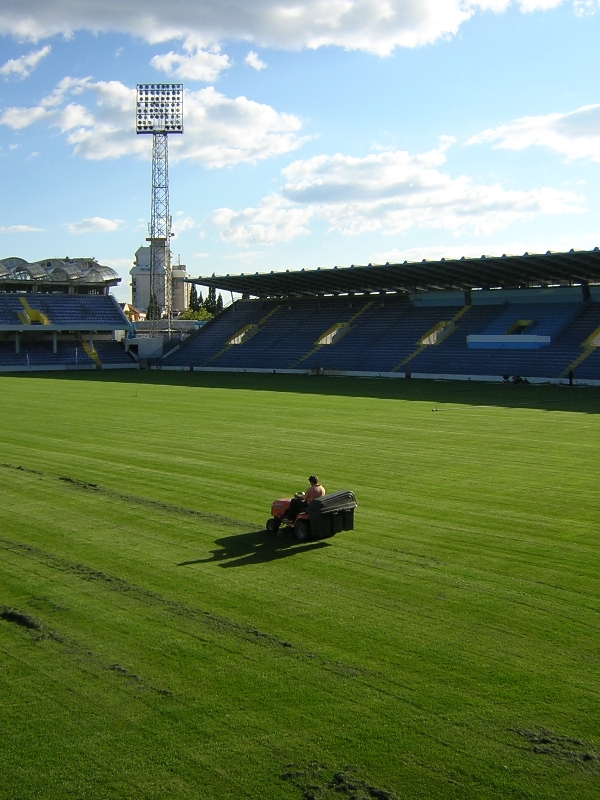
Podgorica City Stadium (Montenegrin: Stadion pod Goricom, Стадион под Горицом) is an all-seater multi-purpose stadium in Podgorica, Montenegro. Its seating capacity changed over the years due to several renovations, as of 2019 it has 11,080 seats. The stadium is the home ground of the Montenegro national team and Budućnost.
Podgorica City Stadium was built in 1945, following World War II. Before the war, Budućnost and other clubs from Podgorica played their matches in a field near that location.
The stadium's original capacity was around 5,000 spectators. The stadium burned down completely in 1952, but was later rebuilt, with a new capacity of about 17,000 seats. The new stadium has four stands—west, east, south and north.
In 1989, floodlights were installed in the City Stadium in Podgorica (then known as Titograd). During the 1980s, the main stand (west) was reconstructed. The new stand has a seating capacity of 6,000 and a modern roof.
After the breakup of SFR Yugoslavia, the stadium underwent additional construction work. The east stand was torn down, and a new north stand was built. Capacity was reduced to 12,000.
On 27 March 2015, the stadium was the site of an abandoned match when the UEFA Euro 2016 qualifier between Montenegro and Russia was dismissed by the referees to ensure the safety of the players. Russian goalkeeper Igor Akinfeev had been struck in the head by a flare and was sent to a hospital as a result. Russia was awarded a 3-0 result by UEFA as a result of the match abandonment.
The north stand is the home of Budućnost fans, the popular Varvari (Barbarians). Varvari often account for a large percentage of the attendance at games featuring Budućnost. They are the largest ultras group in Montenegro.
Since 2006, Podgorica City Stadium has had four stands. From 1992 to 2006, there were three stands (after the old east stand was torn down). Below are the approximate capacities of each stand with technical details.
Hub AI
Podgorica City Stadium AI simulator
(@Podgorica City Stadium_simulator)
Podgorica City Stadium
Podgorica City Stadium (Montenegrin: Stadion pod Goricom, Стадион под Горицом) is an all-seater multi-purpose stadium in Podgorica, Montenegro. Its seating capacity changed over the years due to several renovations, as of 2019 it has 11,080 seats. The stadium is the home ground of the Montenegro national team and Budućnost.
Podgorica City Stadium was built in 1945, following World War II. Before the war, Budućnost and other clubs from Podgorica played their matches in a field near that location.
The stadium's original capacity was around 5,000 spectators. The stadium burned down completely in 1952, but was later rebuilt, with a new capacity of about 17,000 seats. The new stadium has four stands—west, east, south and north.
In 1989, floodlights were installed in the City Stadium in Podgorica (then known as Titograd). During the 1980s, the main stand (west) was reconstructed. The new stand has a seating capacity of 6,000 and a modern roof.
After the breakup of SFR Yugoslavia, the stadium underwent additional construction work. The east stand was torn down, and a new north stand was built. Capacity was reduced to 12,000.
On 27 March 2015, the stadium was the site of an abandoned match when the UEFA Euro 2016 qualifier between Montenegro and Russia was dismissed by the referees to ensure the safety of the players. Russian goalkeeper Igor Akinfeev had been struck in the head by a flare and was sent to a hospital as a result. Russia was awarded a 3-0 result by UEFA as a result of the match abandonment.
The north stand is the home of Budućnost fans, the popular Varvari (Barbarians). Varvari often account for a large percentage of the attendance at games featuring Budućnost. They are the largest ultras group in Montenegro.
Since 2006, Podgorica City Stadium has had four stands. From 1992 to 2006, there were three stands (after the old east stand was torn down). Below are the approximate capacities of each stand with technical details.
Recent media