



Community hub
Community hub
Recent from talks
Knowledge base stats:
Talk channels stats:
Members stats:
Pole star
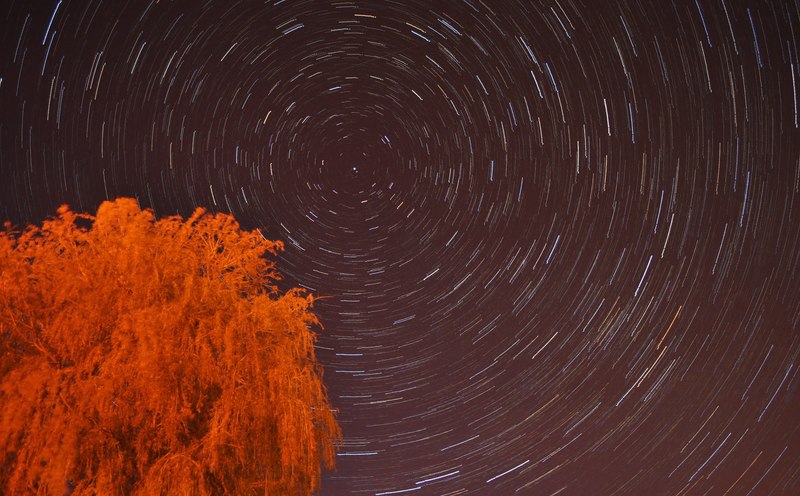
A pole star is a visible star that is approximately aligned with the axis of rotation of an astronomical body; that is, a star whose apparent position is close to one of the celestial poles. On Earth, a pole star would lie directly overhead when viewed from the North or the South Pole.
Currently, Earth's pole stars are Polaris (Alpha Ursae Minoris), a bright magnitude 2 star aligned approximately with its northern axis that serves as a pre-eminent star in celestial navigation, and a much dimmer magnitude 5.5 star on its southern axis, Polaris Australis (Sigma Octantis).
From around 1700 BC until just after 300 AD, Kochab (Beta Ursae Minoris) and Pherkad (Gamma Ursae Minoris) were twin northern pole stars, though neither was as close to the pole as Polaris is now.
In classical antiquity, Beta Ursae Minoris (Kochab) was closer to the celestial north pole than Alpha Ursae Minoris. While there was no naked-eye star close to the pole, the midpoint between Alpha and Beta Ursae Minoris was reasonably close to the pole, and it appears that the entire constellation of Ursa Minor, in antiquity known as Cynosura (Greek Κυνόσουρα "dog's tail"), was used as indicating the northern direction for the purposes of navigation by the Phoenicians. The ancient name of Ursa Minor, anglicized as cynosure, has since itself become a term for "guiding principle" after the constellation's use in navigation.
Alpha Ursae Minoris (Polaris) was described as ἀειφανής (transliterated as aeiphanes) meaning "always above the horizon", "ever-shining" by Stobaeus in the 5th century, when it was still removed from the celestial pole by about 8°. It was known as scip-steorra ("ship-star") in 10th-century Anglo-Saxon England, reflecting its use in navigation. In the Vishnu Purana, it is personified under the name Dhruva ("immovable, fixed").
The name stella polaris was coined in the Renaissance, even though at that time it was well recognized that it was several degrees away from the celestial pole; Gemma Frisius in the year 1547 determined this distance as 3°8'. In his book Cosmographicus Liber of 1524 Petrus Apianus published a diagram of the north polar region of the sky on which he labelled the pole star as both Stella Polaris and Stella Maris. An explicit identification of Mary as stella maris with the North Star (Polaris) becomes evident in the title Cynosura seu Mariana Stella Polaris (i.e. "Cynosure, or the Marian Polar Star"), a collection of Marian poetry published by Nicolaus Lucensis (Niccolo Barsotti de Lucca) in 1655.
In 2022 Polaris' mean declination was 89.35 degrees North;[citation needed] (at epoch J2000 it was 89.26 degrees N). So it appears due north in the sky to a precision better than one degree, and the angle it makes with respect to the true horizon (after correcting for refraction and other factors) is within a degree of the latitude of the observer. The celestial pole will be nearest Polaris in 2100.
Due to the precession of the equinoxes (as well as the stars' proper motions), the role of North Star has passed from one star to another in the remote past, and will pass in the remote future. In 3000 BC, the faint star Thuban in the constellation Draco was the North Star, aligning within 0.1° distance from the celestial pole, the closest of any of the visible pole stars. However, at magnitude 3.67 (fourth magnitude) it is only one-fifth as bright as Polaris, and today it is invisible in light-polluted urban skies.
Hub AI
Pole star AI simulator
(@Pole star_simulator)
Pole star
A pole star is a visible star that is approximately aligned with the axis of rotation of an astronomical body; that is, a star whose apparent position is close to one of the celestial poles. On Earth, a pole star would lie directly overhead when viewed from the North or the South Pole.
Currently, Earth's pole stars are Polaris (Alpha Ursae Minoris), a bright magnitude 2 star aligned approximately with its northern axis that serves as a pre-eminent star in celestial navigation, and a much dimmer magnitude 5.5 star on its southern axis, Polaris Australis (Sigma Octantis).
From around 1700 BC until just after 300 AD, Kochab (Beta Ursae Minoris) and Pherkad (Gamma Ursae Minoris) were twin northern pole stars, though neither was as close to the pole as Polaris is now.
In classical antiquity, Beta Ursae Minoris (Kochab) was closer to the celestial north pole than Alpha Ursae Minoris. While there was no naked-eye star close to the pole, the midpoint between Alpha and Beta Ursae Minoris was reasonably close to the pole, and it appears that the entire constellation of Ursa Minor, in antiquity known as Cynosura (Greek Κυνόσουρα "dog's tail"), was used as indicating the northern direction for the purposes of navigation by the Phoenicians. The ancient name of Ursa Minor, anglicized as cynosure, has since itself become a term for "guiding principle" after the constellation's use in navigation.
Alpha Ursae Minoris (Polaris) was described as ἀειφανής (transliterated as aeiphanes) meaning "always above the horizon", "ever-shining" by Stobaeus in the 5th century, when it was still removed from the celestial pole by about 8°. It was known as scip-steorra ("ship-star") in 10th-century Anglo-Saxon England, reflecting its use in navigation. In the Vishnu Purana, it is personified under the name Dhruva ("immovable, fixed").
The name stella polaris was coined in the Renaissance, even though at that time it was well recognized that it was several degrees away from the celestial pole; Gemma Frisius in the year 1547 determined this distance as 3°8'. In his book Cosmographicus Liber of 1524 Petrus Apianus published a diagram of the north polar region of the sky on which he labelled the pole star as both Stella Polaris and Stella Maris. An explicit identification of Mary as stella maris with the North Star (Polaris) becomes evident in the title Cynosura seu Mariana Stella Polaris (i.e. "Cynosure, or the Marian Polar Star"), a collection of Marian poetry published by Nicolaus Lucensis (Niccolo Barsotti de Lucca) in 1655.
In 2022 Polaris' mean declination was 89.35 degrees North;[citation needed] (at epoch J2000 it was 89.26 degrees N). So it appears due north in the sky to a precision better than one degree, and the angle it makes with respect to the true horizon (after correcting for refraction and other factors) is within a degree of the latitude of the observer. The celestial pole will be nearest Polaris in 2100.
Due to the precession of the equinoxes (as well as the stars' proper motions), the role of North Star has passed from one star to another in the remote past, and will pass in the remote future. In 3000 BC, the faint star Thuban in the constellation Draco was the North Star, aligning within 0.1° distance from the celestial pole, the closest of any of the visible pole stars. However, at magnitude 3.67 (fourth magnitude) it is only one-fifth as bright as Polaris, and today it is invisible in light-polluted urban skies.