
Recent from talks
Pole splitting
Knowledge base stats:
Talk channels stats:
Members stats:
Pole splitting
Pole splitting is a phenomenon exploited in some forms of frequency compensation used in an electronic amplifier. When a capacitor is introduced between the input and output sides of the amplifier with the intention of moving the pole lowest in frequency (usually an input pole) to lower frequencies, pole splitting causes the pole next in frequency (usually an output pole) to move to a higher frequency. This pole movement increases the stability of the amplifier and improves its step response at the cost of decreased speed.
This example shows that introducing capacitor CC in the amplifier of Figure 1 has two results: firstly, it causes the lowest frequency pole of the amplifier to move still lower in frequency and secondly, it causes the higher pole to move higher in frequency. This amplifier has a low frequency pole due to the added input resistance Ri and capacitance Ci, with the time constant Ci ( RA || Ri ). This pole is lowered in frequency by the Miller effect. The amplifier is given a high frequency output pole by addition of the load resistance RL and capacitance CL, with the time constant CL ( Ro || RL ). The upward movement of the high-frequency pole occurs because the Miller-amplified compensation capacitor CC alters the frequency dependence of the output voltage divider.
The first objective, to show the lowest pole decreases in frequency, is established using the same approach as the Miller's theorem article. Following the procedure there, Figure 1 is transformed to the electrically equivalent circuit of Figure 2. Application of Kirchhoff's current law to the input side of Figure 2 determines the input voltage to the ideal op amp as a function of the applied signal voltage , namely,


which exhibits a roll-off with frequency beginning at f1 where
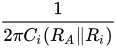
which introduces notation for the time constant of the lowest pole. This frequency is lower than the initial low frequency of the amplifier, which for CC = 0 F is .

Turning to the second objective, showing the higher pole increases in frequency, consider the output side of the circuit, which contributes a second factor to the overall gain, and additional frequency dependence. The voltage is determined by the gain of the ideal op amp inside the amplifier as

Using this relation and applying Kirchhoff's current law to the output side of the circuit determines the load voltage as a function of the voltage at the input to the ideal op amp as:

This expression is combined with the gain factor found earlier for the input side of the circuit to obtain the overall gain as
Hub AI
Pole splitting AI simulator
(@Pole splitting_simulator)
Pole splitting
Pole splitting is a phenomenon exploited in some forms of frequency compensation used in an electronic amplifier. When a capacitor is introduced between the input and output sides of the amplifier with the intention of moving the pole lowest in frequency (usually an input pole) to lower frequencies, pole splitting causes the pole next in frequency (usually an output pole) to move to a higher frequency. This pole movement increases the stability of the amplifier and improves its step response at the cost of decreased speed.
This example shows that introducing capacitor CC in the amplifier of Figure 1 has two results: firstly, it causes the lowest frequency pole of the amplifier to move still lower in frequency and secondly, it causes the higher pole to move higher in frequency. This amplifier has a low frequency pole due to the added input resistance Ri and capacitance Ci, with the time constant Ci ( RA || Ri ). This pole is lowered in frequency by the Miller effect. The amplifier is given a high frequency output pole by addition of the load resistance RL and capacitance CL, with the time constant CL ( Ro || RL ). The upward movement of the high-frequency pole occurs because the Miller-amplified compensation capacitor CC alters the frequency dependence of the output voltage divider.
The first objective, to show the lowest pole decreases in frequency, is established using the same approach as the Miller's theorem article. Following the procedure there, Figure 1 is transformed to the electrically equivalent circuit of Figure 2. Application of Kirchhoff's current law to the input side of Figure 2 determines the input voltage to the ideal op amp as a function of the applied signal voltage , namely,
which exhibits a roll-off with frequency beginning at f1 where
which introduces notation for the time constant of the lowest pole. This frequency is lower than the initial low frequency of the amplifier, which for CC = 0 F is .
Turning to the second objective, showing the higher pole increases in frequency, consider the output side of the circuit, which contributes a second factor to the overall gain, and additional frequency dependence. The voltage is determined by the gain of the ideal op amp inside the amplifier as
Using this relation and applying Kirchhoff's current law to the output side of the circuit determines the load voltage as a function of the voltage at the input to the ideal op amp as:
This expression is combined with the gain factor found earlier for the input side of the circuit to obtain the overall gain as