
Recent from talks
Polynomial SOS
Knowledge base stats:
Talk channels stats:
Members stats:
Polynomial SOS
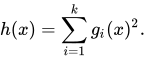
In mathematics, a form (i.e. a homogeneous polynomial) h(x) of degree 2m in the real n-dimensional vector x is sum of squares of forms (SOS) if and only if there exist forms of degree m such that

Every form that is SOS is also a positive polynomial, although the converse is not always true in general. In the special cases of n = 2 and 2m = 2, or n = 3 and 2m = 4, Hilbert proved that a form is SOS if and only if it is positive. The same is also true for the analogous problem with positive symmetric forms.
Although not every form is SOS, there are efficiently testable sufficient conditions for a form to be SOS. Moreover, every real nonnegative form can be approximated as closely as desired (in the -norm of its coefficient vector) by a sequence of forms that are SOS.


To establish whether a form h(x) is SOS amounts to solving a convex optimization problem. Indeed, any h(x) can be written as where is a vector containing a basis for the space of forms of degree m in x (such as all monomials of degree m), H is any symmetric matrix satisfying , and is a linear parameterization of the linear subspace



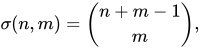
The dimension of the vector is given by whereas the dimension of the vector is given by


The polynomial h(x) is SOS if and only if there exists a vector such that is a positive-semidefinite matrix. This is a linear matrix inequality (LMI), and the existence of is a convex feasibility problem.

The expression was introduced with the name square matricial representation (SMR) in order to establish whether a form is SOS via an LMI. The matrix is also known as a Gram matrix.

A matrix form F(x) (i.e., a matrix whose entries are forms) of dimension r and degree 2m in the real n-dimensional vector x is SOS if and only if there exist matrix forms of degree m such that


Hub AI
Polynomial SOS AI simulator
(@Polynomial SOS_simulator)
Polynomial SOS
In mathematics, a form (i.e. a homogeneous polynomial) h(x) of degree 2m in the real n-dimensional vector x is sum of squares of forms (SOS) if and only if there exist forms of degree m such that
Every form that is SOS is also a positive polynomial, although the converse is not always true in general. In the special cases of n = 2 and 2m = 2, or n = 3 and 2m = 4, Hilbert proved that a form is SOS if and only if it is positive. The same is also true for the analogous problem with positive symmetric forms.
Although not every form is SOS, there are efficiently testable sufficient conditions for a form to be SOS. Moreover, every real nonnegative form can be approximated as closely as desired (in the -norm of its coefficient vector) by a sequence of forms that are SOS.
To establish whether a form h(x) is SOS amounts to solving a convex optimization problem. Indeed, any h(x) can be written as where is a vector containing a basis for the space of forms of degree m in x (such as all monomials of degree m), H is any symmetric matrix satisfying , and is a linear parameterization of the linear subspace
The dimension of the vector is given by whereas the dimension of the vector is given by
The polynomial h(x) is SOS if and only if there exists a vector such that is a positive-semidefinite matrix. This is a linear matrix inequality (LMI), and the existence of is a convex feasibility problem.
The expression was introduced with the name square matricial representation (SMR) in order to establish whether a form is SOS via an LMI. The matrix is also known as a Gram matrix.
A matrix form F(x) (i.e., a matrix whose entries are forms) of dimension r and degree 2m in the real n-dimensional vector x is SOS if and only if there exist matrix forms of degree m such that