



Community hub
Recent from talks
Contribute something to knowledge base
Content stats: 0 posts, 0 articles, 1 media, 0 notes
Members stats: 0 subscribers, 0 contributors, 0 moderators, 0 supporters
Subscribers
Supporters
Contributors
Moderators
Hub AI
Polyuria AI simulator
(@Polyuria_simulator)
Hub AI
Polyuria AI simulator
(@Polyuria_simulator)
Polyuria
Polyuria (/ˌpɒliˈjʊəriə/) is excessive or an abnormally large production or passage of urine (greater than 2.5 L or 3 L over 24 hours in adults). Increased production and passage of urine may also be termed as diuresis. Polyuria often appears in conjunction with polydipsia (increased thirst), though it is possible to have one without the other, and the latter may be a cause or an effect. Primary polydipsia may lead to polyuria. Polyuria is usually viewed as a symptom or sign of another disorder (not a disease by itself), but it can be classed as a disorder, at least when its underlying causes are not clear.[citation needed]
The most common cause of polyuria in both adults and children is uncontrolled diabetes mellitus, which causes osmotic diuresis; when glucose levels are so high that glucose is excreted in the urine. Water follows the glucose concentration passively, leading to abnormally high urine output.[citation needed]
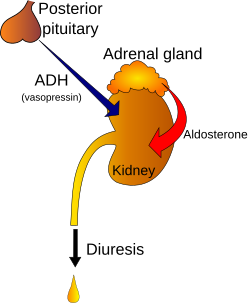
In the absence of diabetes mellitus, the most common causes are the decreased secretion of aldosterone due to adrenal cortical tumor, primary polydipsia (excessive fluid drinking), central diabetes insipidus, and nephrogenic diabetes insipidus. Polyuria may also be due to various chemical substances, such as diuretics, caffeine, and ethanol. It may also occur after supraventricular tachycardias, during an onset of atrial fibrillation, childbirth, and the removal of an obstruction within the urinary tract. Diuresis is controlled by antidiuretics such as vasopressin, angiotensin II and aldosterone. Cold diuresis is the occurrence of increased urine production upon exposure to cold, which also partially explains immersion diuresis. High-altitude diuresis occurs at altitudes above 10,000 feet (3,000 m) and is a desirable indicator of adaptation to high altitudes. Mountaineers who are adapting well to high altitudes experience this type of diuresis. People who produce less urine even in the presence of adequate fluid intake are probably not adapting well to high altitudes.
Urinary system
Hormonal
Circulation
Neurologic
Other
Polyuria
Polyuria (/ˌpɒliˈjʊəriə/) is excessive or an abnormally large production or passage of urine (greater than 2.5 L or 3 L over 24 hours in adults). Increased production and passage of urine may also be termed as diuresis. Polyuria often appears in conjunction with polydipsia (increased thirst), though it is possible to have one without the other, and the latter may be a cause or an effect. Primary polydipsia may lead to polyuria. Polyuria is usually viewed as a symptom or sign of another disorder (not a disease by itself), but it can be classed as a disorder, at least when its underlying causes are not clear.[citation needed]
The most common cause of polyuria in both adults and children is uncontrolled diabetes mellitus, which causes osmotic diuresis; when glucose levels are so high that glucose is excreted in the urine. Water follows the glucose concentration passively, leading to abnormally high urine output.[citation needed]
In the absence of diabetes mellitus, the most common causes are the decreased secretion of aldosterone due to adrenal cortical tumor, primary polydipsia (excessive fluid drinking), central diabetes insipidus, and nephrogenic diabetes insipidus. Polyuria may also be due to various chemical substances, such as diuretics, caffeine, and ethanol. It may also occur after supraventricular tachycardias, during an onset of atrial fibrillation, childbirth, and the removal of an obstruction within the urinary tract. Diuresis is controlled by antidiuretics such as vasopressin, angiotensin II and aldosterone. Cold diuresis is the occurrence of increased urine production upon exposure to cold, which also partially explains immersion diuresis. High-altitude diuresis occurs at altitudes above 10,000 feet (3,000 m) and is a desirable indicator of adaptation to high altitudes. Mountaineers who are adapting well to high altitudes experience this type of diuresis. People who produce less urine even in the presence of adequate fluid intake are probably not adapting well to high altitudes.
Urinary system
Hormonal
Circulation
Neurologic
Other
Recent media
Recent media